
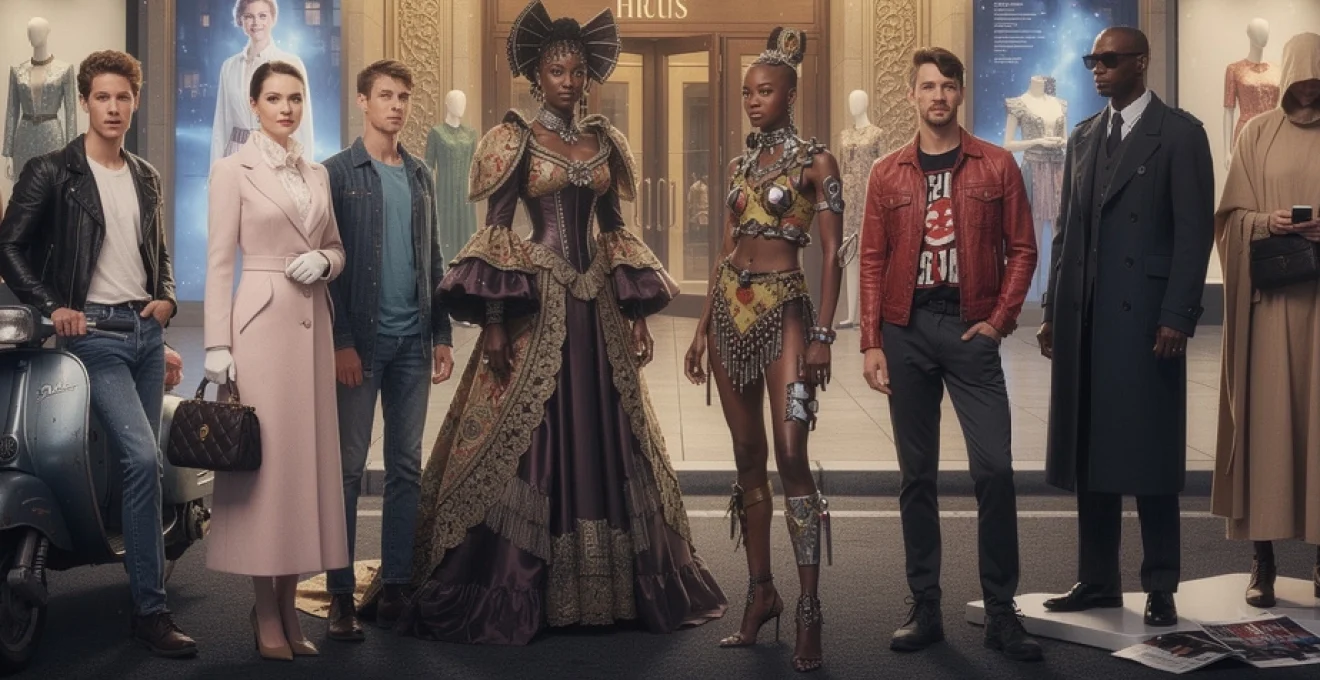
Cinema has always functioned as more than mere entertainment—it serves as a cultural barometer, reflecting and simultaneously shaping societal values, aspirations, and aesthetic preferences. From the moment moving pictures flickered across silver screens in darkened theatres, what characters wore became as significant as what they said or did. The relationship between film and fashion exists as a symbiotic exchange, where costume designers draw from haute couture while fashion houses plunder cinematic imagery for inspiration. Today, this dialogue has intensified exponentially, with blockbuster releases triggering immediate fashion responses across global markets. The influence operates through multiple channels: through costume design that becomes instantly iconic, through character archetypes that define generational style codes, and through the accelerated digital dissemination that transforms screen aesthetics into street fashion within days rather than seasons.
Historical convergence: cinema as catalyst for fashion revolution from 1920s to 1960s
The early decades of cinema established foundational patterns for how film would influence fashion consciousness. During the 1920s, silent film stars like Louise Brooks and Clara Bow didn’t simply wear costumes—they embodied entire aesthetic philosophies that audiences desperately sought to replicate. The flapper silhouette, with its dropped waistlines and liberated hemlines, gained mainstream acceptance partly through its constant visibility on screen. Cinema provided a democratizing force, allowing working-class audiences to observe and aspire to styles previously confined to elite social circles. This visual accessibility fundamentally altered fashion dissemination, creating what scholars now recognize as the first iteration of mass fashion influence driven by visual media rather than traditional couture channels.
Coco chanel’s little black dress and audrey hepburn’s breakfast at tiffany’s cultural impact
When Audrey Hepburn appeared in the opening sequence of Breakfast at Tiffany’s (1961) wearing Hubert de Givenchy’s interpretation of the little black dress, she crystallized a garment concept that Coco Chanel had introduced decades earlier into a universally recognized fashion icon. The simplicity of the sleeveless black sheath, accessorized with pearls, gloves, and oversized sunglasses, communicated sophistication without ostentation. What made this cinematic moment revolutionary wasn’t the novelty of the dress itself but rather the accessibility of aspiration it represented. Women worldwide could purchase their own versions from department stores, translating Hepburn’s ethereal elegance into everyday reality. The film’s costume design, created by Givenchy specifically for Hepburn’s frame and persona, demonstrated how cinema could elevate fashion beyond seasonal trends into timeless archetypes that transcend their original context.
Marlon brando’s A streetcar named desire and the mainstreaming of the white T-Shirt
Before Marlon Brando’s explosive performance in A Streetcar Named Desire (1951), the white T-shirt existed primarily as military-issued underwear or working-class undershirt. Brando’s Stanley Kowalski transformed this utilitarian garment into a symbol of raw masculinity and rebellious sexuality. The costume choice, seemingly simple, carried profound semiotic weight—it stripped away the conventional markers of respectable masculinity (tailored suits, crisp shirts, ties) and presented male physicality without social pretense. Post-release, sales of white T-shirts skyrocketed as young men sought to embody Kowalski’s dangerous appeal. This shift illustrated cinema’s power to recontextualize existing garments, assigning new cultural meanings that fashion industries then commodified and marketed. The white T-shirt subsequently became fundamental to American casual wear, a direct legacy of this singular cinematic performance.
Grace kelly’s rear window wardrobe and the birth of accessible luxury aesthetics
Alfred Hitchcock’s Rear Window (1954) showcased Grace Kelly in a wardrobe designed by Edith Head that represented aspirational elegance rendered believable through narrative context. Kelly’s character, Lisa Fremont, appeared in multiple costume changes—from the ethereal white chiffon dress in her first appearance to practical capri pants for investigative work—
signalling a fluid negotiation between haute couture fantasy and plausible daywear. What distinguished these looks was their construction around separates—bodice, jacket, skirt, scarf—that audiences could approximate through ready-to-wear pieces rather than unattainable couture gowns. The result was a new paradigm of accessible luxury: an aesthetic that communicated affluence and refinement while remaining legible and reproducible for middle-class consumers. Department stores quickly translated Kelly’s silhouettes into capsule collections, and her character’s blend of polish and practicality anticipated the modern notion of the “day-to-night” wardrobe. In this sense, Rear Window prefigured contemporary fashion codes where cinematic glamour is expected to feel wearable, not distant.
James dean’s rebel without a cause and the codification of youth counter-culture uniform
If Grace Kelly crystallised accessible luxury, James Dean in Rebel Without a Cause (1955) codified the visual grammar of teenage rebellion. His red windbreaker, white T-shirt and indigo denim jeans formed a deceptively simple triad that became the blueprint for youth counter-culture dressing. The colour symbolism was unmistakable: the red jacket as a flare of emotional volatility, the white T-shirt as vulnerable core, and the dark denim grounding him in working-class reality. Together, these garments constructed an archetype of disaffected youth that fashion continues to revisit, from Hedi Slimane’s skinny silhouettes at Saint Laurent to contemporary streetwear editorials.
This “rebel uniform” represented a key moment in the shifting power dynamics of style leadership. For the first time, adolescents rather than adults set the agenda for what felt modern and desirable. Cinema didn’t just mirror this generational shift; it accelerated it by projecting Dean’s image across global screens. Clothing retailers responded almost immediately, standardising the bomber or windbreaker jacket and slim-cut jeans as staples of casualwear. More than a nostalgic reference, the Rebel Without a Cause wardrobe remains a living template for contemporary fashion codes around authenticity, angst and non-conformity.
Semiotic analysis: how cinematic costume design translates to street-level fashion adoption
From the mid-20th century onward, the influence of cinema on contemporary fashion codes became increasingly sophisticated, operating less through direct imitation and more through subtle semiotic transfers. Costume design functions as a visual language: silhouettes, textures and colour palettes communicate information about class, power, gender, and psychological states. When a film resonates culturally, its costume vocabulary often migrates into mainstream fashion, where designers, retailers and consumers unconsciously reassemble its codes. Understanding this process requires looking beyond “inspiration” to see how garments operate as signs that are decoded, simplified and then re-circulated through the fashion system.
In this sense, cinema acts like a laboratory where experimental aesthetics are tested on a mass audience before being filtered into everyday wardrobes. Some elements travel intact—like a recognisable neckline or colour scheme—while others are abstracted into mood or attitude. We might not all wear exact replicas of period corsets or superhero suits, but we do adopt puffed sleeves, exaggerated shoulders, or monochrome styling that originate in iconic screen wardrobes. This semiotic drift helps explain why a seemingly niche costume decision can, within a few seasons, reappear as a dominant ready-to-wear trend in global markets.
Sandy powell’s costume architecture in the favourite and baroque revival trends
Sandy Powell’s work on The Favourite (2018) is a textbook case of how cerebral costume design can catalyse contemporary fashion trends without resorting to literal reproduction. Rather than faithfully replicating 18th-century court dress, Powell stripped back colour and introduced stark black-and-white palettes, leather elements and exaggerated proportions. Corseted bodices, swollen hip structures and elongated sleeves functioned as architectural forms, framing the actresses’ bodies like moving sculptures. The result was a baroque vocabulary translated into modern minimalism—opulent in silhouette yet austere in colour and material.
Within two seasons of the film’s release, runway collections began to echo this “neo-baroque” mood. Designers such as Simone Rocha, Erdem and Richard Quinn leaned into ballooned shapes, pannier-inspired skirts and pearl embellishments, but often paired them with monochrome or desaturated tones. Fast fashion followed suit with puff-sleeve blouses, square necklines and corset-detail dresses that softened Powell’s radical forms into wearable pieces. Here, we see semiotics at work: audiences responded less to historical accuracy and more to the emotional register of power, confinement and theatricality, which the fashion industry translated into romantic yet assertive silhouettes for everyday wear.
Colleen atwood’s alice in wonderland and neo-victorian fashion lexicon
Colleen Atwood’s costumes for Tim Burton’s Alice in Wonderland (2010) played a pivotal role in reigniting interest in neo-Victorian and fantasy-inflected fashion. By amplifying Victorian dress codes—high collars, bustle-like volumes, ornate trims—and infusing them with surreal proportions and saturated colour, Atwood created a wardrobe that felt both nostalgic and otherworldly. Alice’s evolving dresses chart her psychological journey, oscillating between girlish innocence and empowered agency, while characters like the Red Queen exaggerated power through inflated silhouettes and weaponised accessories.
Following the film’s release, we saw a noticeable uptick in neo-Victorian motifs: lace blouses with stand-up collars, military frock coats, ankle boots with Victorian lacing, and tea-length skirts returned to the mainstream. Steampunk aesthetics, already simmering in subcultural circles, gained renewed visibility at both indie labels and high-street retailers. Atwood’s work effectively expanded the contemporary fashion lexicon, legitimising historically-inspired garments as vehicles for personal storytelling rather than mere costume. For consumers, incorporating a lace jabot or corseted waist into everyday outfits became a way to tap into the film’s whimsical defiance of reality.
Ruth e. carter’s black panther afrofuturism and decolonised fashion narratives
Ruth E. Carter’s Oscar-winning costume design for Black Panther (2018) revolutionised how mainstream cinema represents African heritage and future-facing fashion. Drawing from diverse pan-African references—Maasai beadwork, Ndebele neck rings, Basotho blankets—Carter fused traditional craftsmanship with advanced materials and superhero silhouettes. Wakanda’s wardrobe communicated a decolonised narrative: African aesthetics were not framed as primitive or exotic, but as technologically advanced, aspirational and central to global modernity. The film demonstrated that contemporary fashion codes could be rooted in non-Western lineages without dilution.
This visual impact quickly translated into real-world fashion. We saw heightened demand for Ankara prints, beaded jewellery and headwrap styling, but crucially, also more visibility for African and diasporic designers on international runways. Brands like Pyer Moss, Thebe Magugu and Imane Ayissi gained wider recognition as consumers sought authentic expressions of Afrofuturist style. Streetwear incorporated bold colour blocking, geometric patterning and sculptural accessories reminiscent of Wakandan costuming. In semiotic terms, Carter’s costumes shifted the meaning attached to African-inspired fashion—from occasional “tribal” trend to enduring signifier of innovation, pride and sovereignty.
Arianne phillips’ once upon a time in hollywood and 1960s silhouette re-interpretation
Arianne Phillips’ work on Once Upon a Time in Hollywood (2019) exemplifies how a nostalgic cinematic wardrobe can recalibrate contemporary vintage revival trends. Rather than presenting a generic 1960s pastiche, Phillips differentiated subcultures through precise silhouette language: Sharon Tate’s mini-dresses and go-go boots signalled LA ingénue glamour; Rick Dalton’s leather jackets and turtlenecks evoked fading studio masculinity; Cliff Booth’s Hawaiian shirts and distressed denim channelled blue-collar cool. The film’s costumes functioned as a visual taxonomy of late-1960s West Coast style, each look mapping onto a specific social role.
In the seasons following the film’s release, there was a discernible shift from abstract “retro” styling toward more accurate 1960s silhouettes: A-line minis, mock-neck tops, high-waisted flares and boxy leather jackets became fixtures in both luxury and high-street collections. Brands used Phillips’ palette—mustard yellows, burnt oranges, avocado greens—as shorthand for laid-back Californian nostalgia. Importantly, the adoption was less about costume replication and more about silhouette and proportion; we saw shorter hemlines paired with flat boots, cropped jackets with high-rise jeans, and graphic tees tucked into flares. Through this semiotic transfer, the film helped refine how contemporary fashion interprets mid-century nostalgia without slipping into caricature.
Character archetypes as fashion blueprints: from neo’s matrix trench coat to tyler durden’s fight club aesthetic
Beyond specific garments, it is often character archetypes that exert the most enduring influence on contemporary fashion codes. Certain cinematic figures become visual shorthand for entire attitudes or lifestyles, with their wardrobes operating as instantly recognisable blueprints. Two of the most notable examples from late-1990s cinema are Neo from The Matrix (1999) and Tyler Durden from Fight Club (1999). Their looks could not be more different—sleek cyber-minimalism versus chaotic thrift-store maximalism—yet both continue to shape how designers and consumers imagine rebellion and non-conformity.
Neo’s ankle-length black trench coat, narrow sunglasses and monochrome tailoring established a cyberpunk-inflected visual code that resurfaces whenever fashion leans into tech noir minimalism. We see echoes of this aesthetic in Rick Owens’ elongated silhouettes, Balenciaga’s dystopian streetwear and even in the rise of all-black techwear. The character’s wardrobe communicates control, detachment and latent power, making it an enduring reference for anyone curating a “future-proof” personal style. In contrast, Tyler Durden’s mismatched printed shirts, scarred leather jackets and lurid red tones embody a philosophy of anti-consumerist chaos that paradoxically became highly commodified. His look still informs contemporary interpretations of “grunge 2.0” and vintage-driven streetwear.
Why do these archetypal wardrobes resonate so strongly? Partly because they offer coherent visual systems that individuals can adopt or adapt with relatively few pieces. A floor-length coat, slim black trousers and boots can instantly signal “Matrix-esque” cool, just as a boldly coloured leather jacket and patterned shirt evoke Durden’s reckless charisma. Brands knowingly reference these archetypes in campaigns and lookbooks, tapping into pre-existing narrative associations rather than building new ones from scratch. For consumers, wearing these codes is a way of aligning with particular worldviews—techno-sceptic hacker, anarchic outsider—without saying a word.
Fast fashion industry response mechanisms to blockbuster film releases
As cinema’s influence on contemporary fashion codes has intensified, the fast fashion industry has developed highly efficient mechanisms to capitalise on blockbuster releases. Where once film-inspired trends might have taken a year or more to trickle down from runway to high street, today’s vertically integrated retailers can replicate key aesthetics within weeks. This acceleration is driven by sophisticated trend forecasting, social media listening and agile supply chains that treat a major film premiere much like a fashion week event. The result is a feedback loop in which cinematic costumes and mass-market garments evolve in near real-time dialogue.
However, this speed raises questions about sustainability, authorship and the dilution of costume design’s artistic integrity. When a complex character wardrobe is reduced to a slogan T-shirt or printed dress on a fast fashion rack, much of its narrative nuance is lost. At the same time, the democratization of film-inspired fashion cannot be dismissed; for many consumers, these accessible pieces provide an entry point into styles they might otherwise only admire on screen. The challenge for brands—and for us as consumers—is to navigate this space consciously, balancing appetite for cinematic aesthetics with ethical concerns.
Zara and H&M’s rapid production cycles post-cruella and emily in paris
The recent releases of Cruella (2021) and Emily in Paris (2020–) offer clear case studies in how fast fashion giants like Zara and H&M react to screen-driven fashion moments. Cruella, with its punk-inflected London couture and dramatic monochrome gowns, generated immediate buzz around deconstructed tailoring, dalmatian-like prints and exaggerated outerwear. Within a single season, high-street racks carried biker jackets with contrast panelling, ruffled tulle skirts and graphic black-and-white motifs that nodded directly to the film’s anarchic glamour. While not official collaborations, these collections were obviously timed to coincide with the movie’s streaming lifecycle.
Emily in Paris, meanwhile, became a template for “Instagrammable” daywear: clashing prints, bold colour blocking, berets, and micro-bags. H&M and Zara quickly rolled out capsule collections featuring checked blazers, statement coats and Parisian-inspired accessories, aligning product drops with new-season episodes. Their design and buying teams monitor social media sentiment—tracking which looks go viral on TikTok and Instagram—to decide which items to fast-track into production. This responsiveness shows how pop culture can now shape in-season inventory decisions rather than merely informing long-term trend reports.
Luxury brand collaborations: prada’s the great gatsby partnership analysis
Fast fashion is not the only sector responding to cinematic influence; luxury brands also leverage film partnerships to reinforce their heritage and creative authority. Prada’s collaboration on Baz Luhrmann’s The Great Gatsby (2013) stands out as a strategic alignment of brand identity and narrative world-building. Miuccia Prada reinterpreted 1920s silhouettes through a contemporary lens, designing over 40 looks that blended archival inspirations with modern materials and embellishments. Beaded flapper dresses, crystal-fringed gowns and angular art deco motifs projected an image of Jazz Age decadence that felt both historically evocative and distinctly Prada.
The partnership extended beyond the screen. Prada mounted exhibitions of the film’s costumes in flagship stores and launched limited-edition pieces that echoed the movie’s aesthetic without becoming direct replicas. This approach allowed the brand to monetise cinematic visibility while maintaining exclusivity—crucial for luxury positioning. The collaboration also reinforced Prada’s long-standing interest in narrative-driven fashion, strengthening its role in the ongoing conversation between film and couture. From a consumer perspective, owning a Gatsby-adjacent piece became a way to inhabit Luhrmann’s opulent universe, blurring the line between fandom and fashion investment.
Social commerce integration: shoppable moments in euphoria and bridgerton
As streaming platforms and social media converge, the pathway from screen to wardrobe is increasingly mediated by social commerce. Series like Euphoria and Bridgerton have spawned countless “get the look” posts, affiliate links and brand partnerships that turn individual scenes into shoppable moments. In Euphoria, costume designer Heidi Bivens uses glitter, mesh, cut-outs and subcultural references to map teenage identity struggles; these looks then circulate on TikTok and Instagram, where influencers tag exact products or close matches from brands like Dolls Kill, House of Sunny or independent designers.
Bridgerton, by contrast, has driven demand for “Regencycore”: empire-line dresses, puff sleeves, corsets worn as outerwear and pastel palettes. Retailers partner with platforms and influencers to create curated edit pages, allowing viewers to click from a still of Daphne or Penelope to a carousel of similar dresses and accessories. This integration turns costume design into a real-time retail funnel. While this dynamic can reduce complex period wardrobes to trend hashtags, it also illustrates how deeply cinema and fashion have interwoven with digital commerce. For designers and marketers, the key question becomes: how do we harness this immediacy without flattening the storytelling power of clothes?
Digital era transformation: instagram, TikTok, and the democratisation of film-inspired fashion codes
The digital era has radically transformed not only the speed but also the direction of influence between cinema and fashion. Where style once flowed from screen to runway to street, today it circulates multidirectionally through platforms like Instagram, TikTok and Pinterest. A single screenshot from a film can be remixed into moodboards, styling tutorials and micro-trends within hours. In this ecosystem, fans, influencers and small designers participate alongside major brands and studios, collaboratively shaping how cinematic looks are interpreted and adopted.
This democratisation has two key consequences. First, it decentralises authority: you no longer need access to a fashion editorial or designer showroom to engage with film-inspired fashion; a smartphone and social account suffice. Second, it fragments aesthetics into countless “-core” subgenres—each tied to a cluster of film references, songs and visual tropes. The result is a kaleidoscopic landscape in which cinema provides raw material, but communities decide which elements to amplify, hybridise or discard. For anyone working at the intersection of film and fashion, understanding these digital feedback loops is now as important as studying box office numbers.
Hashtag analytics: #corecore movements and cinematic aesthetic fragmentation
One of the most intriguing digital phenomena is the rise of “#core” aesthetics—short-hand labels like “cottagecore”, “dark academia”, or “barbiecore” that bundle fashion, interiors, and lifestyle into cohesive visual narratives. Many of these movements draw heavily on cinematic references: Pride and Prejudice and Studio Ghibli for cottagecore, the Harry Potter series and Dead Poets Society for dark academia, Barbie (2023) and early-2000s rom-coms for barbiecore. On TikTok and Instagram, users assemble clips, outfits and soundtracks into short videos that function like micro fashion films, each with its own costume logic.
Hashtag analytics reveal the scale of this fragmentation. For instance, by late 2024, #cottagecore had amassed over 14 billion views on TikTok, while #barbiecore surged in the wake of Greta Gerwig’s film release. These metrics matter because they guide retailers’ and designers’ decisions about which cinematic aesthetics to invest in. When a specific “-core” spikes, we soon see corresponding product lines: prairie dresses, corsets, tweed blazers, pastel athleisure. You can think of these hashtags as informal focus groups, quantifying which film-derived mood boards resonate most strongly and for how long.
Influencer replication strategies of dune’s desert minimalism and oppenheimer’s mid-century tailoring
Recent releases like Dune (2021) and Oppenheimer (2023) demonstrate how influencers parse visually rich films into digestible fashion codes. Dune’s costuming—dominated by sand-toned palettes, layered drapery and utilitarian hardware—has fed directly into the rise of “desert minimalism”: neutral cargo trousers, sculptural cloaks, technical fabrics and wrap silhouettes. Fashion content creators on Instagram and TikTok break down these looks into styling formulas (“three ways to dress like a Bene Gesserit”) using accessible brands or thrifted pieces, making sci-fi austerity feel wearable for urban environments.
Oppenheimer, conversely, has contributed to renewed interest in mid-century tailoring: high-waisted pleated trousers, narrow lapel jackets, fedora hats and muted, workwear-adjacent colour schemes. Influencers frame this as “quiet power dressing”, offering guides on how to channel Cillian Murphy’s character through vintage menswear, gender-neutral suiting or office-appropriate separates. In both cases, we see how digital creators act as translators between cinematic costume design and everyday wardrobes, extracting key silhouettes and proportions while adapting fabrics and price points. Their content sits somewhere between homage and practical styling advice, a hybrid role that would have been impossible before the age of social video.
Pinterest board psychology and the archiving of iconic film fashion moments
While TikTok and Instagram drive rapid-fire trend cycles, Pinterest functions as a slower, archival layer in the digital fashion ecosystem. Users curate boards dedicated to specific films (In the Mood for Love outfits), directors (Wes Anderson’s colour palettes), or themes (70s film fashion, noir femme fatales). These boards operate like living research archives, preserving stills and behind-the-scenes imagery that might otherwise be lost in the scroll. For students, designers and enthusiasts, they offer a visual database of how cinema has shaped fashion across eras.
Psychologically, the act of pinning these images is also about identity construction. When you create a board titled “Eternal Sunshine style” or “French New Wave looks”, you are not just collecting references; you are signalling the aesthetic universe you wish to inhabit. This feeds back into purchasing decisions—when it comes time to buy a coat or dress, you subconsciously measure options against your pinned canon of favourite film wardrobes. Brands increasingly mine Pinterest data to understand these long-term affinities, drawing on boards that cluster around particular movies or characters to inform colour stories and cuts for upcoming collections.
Gender fluidity and identity politics: how contemporary cinema reshapes fashion boundaries through representation
The final, and perhaps most transformative, dimension of cinema’s influence on contemporary fashion codes concerns gender and identity. As films and series become more inclusive—featuring queer, trans, non-binary and gender-nonconforming characters—costume design has evolved into a powerful tool for challenging traditional binaries. Clothing on screen no longer simply signals “male” or “female”; it can articulate transition, ambiguity, resistance or play. This shifting visual landscape gives audiences new scripts for self-presentation, encouraging experiments with silhouette, colour and styling that might have once felt socially risky.
Consider the soft, androgynous tailoring in Call Me by Your Name, the glam-rock gender play of Hedwig and the Angry Inch, or the streetwear-femme mashups seen in shows like Euphoria. These wardrobes model a spectrum of gender expression, from subtle subversion (a man in pearl jewellery, a woman in oversized suiting) to full-throttle camp. For younger generations in particular, such representations validate the idea that fashion is a toolkit for exploring who you are, not a uniform imposed by birth assignment. It’s no coincidence that the rise of gender-fluid collections in retail—labels offering “no gender” sections or shared sizing—has paralleled the proliferation of such characters on screen.
At the same time, identity politics in cinema has sparked important debates about who gets to wear what and why. When films engage with race, class or cultural heritage, costume choices can either reinforce stereotypes or destabilise them, influencing how similar garments are perceived in everyday life. A sari worn by a complex South Asian protagonist, for instance, carries different semiotic weight than the same garment used as exotic background decoration. As viewers, we internalise these meanings, and they affect the social reception of analogous outfits in workplaces, streets and social spaces. In this way, contemporary cinema does more than set trends; it actively participates in renegotiating the boundaries of visibility, belonging and self-expression through what its characters wear.