
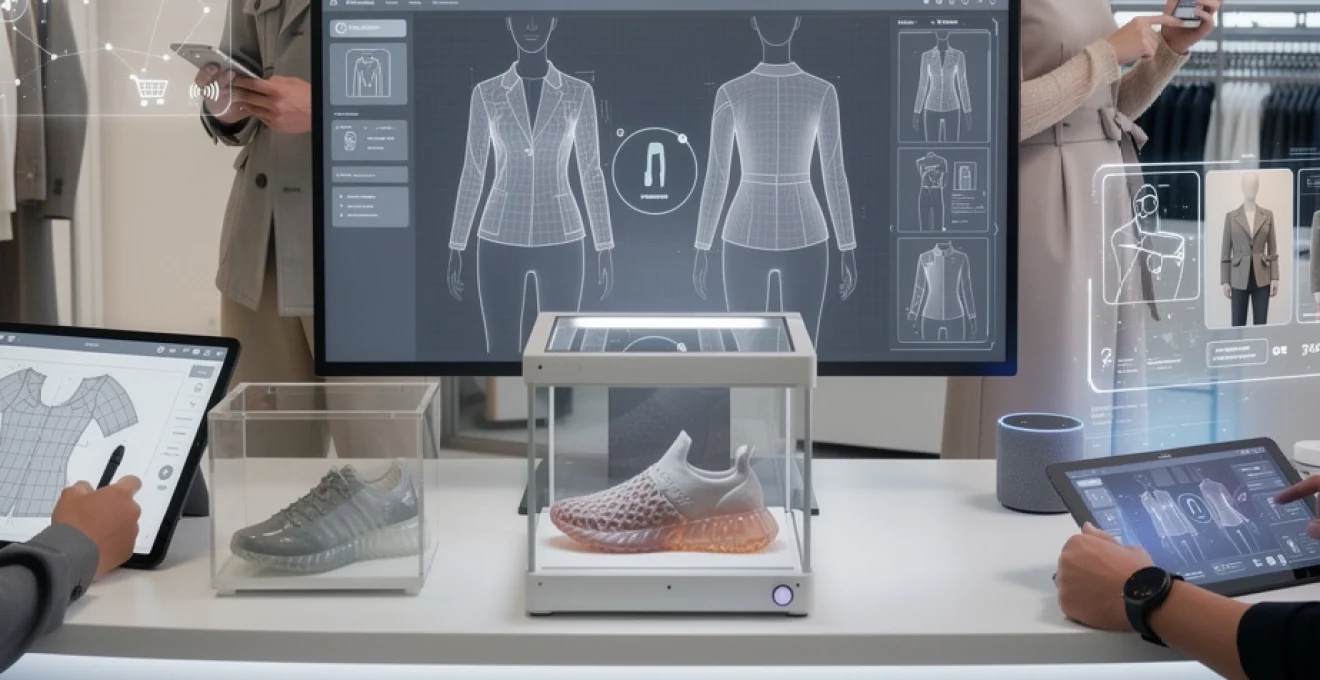
The fashion industry stands at the precipice of its most significant transformation since the invention of the sewing machine. Digital technologies are revolutionising every aspect of fashion, from conceptual design to consumer delivery, creating unprecedented opportunities for innovation, sustainability, and customer engagement. This transformation extends far beyond simple e-commerce adoption, encompassing artificial intelligence-driven design processes, blockchain-enabled supply chain transparency, and immersive virtual reality shopping experiences that are fundamentally reshaping how brands create, market, and sell their products.
The convergence of advanced manufacturing techniques, data analytics, and consumer technology has created a new paradigm where traditional fashion boundaries are dissolving. Brands now leverage sophisticated algorithms to predict trends, utilise 3D printing for rapid prototyping, and deploy augmented reality to enhance customer experiences. This digital revolution isn’t merely about adopting new tools; it represents a complete reimagining of fashion industry operations, promising greater efficiency, reduced environmental impact, and more personalised consumer experiences than ever before.
Digital design and product development revolution
The fashion design landscape has undergone a dramatic metamorphosis through digital innovation, fundamentally altering how designers conceptualise, create, and refine their collections. Modern fashion houses increasingly rely on sophisticated digital tools that enable rapid iteration, precise visualisation, and seamless collaboration across global teams. This technological integration has compressed traditional design timelines from months to weeks while simultaneously improving design accuracy and reducing material waste.
3D modelling software integration: CLO 3D and browzwear VStitcher applications
CLO 3D and Browzwear VStitcher represent the pinnacle of three-dimensional garment visualisation technology, enabling designers to create photorealistic digital prototypes that behave like actual fabric. These platforms simulate fabric drape, stretch, and movement with remarkable accuracy, allowing designers to experiment with different materials, patterns, and fits without producing physical samples. The software’s advanced physics engines calculate how various textiles will behave under different conditions, providing designers with unprecedented insight into their creations before committing to production.
Fashion brands utilising these technologies report up to 70% reduction in sample production costs and 50% faster time-to-market for new collections. The software’s collaborative features enable global design teams to work simultaneously on projects, with real-time updates and modifications visible to all stakeholders. This capability has become particularly valuable for international brands managing design teams across multiple continents, ensuring consistency and quality throughout the development process.
Virtual prototyping workflows: reducing physical sample production costs
Virtual prototyping workflows have revolutionised the fashion industry’s approach to product development, dramatically reducing both costs and environmental impact. Traditional sampling processes typically require multiple physical iterations, consuming significant quantities of fabric and generating substantial waste. Digital prototyping eliminates much of this waste by allowing designers to perfect their creations in virtual environments before any physical materials are cut.
The financial implications of virtual prototyping are substantial, with industry leaders reporting cost savings of 60-80% in their sampling budgets. These workflows integrate seamlessly with existing design processes, enabling designers to visualise how garments will look and fit across different body types and sizes. The technology’s precision has reached a point where many brands now make production decisions based entirely on virtual samples, only creating physical prototypes for final approval or marketing purposes.
Parametric design tools: nike’s flyknit and adidas’ 4D printing technologies
Parametric design tools represent the cutting edge of computational fashion design, enabling the creation of complex, performance-oriented garments that would be impossible to achieve through traditional methods. Nike’s Flyknit technology exemplifies this approach, using algorithmic design to create seamless, lightweight athletic footwear with precisely engineered support zones. The technology allows for infinite customisation possibilities, with each shoe potentially featuring unique structural characteristics tailored to specific performance requirements.
Similarly, Adidas’ 4D printing technology leverages parametric design principles to create midsoles with lattice structures optimised for individual biomechanics. This approach uses light and oxygen to cure liquid resin into precisely engineered cushioning systems, with each unit featuring thousands of struts designed to provide optimal energy return and comfort. The technology demonstrates how parametric design can transform functional apparel components from
being static components into dynamic structures that can be tuned like musical instruments. As data from athletes and everyday wearers feeds back into these systems, brands can iteratively refine geometries, densities, and support zones, closing the loop between real-world performance and digital design. For fashion professionals, mastering parametric design and understanding how to translate performance data into design rules is quickly becoming as important as traditional pattern cutting skills.
Computer-aided pattern making: gerber AccuMark and lectra modaris systems
Computer-aided pattern making systems such as Gerber AccuMark and Lectra Modaris underpin much of the fashion industry’s digital transformation behind the scenes. These platforms allow pattern makers to draft, grade, and modify patterns with millimetre precision, dramatically reducing the errors and inconsistencies common in manual processes. Digital pattern libraries can be reused and adapted across seasons, product lines, and regions, creating a powerful foundation for scalable, consistent production.
One of the most impactful capabilities of these systems is automated grading, where sizes are generated algorithmically based on defined rules rather than recreated from scratch. This not only accelerates development but also supports inclusive size ranges by making it easier to extend patterns beyond traditional size runs. Integrated fabric consumption calculators and marker-making tools help optimise material usage, shaving percentage points off fabric waste that translate into significant cost and sustainability gains at scale.
Modern CAD pattern systems also integrate seamlessly with 3D garment simulation tools and cutting-room equipment, creating an end-to-end digital workflow from initial block to final lay plan. As more factories adopt automated cutters that read digital files directly, brands that invest in robust digital pattern infrastructures are better positioned to shorten lead times and switch production between facilities without compromising fit or quality. For many labels, the shift from paper patterns to fully digital pattern ecosystems has been as transformative as moving from film to digital photography.
E-commerce platform transformation and omnichannel retail
While digital tools have revolutionised how garments are designed and developed, the most visible transformation for consumers is happening in e-commerce and omnichannel retail. Fashion brands are no longer simply running online stores; they are orchestrating connected experiences that span websites, apps, social media, physical boutiques, and even voice assistants. The goal is a seamless journey where customers can discover, evaluate, purchase, and return products through whichever channel they prefer, without friction or inconsistency.
To achieve this, leading fashion retailers are investing in sophisticated commerce platforms, immersive front-end technologies, and data platforms that unify customer profiles and inventory information. The result is an omnichannel retail environment where a shopper might discover a product on Instagram, visualise it via augmented reality, add it to a wishlist on mobile, and complete the purchase in-store or via voice command. For brands willing to rethink their retail architecture, digital technology is turning each customer touchpoint into an opportunity for deeper engagement and higher conversion.
Shopify plus and magento commerce fashion-specific customisations
Enterprise-ready platforms such as Shopify Plus and Adobe Commerce (Magento) have become the backbone of many fashion e-commerce operations. Beyond basic storefront capabilities, these systems offer fashion-specific customisations like advanced size guides, lookbook-style merchandising, and sophisticated product attribute management for colourways, fits, and fabric compositions. Brands can launch regional sites, flash sales, or capsule collections quickly, all while maintaining a consistent brand experience.
One of the key advantages of these platforms is their extensible ecosystem of apps and integrations tailored to fashion retail. From virtual fitting plugins and returns management systems to loyalty programmes and pre-order modules, brands can assemble a technology stack that mirrors their unique business model. For example, a direct-to-consumer label can integrate subscription billing and drop-model launches, while a multi-brand retailer can focus on marketplace capabilities and advanced search tailored to fashion taxonomy.
For fashion managers, the strategic question is no longer whether to sell online, but how to configure e-commerce platforms to support omnichannel success. Investing in robust product information management (PIM), unified inventory across channels, and real-time analytics allows you to move beyond static catalogues towards data-driven merchandising. By monitoring metrics like add-to-cart rates by size, search term performance, and cross-device journeys, retailers can continuously refine their online experience much like a designer iterates a garment pattern.
Augmented reality try-on solutions: sephora virtual artist and warby parker integration
Augmented reality (AR) try-on solutions have rapidly moved from novelty to expectation in several fashion and beauty categories. Sephora’s Virtual Artist and Warby Parker’s glasses try-on are prime examples of how AR can reduce purchase anxiety and bridge the gap between digital browsing and physical trial. Using smartphone cameras and facial mapping, these tools overlay products—lipsticks, eyeshadows, frames—onto the user’s live image, allowing them to experiment with styles in real time.
For apparel and accessories, AR-powered virtual try-on is evolving from simple overlays to more sophisticated body and motion tracking. This shift is crucial for improving accuracy and building trust, as shoppers expect the virtual fit to match real-world results. When implemented well, AR can significantly reduce return rates, particularly for categories with complex sizing or aesthetic preferences. Retailers have reported conversion uplifts of 20–30% on products supported by AR try-on, along with higher engagement times and repeat visits.
Implementing AR is not without challenges—accurate 3D assets, device compatibility, and user education all play a role. However, by starting with high-impact product lines (such as eyewear, cosmetics, or footwear) and focusing on intuitive interfaces, brands can introduce AR as a natural extension of the shopping journey rather than a tech gimmick. As camera-centric platforms like Instagram, Snapchat, and TikTok continue to blend content and commerce, AR try-ons are fast becoming the digital equivalent of a fitting room.
Voice commerce implementation: amazon alexa fashion shopping capabilities
Voice commerce adds another layer to omnichannel retail, enabling customers to interact with fashion brands through smart speakers and voice assistants like Amazon Alexa and Google Assistant. While ordering a dress via voice may sound futuristic, consumers are already using voice search to discover brands, check order statuses, and re-order staple items. Amazon’s Alexa, for instance, can recommend outfits based on past purchases or trending items, turning shopping into a conversational experience.
The main opportunity for fashion retailers lies in using voice as a complementary channel rather than a standalone store. Voice is particularly effective for low-friction tasks: checking delivery times, locating nearby stores, managing wishlists, or getting styling tips. By integrating voice skills with existing customer accounts and recommendation engines, brands can offer personalised interactions that feel like having a stylist on call. The simplicity of a spoken request—“Alexa, what should I wear for a winter wedding?”—can unlock complex back-end logic pulling from inventories, lookbooks, and user preferences.
Designing for voice requires a different mindset than designing for screens. Fashion teams need to think in terms of conversational flows, clear prompts, and concise responses rather than visual layouts. Data privacy and consent are also critical, as voice assistants capture sensitive behavioural data. However, as customers grow more comfortable talking to devices in their homes and cars, integrating voice commerce into your omnichannel strategy can provide a subtle but powerful edge in customer convenience and brand recall.
Progressive web applications: ASOS and zalando mobile-first strategies
With mobile accounting for well over 60% of fashion e-commerce traffic in many markets, mobile-first strategies are now non-negotiable. Progressive Web Applications (PWAs)—websites that behave like native apps—have become a popular way for fashion retailers to deliver fast, app-like experiences without requiring an app store download. ASOS and Zalando are among the leaders leveraging PWA principles to optimise speed, responsiveness, and offline capabilities.
PWAs combine features like instant loading, push notifications, and home-screen icons with the discoverability of the web. For fashion shoppers, this means smoother browsing of image-heavy catalogues, faster checkout flows, and fewer abandoned carts due to sluggish performance. From a technical standpoint, service workers cache key assets and enable offline browsing of previously visited pages—ideal for users on unstable mobile networks or commuting underground.
For brands, adopting PWA architecture can be likened to upgrading from a narrow boutique to a spacious, well-lit flagship store without changing address. Page speed improvements alone can have outsized effects on conversion, as even a one-second delay has been shown to reduce mobile conversions by up to 20%. By aligning design, development, and merchandising teams around a mobile-first mindset—large touch targets, concise copy, vertically stacked layouts—fashion retailers can ensure that the smallest screen delivers the biggest impact.
Supply chain digitalisation and blockchain implementation
Behind the slick front-end of digital fashion lies a complex supply chain that is also being rewired by technology. Digitalisation is enabling brands to track materials and finished goods in real time, align production more closely with demand, and provide unprecedented transparency into where and how garments are made. In an era where consumers increasingly ask “who made my clothes?” and regulators scrutinise environmental impact, supply chain visibility is shifting from competitive advantage to basic expectation.
Technologies such as RFID, IoT sensors, AI-driven forecasting, and blockchain are converging to create supply chains that are not only more efficient, but also more accountable. Instead of opaque, linear flows from factory to store, we are seeing the emergence of digital supply networks where data moves as freely as products. This shift allows fashion companies to reduce overproduction, respond faster to trends, and substantiate claims about sustainability and ethical sourcing.
RFID tracking systems: zara’s real-time inventory management
Radio-frequency identification (RFID) has become a cornerstone of real-time inventory management in fashion, with Zara often cited as a benchmark. By embedding RFID tags in garments and equipping stores and distribution centres with readers, Zara can track individual items from warehouse to fitting room. Store associates can see precisely which sizes and colours are available on the shop floor and in the stockroom, reducing lost sales due to perceived stock-outs.
The impact of RFID extends beyond better shelf availability. Accurate, item-level data enables more precise replenishment and reduces safety stocks, freeing up working capital. It also supports services like in-store pickup of online orders and ship-from-store, both critical components of omnichannel retail. When a customer buys the last size 38 blazer online, the system knows exactly which store or warehouse holds it and can orchestrate the most efficient fulfilment route.
For brands considering RFID deployment, the analogy of turning on the lights in a dark warehouse is apt. You suddenly see where products actually are, how fast they move, and where bottlenecks occur. While initial investment in tags, readers, and systems integration can be significant, the payback often comes through reduced markdowns, fewer write-offs, and improved customer satisfaction due to fewer “out of stock” disappointments.
Blockchain provenance solutions: kering’s sustainability transparency platform
Blockchain technology is emerging as a powerful tool for verifying product provenance and sustainability claims. Luxury group Kering, whose portfolio includes Gucci, Saint Laurent, and Balenciaga, has invested in blockchain-based platforms to trace materials from source to finished product. Each step in the journey—raw fibre, spinning, weaving, dyeing, assembly—is recorded as a tamper-resistant transaction, creating a digital passport for the garment or accessory.
This level of transparency allows brands to substantiate assertions about organic cotton, responsibly sourced leather, or fair labour practices. Consumers can scan a QR code or NFC tag to access this information, aligning purchase decisions with personal values. For regulators and certification bodies, blockchain provides an auditable trail that is far more robust than paper certificates or manual reporting.
Implementing blockchain provenance is not without complexity; it requires coordination across suppliers, standardisation of data formats, and careful governance of who can write to and read from the ledger. Yet as sustainability moves from marketing message to measurable requirement, we can expect more fashion companies to follow Kering’s lead. Those that invest early gain not only credibility but also better internal visibility into their own supply networks, enabling them to identify risks and opportunities that were previously hidden.
Automated demand forecasting: H&M’s AI-powered inventory optimisation
One of the fashion industry’s most persistent challenges is matching supply to volatile demand. Overproduce, and you face markdowns and waste; underproduce, and you lose sales and frustrate customers. H&M has turned to artificial intelligence to improve demand forecasting and inventory optimisation, leveraging machine learning models that ingest historical sales, weather data, social media signals, and local events to predict what will sell where and when.
These AI systems can detect patterns too complex or subtle for human planners—for instance, how a specific colourway of a dress performs in coastal cities versus inland, or how a viral TikTok trend accelerates demand in particular demographics. Based on these insights, H&M adjusts purchase orders, allocates stock to stores, and even decides when to accelerate or slow down replenishment of fast-moving items. The result is a leaner, more responsive inventory that reduces both stockouts and end-of-season surplus.
For smaller brands, the lesson is not that you must replicate H&M’s data infrastructure overnight, but that demand forecasting is evolving from art to science. Even modest implementations—such as using analytics to understand size curves by region or to identify chronically overbought SKUs—can yield immediate benefits. As AI tools become more accessible through cloud platforms, fashion managers who learn to frame the right questions and feed the right data into these systems will gain a tangible edge in profitability and sustainability.
Digital factory integration: shima seiki’s WHOLEGARMENT knitting systems
On the production floor, digital factory integration is enabling new levels of efficiency and flexibility. Shima Seiki’s WHOLEGARMENT knitting systems offer a vivid example: these machines can knit entire garments in one piece, directly from digital patterns, with minimal or no sewing required. Designs created in Shima Seiki’s software are transmitted to knitting machines that execute them with high precision, drastically reducing material waste and labour-intensive assembly steps.
Because WHOLEGARMENT technology can produce on-demand and in smaller batches, it supports more agile, localised manufacturing models. Brands can test capsule collections with reduced risk, replenish popular items faster, and even explore made-to-order knitwear that responds to individual measurements or design preferences. Compared to traditional cut-and-sew knitwear, the reduction in yarn waste and the elimination of seam-related defects contribute both to cost savings and improved sustainability metrics.
Digital factory integration goes beyond individual machines; it encompasses connecting design systems, production planning, quality control, and logistics through shared data. When a designer tweaks a neckline in the 3D environment, that change can cascade automatically into machine instructions, bills of materials, and production schedules. For factories and brands alike, this end-to-end digital thread shortens the distance between idea and finished product, turning manufacturing into a more programmable and responsive process.
Artificial intelligence and machine learning applications
Artificial intelligence (AI) and machine learning (ML) have become central to digital transformation in fashion, touching everything from trend forecasting and design to pricing, customer service, and visual search. If data is the new fabric of the industry, AI is the loom that weaves it into usable insights. By detecting patterns in vast datasets that no human team could manually process, AI systems allow fashion brands to make faster, more informed decisions and to personalise experiences at scale.
In product development, non-generative AI models analyse social media content, search queries, and sales data to identify emerging trends and inform design directions. Tools can suggest colour palettes, silhouettes, and motifs likely to resonate with specific segments, reducing the guesswork that traditionally underpinned seasonal planning. Some retailers use generative AI to create mood boards, print designs, or campaign visuals, speeding up creative workflows while leaving final curation to human designers.
On the retail side, AI-powered recommendation engines—which you encounter every time you see “you may also like” or “complete the look”—drive a significant share of online fashion revenue. By analysing browsing history, purchase patterns, and even return behaviour, these systems surface products that align with an individual’s style and fit preferences. The effect is akin to having a personal stylist who learns your taste over time, increasing both basket size and customer satisfaction.
Computer vision, another branch of AI, enables visual search and auto-tagging of product images. Shoppers can upload a photo of an outfit they saw on the street or social media and instantly find similar items from a retailer’s catalogue. For merchants, automated tagging of attributes like neckline, sleeve length, or print type improves search accuracy and merchandising analytics. Generative AI is also beginning to power virtual models and digital try-ons, reducing the need for physical photoshoots and expanding representation by easily showcasing diverse body types and skin tones.
AI is transforming back-office functions as well. Dynamic pricing algorithms adjust discounts in real time based on demand, inventory levels, and competitor activity, aiming to maximise margin without alienating customers. Chatbots and virtual assistants handle a growing volume of customer service interactions—tracking orders, managing returns, answering size queries—freeing human agents to focus on complex cases. As with any powerful tool, responsible use is critical: brands must address concerns around bias in algorithms, data privacy, and transparency to ensure that AI enhances, rather than undermines, customer trust.
Sustainable fashion technology and circular economy solutions
Digital technology is not only making fashion faster and more personalised; it is also a key enabler of sustainability and circular economy models. The industry is under intense pressure to reduce its environmental footprint, from fibre production and dyeing to overproduction and landfill waste. Technology provides new ways to measure impact, design out waste, and keep products and materials in use for longer—ultimately reshaping how value is created and captured.
At the design stage, tools like 3D prototyping and digital material libraries allow brands to experiment with lower-impact textiles—recycled polyester, organic cotton, bio-based fibres—without incurring the cost and waste of physical sampling. Lifecycle assessment (LCA) software integrated into design platforms can estimate the carbon, water, and chemical footprint of different design choices, guiding teams towards more sustainable options before a single metre of fabric is ordered. In this sense, digital design acts like a sustainability “sandbox,” letting you test scenarios virtually rather than in the real world.
In production, technologies such as 3D printing and on-demand manufacturing help align output more closely with actual demand, reducing unsold inventory that might otherwise be discounted or destroyed. Waterless dyeing techniques, digital printing, and automated cutting guided by AI-driven marker optimisation all contribute to lower resource use and waste. Combined with renewable energy at manufacturing sites, these innovations can significantly cut emissions across the supply chain.
Digital platforms are also powering new circular business models. Resale marketplaces, rental services, and repair programmes rely on robust digital infrastructure to track items, manage logistics, and connect supply with demand. Brands are launching their own take-back schemes and authenticated resale platforms, often using QR codes or RFID tags to verify authenticity and gather data on product lifecycles. This data, in turn, informs design improvements—stronger seams, modular components, or mono-material constructions that make garments easier to repair and recycle.
Blockchain and product passports play an important role in enabling circularity by recording material composition and care instructions in a durable, accessible format. Imagine scanning a jacket’s label in ten years to see not just where it was made, but how to disassemble it for recycling, which components are recyclable, and which recycler is certified to handle them. While the industry is still in early stages of this vision, pilots in Europe and beyond suggest that digital identity for garments will be central to future regulations and consumer expectations. For brands, embracing these technologies today is a way to future-proof operations and demonstrate genuine commitment to sustainable fashion.
Social media integration and influencer marketing platforms
Social media has become the modern-day runway, with platforms like Instagram, TikTok, and Pinterest setting the pace for trends and shaping consumer perceptions of brands. Digital technology has turned these networks into powerful commerce engines, where inspiration and transaction can happen in a matter of seconds. Shoppable posts, live-streamed try-on hauls, and embedded product tags allow users to move from seeing a look they love to owning it with minimal friction.
Influencer marketing platforms have evolved alongside this shift, helping brands identify, manage, and measure partnerships with creators ranging from mega-celebrities to micro-influencers. Using data on audience demographics, engagement rates, and content performance, these platforms match campaigns to influencers whose communities align with brand values and target segments. The result is more authentic, targeted collaborations that feel like recommendations from a trusted friend rather than traditional advertising.
Advanced social listening tools and analytics platforms give fashion marketers real-time visibility into what customers are saying, wearing, and wanting. By tracking hashtags, mentions, and sentiment across channels, brands can spot emerging micro-trends, assess campaign impact, and even detect potential PR issues before they escalate. In many ways, social media has become a giant, always-on focus group and runway show combined, offering granular insight that would have been impossible to gather a decade ago.
The integration of social media and e-commerce is most visible in features like Instagram Shopping, TikTok Shop, and Pinterest Product Pins, where product discovery, content, and checkout are unified. Livestream commerce—hugely popular in China and gaining traction globally—adds another layer, blending entertainment and shopping in real time. Viewers can ask questions, vote on styles, and purchase featured items with a tap, creating a sense of urgency and community reminiscent of a limited-seat fashion show.
For fashion brands, succeeding in this environment requires more than posting polished campaign images. It calls for a consistent content strategy, a willingness to collaborate with diverse voices, and the agility to respond as trends and algorithms shift. By combining creative storytelling with data-driven optimisation—testing different formats, posting times, and creator partnerships—you can turn social media from a noisy backdrop into a structured, measurable engine for brand building and sales. In the digital era, the brands that learn to choreograph design, commerce, and community across these platforms will be the ones that set the pace for the rest of the industry.