
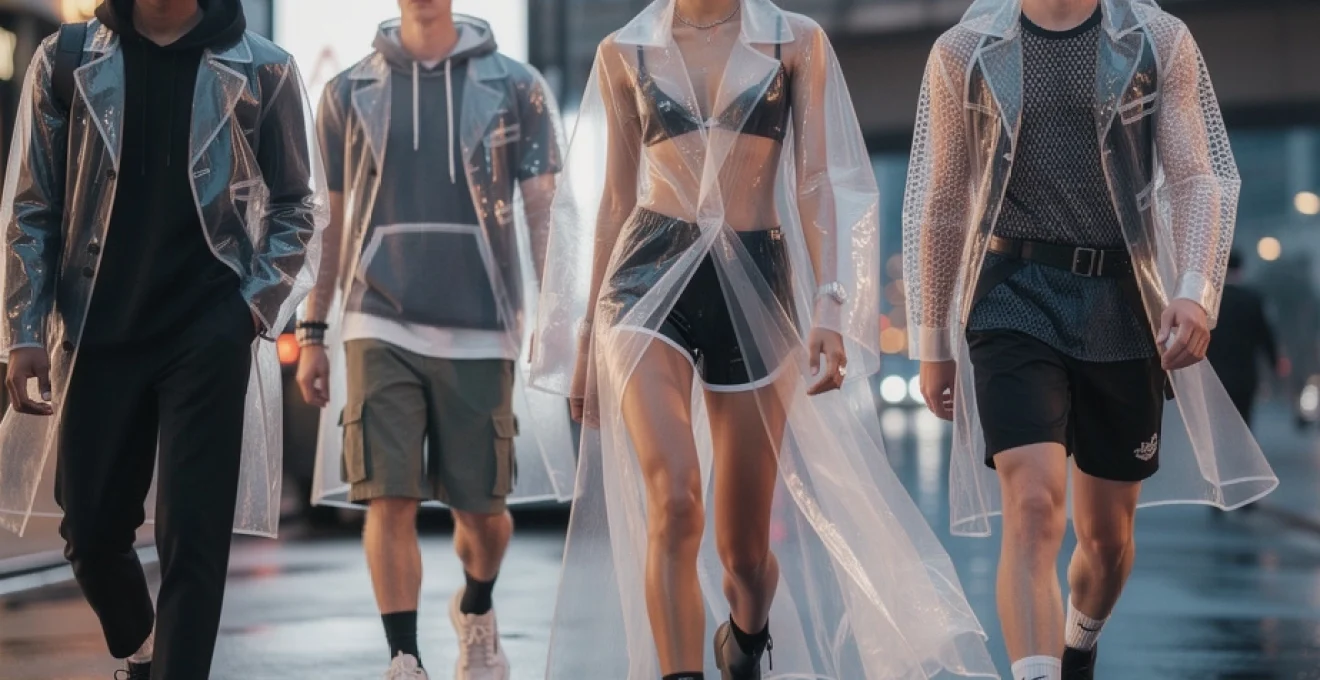
The streets of London, Paris, and New York have become laboratories for a fashion revolution that challenges traditional notions of modesty and structure. Transparent layers have emerged as the defining aesthetic of contemporary urban fashion, transforming everything from casual streetwear to high-end designer collections. This phenomenon extends far beyond simple see-through garments, encompassing a sophisticated interplay of materials, technologies, and cultural shifts that speak to our generation’s desire for authenticity and visual complexity. The transparent trend represents a fundamental reimagining of how clothing can simultaneously reveal and conceal, creating depth through layering whilst maintaining the raw honesty that urban fashion demands.
Mesh and tulle integration in contemporary streetwear collections
The integration of mesh and tulle into streetwear represents one of fashion’s most intriguing contradictions. These traditionally delicate fabrics, once reserved for ballet costumes and wedding gowns, now appear alongside chunky trainers and oversized hoodies. This juxtaposition creates visual tension that defines modern urban aesthetics, where softness meets street sensibility in unexpected harmony.
Contemporary streetwear brands have mastered the art of incorporating these transparent elements without sacrificing the functionality that urban environments demand. Mesh overlays provide ventilation whilst adding textural interest, particularly effective in layering systems where breathability becomes crucial. Tulle, meanwhile, offers movement and ethereal quality that contrasts beautifully with the structured elements of urban wear.
Organza overlays in Off-White and virgil abloh’s deconstructed aesthetic
Virgil Abloh’s approach to organza overlays revolutionised how transparent materials could function within streetwear frameworks. His deconstructed aesthetic employed organza not merely as decoration but as architectural elements that challenged garment construction norms. These translucent layers often revealed construction details—seams, labels, and internal structures—that traditional fashion typically conceals.
The genius of Abloh’s organza applications lay in their dual functionality. These overlays served as protective barriers whilst simultaneously exposing the garment’s inner workings, creating a transparency paradox that became synonymous with Off-White’s design philosophy. This approach influenced countless designers to reconsider how transparent materials could contribute to storytelling within urban fashion contexts.
Helmut lang’s transparent PVC applications in minimalist design
Helmut Lang’s pioneering use of transparent PVC established new parameters for incorporating synthetic transparent materials into high-fashion contexts. Lang’s approach focused on industrial precision, treating PVC not as a novelty material but as a serious medium for exploring themes of exposure and protection in urban environments.
The technical challenges of working with PVC—its tendency to tear, difficulty in sewing, and temperature sensitivity—required innovative construction methods. Lang’s solutions included heat-welding techniques and strategic placement of transparent panels to maximise visual impact whilst maintaining structural integrity. These innovations established benchmarks that continue to influence contemporary designers working with similar materials.
Maison margiela’s experimental sheer fabrications and layering techniques
Maison Margiela’s exploration of sheer fabrications extends beyond conventional transparency into the realm of conceptual fashion. The house’s approach to layering transparent materials creates optical illusions that challenge perceptions of depth and dimension. Their techniques involve multiple transparent layers that create varying degrees of opacity, resulting in graduated transparency effects that shift with movement and lighting conditions.
The brand’s experimental methods include using industrial materials not traditionally associated with fashion—plastic films, medical-grade membranes, and architectural glazing materials. These unconventional choices reflect Margiela’s commitment to pushing boundaries whilst maintaining wearability within urban contexts.
Rick owens’ draped chiffon constructions in Avant-Garde silhouettes
Rick Owens’ mastery of draped chiffon has redefined how transparent materials can create sculptural silhouettes within urban fashion. His constructions emphasise the inherent properties of chiffon—its ability to flow, gather, and create volume—whilst maintaining the stark aesthetic sensibilities that characterise his work.
Owens’ chiff
Owens’ chiffon constructions often function as moving architecture, using semi-transparent fabric to carve out negative space around the body rather than simply covering it. In many of his urban-ready looks, sheer layers fall over cargo-inspired bases, technical leggings or platform boots, creating a tension between fragility and brutality that resonates with city life. By allowing light to pass through his draped silhouettes, Owens demonstrates how transparent layers can soften even the most severe shapes without diluting their subversive power. This approach has filtered down into urban fashion, where elongated sheer tunics, sleeveless chiffon coats and gauzy capes now appear over utilitarian separates, giving wearers an accessible entry point into avant-garde silhouettes.
Technical construction methods for transparent fashion elements
Behind every transparent jacket, mesh-paneled hoodie or PVC trench that appears effortless on the street lies a complex set of technical construction decisions. Unlike opaque textiles, transparent fabrics expose every seam, stitch and structural compromise, leaving no room to hide mistakes. Urban fashion labels working with see-through materials must therefore balance aesthetics with engineering, ensuring that garments can withstand friction from backpacks, crowded commutes and changing weather conditions. Understanding how these pieces are built helps explain why transparent layers have moved from runway novelty to reliable street staples.
Heat-sealed vinyl bonding processes in high-end manufacturing
Heat-sealed bonding has become a cornerstone in constructing transparent vinyl and PVC garments that need to survive real-world wear. Instead of traditional stitching, which can perforate and weaken clear polymers, manufacturers use controlled heat and pressure to fuse edges together, creating smooth, almost invisible joins. This technique is especially valuable in urban rainwear—from glossy hooded parkas to clear tote bags—where water resistance and clean lines define the look. You can think of heat-sealed bonding like welding glass: the goal is a continuous surface that maintains strength without introducing visible clutter.
High-end factories now combine heat bonding with precision molds and jigs to prevent warping, bubbling or yellowing in thicker transparent textiles. Premium streetwear brands leverage these processes to create structured shapes—boxy coats, geometric pockets, angular hoods—that would collapse without rigid seams. As a result, transparent outer layers no longer feel flimsy or costume-like; they behave like serious technical gear. For consumers, this means a transparent vinyl jacket can offer both visual drama and practical durability, making it a viable everyday layer rather than a one-night statement.
Laser-cut mesh perforation patterns and structural integrity
Laser cutting has transformed how designers approach mesh and perforated synthetics in urban apparel. Rather than relying on pre-woven mesh rolls, brands use lasers to cut precise ventilation patterns into solid transparent or semi-transparent fabrics, controlling both breathability and aesthetics. This method allows for intricate motifs—grids, waves, fragmented logos—that double as functional air channels in high-heat zones such as the chest, back and underarms. Imagine a running jacket mapped like a city blueprint, where each cut-out is placed to cool a specific “district” of the body.
From a structural standpoint, laser cutting must be carefully calibrated so that perforations do not compromise the tensile strength of the garment. Designers work with engineers to test different hole sizes, spacing and orientations, ensuring that repeated stretching or washing will not cause tearing. In performance-focused streetwear capsules, you will often see denser, smaller perforations around stress points such as shoulders and elbows, with larger cut-outs in areas with less strain. This engineering-first mindset is what allows transparent layers to move beyond pure aesthetics and support the demands of active urban lifestyles.
Multi-layer assembly techniques using clear thermoplastics
Multi-layer assemblies involving clear thermoplastics have become a powerful tool for creating depth and structure in transparent fashion. By stacking thin, flexible polymer films with mesh, tulle or even traditional cotton, manufacturers can build composite textiles that behave like lightweight armor. Each layer in the stack performs a role: one provides rigidity, another adds breathability, and a third delivers the desired transparent or frosted visual effect. The result is a material that looks delicate but feels surprisingly robust when worn in crowded streets or packed public transport.
These multi-layer constructions also make it easier to embed graphics, reflective foils or RFID tags between transparent sheets without exposing the hardware directly to abrasion. For example, some urban techwear jackets now feature maps, coordinates or brand narratives “floating” within clear panels, protected by outer thermoplastic skins. Multi-layer transparent panels can be strategically placed at the chest, hem or hood to create focal points while keeping the rest of the garment in matte fabrics. This layered assembly approach mirrors the complexity of the city itself: multiple strata coexisting, interacting and revealing different details as you move.
Industrial ultrasonic welding for seamless transparent garment construction
Industrial ultrasonic welding pushes the idea of seamless transparent garments even further, using high-frequency vibrations to fuse synthetic fibers without visible thread. For transparent fashion, this technique is particularly valuable in areas where traditional stitching would distract from the clarity of the design—armholes on a PVC tank, side seams on a clear poncho, or curved panels on a see-through backpack. Because ultrasonic welding creates flat, low-profile seams, it reduces chafing and bulk, improving comfort when pieces are worn directly against the skin or layered under heavier outerwear.
From a technical perspective, ultrasonic welding is also more consistent than manual stitching, leading to repeatable, high-strength joints that withstand the strain of daily wear. Some urban sportswear brands now specify ultrasonic seams in high-sweat zones, pairing transparent or translucent membranes with performance linings. For the wearer, the effect is subtle but impactful: jackets and tops that feel smoother, move more freely and maintain their sheer aesthetics after dozens of wear cycles. As the technology becomes more accessible, we can expect seamless transparent construction to trickle down from luxury capsules into mainstream urban collections.
Material innovation in see-through urban apparel
The rise of transparent layers in urban fashion is not only a story of design; it is equally a story of material science. Early experiments with sheer plastics or delicate tulles often resulted in garments that cracked, fogged, or tore under everyday conditions. Today, textile innovation has delivered a new generation of see-through materials engineered specifically for the city. Recycled nylons, bio-based TPU, breathable membranes and soft-touch meshes have transformed transparent clothing from fragile novelty into long-term wardrobe investments.
One major shift is the move toward sustainability in transparent textiles. Brands now source recycled polyester chiffon, regenerated nylon mesh and PVC-free clear coatings to reduce environmental impact. Some labels partner with labs to develop bio-based thermoplastics that mimic the clarity of traditional PVC but break down more cleanly at the end of their lifecycle. At the same time, coatings that resist UV yellowing, abrasion and fogging extend the lifespan of see-through pieces, aligning transparency with the broader push toward conscious consumption in urban fashion.
Innovation is also happening at the microscopic level. Yarn engineers create multifilament threads with hollow cores or cross-sections that scatter light, giving sheer fabrics a subtle frosted or iridescent glow without additional prints. This allows designers to play with visual depth—matte vs. glossy, clear vs. clouded—within a single garment. For you as a wearer, that translates into transparent pieces that look rich and intentional rather than plastic or cheap. These advanced materials make it possible to wear transparency in more diverse climate conditions, from humid summers to windy transitional seasons, without sacrificing comfort.
Celebrity influence and high-profile transparent fashion moments
Transparent layers might have started in subcultural circles and experimental runways, but celebrity adoption has pushed them into the center of urban fashion discourse. High-profile appearances—from sheer gowns at major award shows to mesh tops in front-row street style—have reframed see-through clothing as both aspirational and accessible. When icons like Rihanna, Zendaya, or Kendall Jenner appear in transparent looks styled with sneakers, oversized blazers or cargo trousers, they send a clear message: sheer is not limited to red carpets; it belongs on city streets too.
These moments matter because they offer a visual blueprint for how transparent layers can be worn with confidence. Instead of presenting transparency as total exposure, stylists often balance it with grounded elements: a structured trench over a naked dress, a voluminous tulle skirt worn with a simple hoodie, or a sheer organza shirt layered over a graphic tee. Urban audiences pick up on these styling cues via social media, where a single viral look can influence thousands of outfits in a matter of days. You might not replicate a runway-level sheer gown, but you may borrow the idea of a see-through shirt over a sports bra and jeans.
At the same time, celebrities have helped decouple transparent fashion from restrictive beauty standards. We now see sheer looks on diverse body types, genders and ages, signalling that urban transparency is less about perfection and more about presence. This shift mirrors wider cultural movements around body neutrality and self-expression. When a musician walks onstage in a mesh top that reveals their scars or tattoos, they are not just making a style choice—they are normalising visibility in a way that resonates deeply with city dwellers negotiating identity in public spaces. The result is a feedback loop: celebrities adopt and amplify transparent trends, and urban communities reinterpret those trends through their own lived realities.
Functional performance features of transparent layering systems
What truly cements transparent layers in urban fashion is their ability to perform, not just to be seen. Modern see-through garments are increasingly engineered like sports equipment, with mapped ventilation, moisture management and even UV protection built into their designs. Rather than acting as fragile shells, transparent layers function as active components in a modular wardrobe system. You can slip a mesh tee under a leather jacket for breathability, throw a clear shell over a hoodie for weather protection, or wear a perforated transparent parka as your primary outerwear when temperatures rise.
Moisture-wicking properties of perforated synthetic membranes
Perforated synthetic membranes sit at the intersection of transparency and performance. Often made from lightweight polyester or nylon blends, these membranes are engineered with micro-holes that allow sweat vapor to escape while maintaining structural coverage. Think of them as the urban equivalent of high-tech running gear: breathable, quick-drying and comfortable against the skin. When used in transparent or translucent panels—across the upper back of a jacket, along the sides of a shirt, or under the arms of a hoodie—they transform garments into dynamic climate systems.
Many contemporary streetwear brands now specify moisture-wicking finishes on their mesh and tulle components, drawing from sportswear technologies like hydrophilic and hydrophobic coatings. Hydrophilic treatments pull moisture away from the skin and spread it across the fabric surface, where it can evaporate quickly, while hydrophobic yarns help prevent the fabric from feeling saturated. For you, this means a transparent layer can actually make a long day of commuting, cycling, or walking more comfortable instead of sticky. It also helps explain why transparent performance tops have become popular under blazers and overshirts, adding both visual interest and functional comfort.
UV protection ratings in clear polymer textile applications
One often overlooked aspect of transparent fashion is sun protection. At first glance, it might seem impossible for a see-through layer to offer serious UV defense, but clear polymer textiles can be engineered with additives that block harmful rays while maintaining visibility. Similar to how clear sunglasses can carry UV filters, transparent jackets and overlays can achieve UPF (Ultraviolet Protection Factor) ratings that rival or exceed some opaque fabrics. This is particularly relevant in cities with high sun exposure, where concrete and glass surfaces amplify reflective glare.
Manufacturers test these materials in accredited labs, measuring how much UVA and UVB radiation penetrates the fabric. A transparent parka with a UPF 30 rating, for example, allows only one-thirtieth of UV rays to reach the skin underneath. Brands often print these ratings discreetly on care labels or marketing tags, giving you concrete data to inform your layering choices. In practice, throwing on a clear, UV-treated shell over a tank top can offer a degree of skin protection without sacrificing the visual lightness and layered storytelling that define transparent urban style. This fusion of safety and aesthetics illustrates how far the category has evolved from its purely decorative roots.
Temperature regulation through strategic ventilation mapping
Temperature regulation is another area where transparent layering systems excel when designed thoughtfully. Rather than treating transparency as a uniform surface, forward-thinking brands map ventilation zones based on how the human body heats and cools throughout the day. The result is a patchwork of sheer and semi-sheer panels that function much like a city’s ventilation network—cooling high-traffic zones while maintaining stability elsewhere. You may notice this in jackets that place mesh or chiffon at the upper back, side seams or inner elbows, where heat tends to accumulate first.
Some collections take this further by combining different transparency levels within a single garment: dense mesh at high-mobility joints, open knit at the chest, and solid overlays where extra insulation or coverage is required. This method, often referred to as “ventilation mapping,” draws on data from sports science and ergonomic research. For urban wearers, it translates into layers that feel surprisingly adaptable as you move from subway to sidewalk to office. Have you ever felt too warm in a hoodie but too exposed without it? Transparent panels offer a nuanced solution, letting your outfit “breathe” without forcing you to strip down.
Durability testing standards for transparent fabric composites
Durability remains one of the biggest concerns when investing in transparent apparel for everyday urban use. Early-generation PVC raincoats and delicate mesh tops often cracked, snagged or clouded after just a few wears. Today, however, more brands are submitting transparent fabric composites to the same rigorous testing standards as heavy-duty outerwear. Abrasion resistance tests, flex crack tests, tear strength measurements and colorfastness evaluations help ensure that sheer garments can survive real city conditions—shoulder bags rubbing against them, repeated folding, or exposure to pollution and rain.
Many technical mills publish performance metrics such as Martindale abrasion scores or cycle counts for flex testing, giving designers a benchmark when selecting transparent materials. Higher scores indicate fabrics that can handle more friction before showing wear. In premium urban collections, you will often find reinforced binding at stress points, double-layered mesh in high-wear zones, and anti-snag finishes applied to delicate tulles and nets. For you as a consumer, this means that transparent pieces are increasingly built to last, moving away from disposable trend items toward long-term staples that can be styled across multiple seasons and contexts.
Market analysis of transparent fashion retail performance
The commercial performance of transparent fashion provides concrete evidence that this is more than a passing microtrend. According to several industry reports, search interest for terms like “sheer top,” “mesh dress,” and “transparent jacket” has increased steadily over the past three years, with spikes following major runway seasons and celebrity appearances. In some urban markets, retailers report double-digit year-on-year growth in categories that combine transparency with streetwear silhouettes—particularly mesh tops, organza shirts and clear outerwear. This growth is not limited to luxury; fast-fashion and mid-market brands have also expanded their transparent offerings, suggesting widespread consumer adoption.
From a merchandising perspective, transparent pieces perform especially well as layering add-ons rather than stand-alone hero items. Buyers often position them as “wardrobe amplifiers” that encourage customers to re-style what they already own. This strategy results in higher basket values, as shoppers pair a sheer overlay with basics like tees, slip dresses or denim they already have. Online, transparent fashion benefits from visual storytelling: product photos that show multiple layering options tend to drive higher engagement and conversion. Retailers who offer styling guidance—whether through lookbooks, short-form video or in-store mannequins—report fewer returns, as customers better understand how to wear sheer items confidently.
There are, of course, regional and cultural nuances. In some markets, fully see-through garments remain niche, reserved for nightlife or creative industries, while more modest interpretations—sheer sleeves, panel inserts, or double-layered tulle—dominate mainstream sales. Brands that succeed in the transparent space are those that treat it as a spectrum rather than a binary, offering multiple opacity levels and styling pathways. For urban consumers, this variety is crucial: it allows you to calibrate your own comfort zone, whether that means a barely-there mesh tank under an oversized shirt or a bold, fully transparent raincoat over monochrome basics. As long as transparency continues to intersect with deeper values—authenticity, self-expression, and technical innovation—its presence in urban fashion retail is likely to remain strong.