
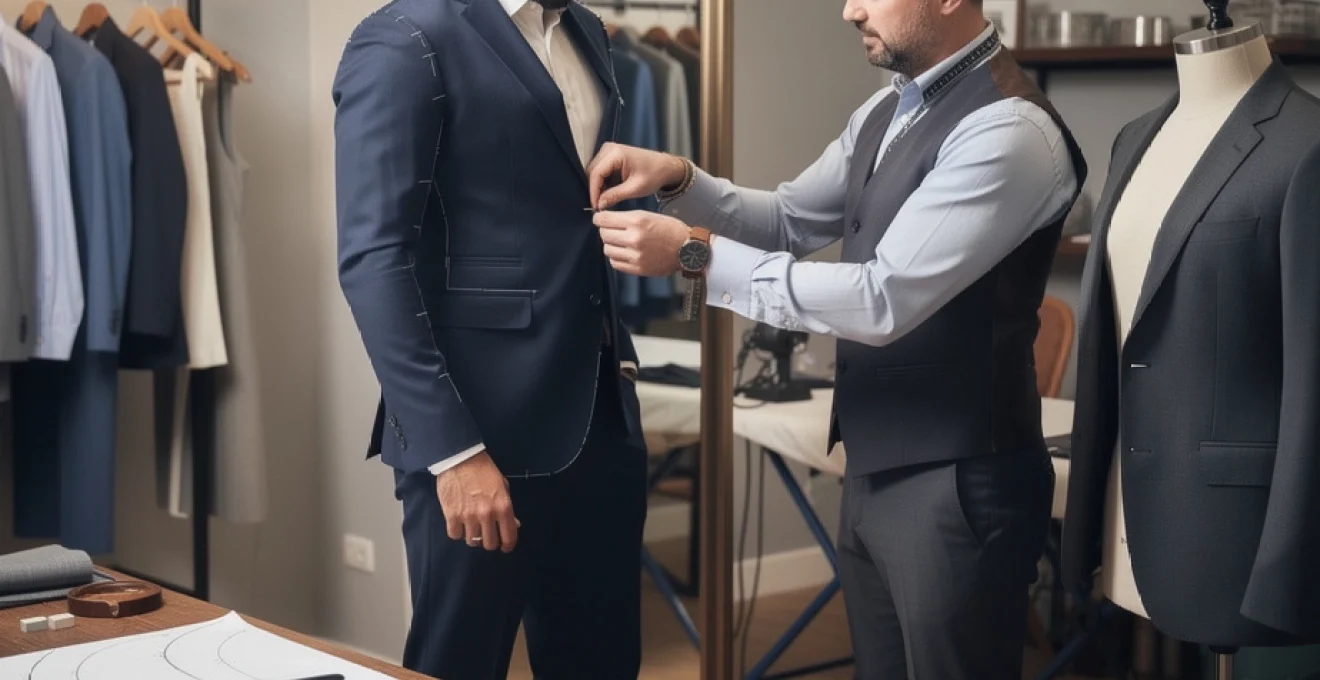
The gap between how clothes look on a mannequin and how they drape on your body represents one of fashion’s most persistent frustrations. Mass-produced garments follow standardised sizing templates that accommodate average measurements, yet human bodies rarely conform to these industrial averages. The result? Wardrobes filled with almost-perfect pieces that never quite deliver the polished appearance you’re seeking. Professional tailoring bridges this gap, transforming generic off-the-rack garments into personalised pieces that enhance your natural proportions. Understanding the technical principles behind expert alterations reveals why this centuries-old craft remains indispensable for anyone serious about their appearance.
The difference between acceptable fit and exceptional fit often measures just millimetres—a sleeve shortened by two centimetres, a waist suppressed by three, or a shoulder seam repositioned by half an inch. These seemingly minor adjustments create disproportionately significant visual improvements. When garments align with your body’s unique architecture, they enhance posture, create flattering silhouettes, and project confidence that transcends the garment itself. The question isn’t whether tailoring matters, but rather how deeply you understand the anatomical and technical principles that make it transformative.
Anatomical fit principles: how bespoke alterations complement your body structure
Every body possesses distinct structural characteristics that influence how fabric drapes and moves. High shoulders versus sloped shoulders, forward posture versus upright carriage, prominent seat measurements versus flat posteriors—these variations demand corresponding adjustments in garment construction. Professional tailors assess these characteristics systematically, identifying where ready-to-wear patterns diverge from your individual anatomy. This diagnostic approach separates competent alterations from exceptional ones, as it addresses the root cause of fit issues rather than merely treating symptoms.
Understanding balance lines and proportion theory in garment construction
The balance line represents an imaginary vertical axis running through a garment’s centre, visible when viewing the piece from the side. Proper balance ensures that front and back panels hang perpendicular to the floor, neither pitching forward nor pulling backward. When this equilibrium fails, you’ll notice telltale signs: jacket fronts that gape open, trouser legs that twist around the leg, or collar backs that stand away from the neck. Correcting balance requires adjusting the relationship between front and back pattern pieces, often by redistributing fabric along key seam lines.
Proportion theory extends beyond simple measurements to address visual relationships between different garment zones. The golden ratio—approximately 1.618:1—appears repeatedly in flattering silhouettes, whether comparing jacket length to trouser rise or sleeve width to shoulder breadth. Skilled tailors manipulate these proportions to create harmony, ensuring that individual elements don’t compete for attention but instead form a cohesive whole. This mathematical approach to aesthetics explains why certain alterations improve appearance dramatically whilst others deliver disappointing results despite technical precision.
Shoulder slope adjustment techniques for proper drape
Shoulder architecture varies considerably between individuals, with slope angles ranging from nearly horizontal to sharply declined. Standard garments typically accommodate a moderate 20-degree slope, which proves problematic for those at either extreme. When shoulders are too high or too low, fabric bunches at the sleeve head or collapses inward, creating unsightly wrinkles that broadcast poor fit. Addressing this requires either adding or removing fabric from the shoulder seam itself, fundamentally altering the garment’s upper structure.
This alteration ranks among the most technically demanding because it affects multiple interconnected elements. The sleeve must be detached, shoulder padding adjusted or replaced, and the armhole reshaped to maintain proper pitch. Expert tailors understand that changing shoulder slope by even 5 degrees requires compensating adjustments throughout the upper garment. The investment proves worthwhile, as proper shoulder fit forms the foundation upon which all other alterations build. You’ll immediately notice improved drape through the chest and back, with fabric following your natural contours rather than fighting against them.
Waist suppression methods: darting versus side seam manipulation
Creating definition at the waistline transforms shapeless garments into structured pieces that complement your natural silhouette. Tailors employ two primary techniques: strategic dart placement and side seam reconstruction. Darts—wedge-shaped tucks sewn into fabric—
shape the garment by removing controlled amounts of fabric, allowing the cloth to contour around the ribcage and midsection without pulling. Because darts concentrate shaping in specific locations, they’re ideal for creating an hourglass effect in dresses, blouses, and the back of tailored jackets. Side seam manipulation, by contrast, distributes shaping more evenly along the length of the garment. By subtly curving the side seams inward at the waist and then releasing them over the hip, a tailor can carve out definition while preserving comfort and mobility.
Which method is better for your clothes? It depends on both the fabric and the style framework of the piece. Stiffer, structured fabrics often respond better to darts, which act like architectural supports, while fluid materials and casual garments usually benefit from side seam refinement that maintains a relaxed appearance. Experienced tailors frequently combine both approaches—opening side seams to remove bulk, then adding or adjusting darts for precision shaping. This blend of techniques creates a clean waistline that visually lengthens the torso and reinforces the impression of a made-to-measure garment.
Sleeve pitch correction for natural arm positioning
If you’ve ever felt that a jacket felt fine on the hanger but twisted or creased once you started moving, sleeve pitch is often to blame. Sleeve pitch refers to the angle at which the sleeve is attached to the body of the garment relative to your natural arm position. Ready-to-wear designers assume that most people stand with their arms hanging straight by their sides, but in reality many of us hold our arms slightly forward due to computer work or habitual posture. When the sleeve pitch doesn’t match your stance, diagonal creases appear at the elbow and bicep, and the cuff may kick backward or forward unnaturally.
Correcting sleeve pitch is a highly specialised alteration because the sleeve must be removed, rotated, and re-set into the armhole without distorting the shoulder line. Tailors mark your natural arm position during a fitting, then adjust the rotational angle of the sleeve so that its seam lines align with your skeletal structure rather than the mannequin’s. Think of it as aligning the wheels on a car: a few degrees of correction dramatically improves performance. Once sleeve pitch is balanced, you’ll notice smoother drape through the upper arm, less resistance when you bend or reach, and a more relaxed, confident stance that looks effortless rather than constrained.
Professional tailoring techniques that transform off-the-rack garments
The most visible tailoring changes—hemming trousers, taking in a waist, shortening sleeves—only scratch the surface of what expert alterations can achieve. Behind the scenes, professional tailors routinely perform structural modifications that reshape a garment’s internal architecture. These deeper interventions are what truly convert an off-the-rack jacket or dress into something that behaves like bespoke clothing. Understanding these techniques helps you evaluate when a piece is worth investing in and what’s realistically achievable within your budget.
While not every ready-made garment justifies advanced surgery, strategic use of professional tailoring can stretch your wardrobe far beyond its initial potential. A suit you thought was “good enough” can become a signature piece; a vintage coat can be modernised without losing its character. The key lies in recognising which elements are malleable and which are fixed—shoulders and armholes, for instance, set hard limits, whereas lengths, waist shapes, and internal canvassing are often fair game for transformation.
Canvas restructuring and interlining replacement in jacket fronts
At the heart of any tailored jacket sits its canvas: the internal layer that gives the chest and lapels their three-dimensional form. Cheaper garments rely on fusible interlinings—essentially glue-bonded layers—that can bubble, delaminate, or feel stiff over time. Higher-quality pieces use floating canvases made from haircloth, wool, or blended fibres stitched into place. When a jacket doesn’t roll cleanly at the lapel or collapses across the chest, the issue often lies not with the outer fabric, but with this hidden framework.
Skilled tailors can partially or completely restructure this interior. In some cases, they remove failing fusible layers and replace them with a softer, hand-padded canvas that follows the body more naturally. In others, they adjust the tension stitching that connects canvas to cloth, subtly rebalancing how the front panel hangs. This is meticulous, time-intensive work, but the effect is profound: lapels begin to curve with a natural roll, the chest appears fuller yet cleaner, and the jacket gains the easy, responsive movement associated with traditional Savile Row standards. For a high-quality cloth with poor factory finishing, canvas restructuring can quite literally rescue the garment.
Trouser break adjustments: full break, half break, and no break applications
The way your trousers meet your shoes is one of the clearest visual indicators of whether your clothes are tailored or simply worn. The “break” describes the small fold created where the trouser hem encounters the shoe. A full break produces a deeper crease and extra fabric, a half break offers a moderate fold, and a no-break finish allows the hem to just kiss the top of the shoe with no visible folding. Each option serves a different style language and body type, and a good tailor will recommend the right one rather than relying on a one-length-fits-all approach.
As a general guideline, traditional business suits and heavier flannels tolerate a slight or full break, which feels classic and grounded. Modern, slim-cut trousers and cropped silhouettes favour a half or no break, especially when worn with sleek footwear. Your height and leg proportions also matter: a no-break hem can visually lengthen shorter legs, whereas a thoughtful half break balances very long limbs. Tailors achieve these effects by precisely measuring with your usual shoes, then adjusting the back and front length independently where necessary. The result is a trouser line that falls cleanly from hip to heel, avoiding the puddling or high-water effect that instantly undermines an otherwise considered outfit.
Armhole reduction surgery: mobility enhancement through strategic cutting
Paradoxically, one of the most effective ways to increase arm mobility in a jacket or dress is to raise and refine the armhole rather than enlarge it. Many mass-market garments use oversized, low armholes because they’re easier to fit on a wide range of bodies and reduce returns. However, this “comfort” comes at a cost: excess fabric under the arm drags the entire garment upward whenever you lift your arms, causing the waist, lapels, and back to distort. A properly cut, higher armhole allows the sleeve to move independently while the body of the garment remains stable.
Armhole reduction—sometimes called “armhole surgery”—involves trimming the armhole shape, re-sculpting the armscye, and reshaping the sleeve head to match the new opening. It’s one of the most advanced tailoring techniques because it touches critical structural points: side seams, shoulder seams, and sleeve pitch must all harmonise. When executed well, the difference is dramatic. You can reach a steering wheel, type at a desk, or raise a glass without your jacket climbing toward your ears. For professionals who live in tailoring, this kind of mobility enhancement can be the single most life-changing alteration they ever authorise.
Collar roll manipulation for optimal neck contour alignment
A jacket or shirt collar that hugs the neck smoothly is a subtle detail, but once you’ve seen a well-fitted collar, a poorly sitting one is impossible to ignore. When the collar “rolls” away from the neck—creating a gap at the back—or digs into the nape, the cause is often a mismatch between the garment’s back balance and your posture or shoulder shape. Rounded shoulders, an erect stance, or a pronounced upper back all affect how the collar wants to sit.
Tailors address collar roll issues by adjusting the back neck seam, redistributing fabric along the upper back, or slightly altering the angle where collar meets lapel. In some cases, they will also remove excess cloth from the back panel or add subtle darts near the shoulder blades to contour the fabric toward the spine. Think of the collar as a bridge between your torso and head: if the supports are misaligned, the span lifts or buckles. Once properly aligned, the collar lies flat, the jacket’s back appears smoother, and the overall impression shifts from “close enough” to quietly impeccable.
Fabric behaviour and grain line realignment during alterations
Even the most brilliant tailoring plan will fail if it ignores how fabrics behave under stress, weight, and movement. Every woven or knitted textile has a grain line—the direction in which the threads run—that dictates how it drapes and stretches. When off-the-rack garments twist, cling, or warp after basic alterations, the underlying issue is often that the original grain alignment was compromised. Professional tailors factor in fibre content, weave structure, and grain orientation before making any cut, ensuring that the finished garment retains its integrity as well as its fit.
This is where tailoring moves from craft to engineering. Cotton denim, lightweight worsted wool, silk crepe, and stretch jersey each respond differently to being taken in or let out. You and your tailor are not just negotiating centimetres; you’re working with materials that have their own physics. A small seam adjustment made with or against the grain can determine whether your trousers hang in a clean line or spiral around your leg like a corkscrew.
Woven versus knit fabric response to structural modifications
Woven fabrics—like classic suiting, shirting cottons, and most denim—have limited inherent stretch along the warp and weft, with maximum give on the bias. This stability means they respond predictably to structural alterations. When you nip in a waist or reshape a sleeve on a woven garment, the new contours tend to hold, provided the grain line remains respected. However, push them too far—over-suppressing a hip or forcing a curve into a straight-cut fabric—and you’ll introduce strain lines and premature wear.
Knits behave very differently. Jersey, ponte, rib knits, and many modern “comfort” fabrics stretch in multiple directions, which makes them forgiving to wear but trickier to alter. Take them in too much and you risk overtaxing the recovery of the fibres, leading to rippling seams or distorted necklines. A seasoned tailor will often reduce the degree of alteration on knits, opting for subtle shaping rather than aggressive suppression. They may also reinforce stress points with stabilising tapes or stay-stitches to maintain the garment’s original elasticity while still improving fit. Understanding this woven-versus-knit distinction helps you choose which pieces will reward investment and which might be better replaced.
Bias grain considerations in curved seam reconstruction
Cutting or altering fabric on the bias—at a 45-degree angle to the grain—unlocks a different kind of drape. Bias-cut garments, from slip dresses to softly skimming skirts, rely on this diagonal alignment to hug the body fluidly without darts. When you alter them, you’re not just moving seams; you’re recalibrating how gravity interacts with the cloth. Make the wrong cut, and the piece may sag, grow longer over time, or cling in unintended areas.
Curved seam reconstruction on bias garments demands a light touch. Tailors often work in tiny increments, pinning and testing on the body before committing to permanent stitches. They may also let a bias garment “rest” on a hanger after alteration to see how the fabric settles before final pressing. Imagine bias cloth like a suspension bridge: tension is distributed along arcs rather than straight lines. Change one curve, and the whole structure adjusts. When handled correctly, however, bias alterations can refine a dress so that it skims over the midsection, follows the hip line, and moves elegantly with each step, all while retaining that signature liquid drape.
Selvedge preservation techniques in denim tapering services
In the world of denim, particularly premium and selvedge jeans, how the outer leg seam is treated carries both aesthetic and monetary significance. Traditional tapering often trims excess from the outer seam, which can destroy the original selvedge—a tightly finished edge that many enthusiasts value. Advanced denim tailors instead remove width from the inseam, preserving the selvedge while refining the leg shape from knee to hem.
This approach requires more than simply shaving off fabric. The tailor must unpick heavy-duty stitching, reshape the leg in a smooth, continuous line, and then reassemble the seam so that the fade pattern and wash remain visually consistent. For rigid denim, they’ll also anticipate how the fabric will break in over time, tapering slightly less than the final desired fit to account for natural stretching. If you’ve ever wondered why some tapered jeans look “off” even though the measurements sound right, poor grain and seam management are often why. A proper selvedge-preserving taper, by contrast, maintains that coveted outer seam detail while delivering a modern, streamlined silhouette.
Investment return analysis: tailoring economics for wardrobe longevity
Viewed purely as a cost, tailoring can seem indulgent. But when you assess it as an investment in wardrobe longevity and personal image, the economics shift quickly. According to recent figures from WRAP in the UK, extending the active life of clothing by just nine months can reduce its carbon, water, and waste footprints by 20–30%. From a personal finance standpoint, if a £150 blazer tailored for £60 becomes a weekly staple for three years instead of an occasional afterthought, its cost-per-wear drops sharply.
One practical way to think about tailoring economics is to categorise your wardrobe into three tiers: foundational pieces (suits, coats, premium denim), high-rotation basics (shirts, trousers, everyday dresses), and occasional statement items. Foundational pieces almost always justify more extensive alterations because they anchor your style and see the heaviest use. High-rotation basics benefit from simpler adjustments that keep them in constant circulation. Statement items, such as event dresses or standout jackets, warrant tailoring when they contribute disproportionately to your confidence or professional presence. Rather than asking, “Is this alteration expensive?” you begin to ask, “How much more value will I extract from this piece if it fits perfectly?”
Savile row standards versus contemporary soft tailoring approaches
Traditional Savile Row tailoring represents the gold standard of structured, canvas-based construction: strong shoulders, sculpted chests, and razor-sharp lines that project formality and authority. Contemporary soft tailoring, by contrast, relaxes many of these conventions, favouring lighter canvases, minimal padding, and more natural shoulder expressions. Neither approach is inherently superior; each serves different style frameworks, body types, and lifestyle needs. The crucial point is that both rely on the same underlying principles of anatomical fit, balance, and grain control.
When you bring an off-the-rack garment to a tailor, part of their role is to translate your preferences along this spectrum. Do you want your blazer to feel like lightweight knitwear, or are you aiming for the decisive structure of classic menswear? For someone with sloped shoulders and a casual wardrobe, soft tailoring with gentle shaping and higher armholes might be ideal. For another with a more formal dress code, reinforcing the shoulder line, refining lapels, and sharpening trouser creases will align better with their goals. Understanding the difference between these schools of tailoring helps you have more precise conversations with your alterations specialist—and ensures the result matches not just your body, but also your personal aesthetic.
Bespoke alterations for different garment categories and style frameworks
Not all garments respond to tailoring in the same way, and not every style framework demands identical levels of precision. A minimalist capsule wardrobe built on neutral suiting and premium basics benefits enormously from exacting alterations: clean lines, consistent trouser breaks, and aligned shoulder seams are the whole point. A more eclectic, vintage-inspired closet might prioritise preserving original design details while discreetly improving comfort and mobility. The art lies in matching the intensity of alterations to both the garment category and how you plan to wear it.
Suits, blazers, and coats typically deliver the highest return on expert tailoring, because they create first impressions in professional and formal contexts. Here, shoulder fit, sleeve length, waist suppression, and collar behaviour deserve meticulous attention. Denim, chinos, and everyday trousers often need hem, taper, and waistband adjustments to become true workhorses in your rotation. Dresses and skirts benefit from waist refinements, strap shortening, and hem calibration to your preferred shoe heights. Even casual pieces—tees, knitwear, utility jackets—can be subtly improved through side seam tweaks or sleeve trims that align them with your proportions.
Ultimately, tailoring your clothes changes everything because it flips the usual equation: instead of forcing your body to adapt to generic patterns, the garments adapt to you. When your wardrobe is built on pieces that respect your anatomy, your posture, and your personal style, getting dressed stops being a daily compromise and becomes a quiet form of self-respect.