
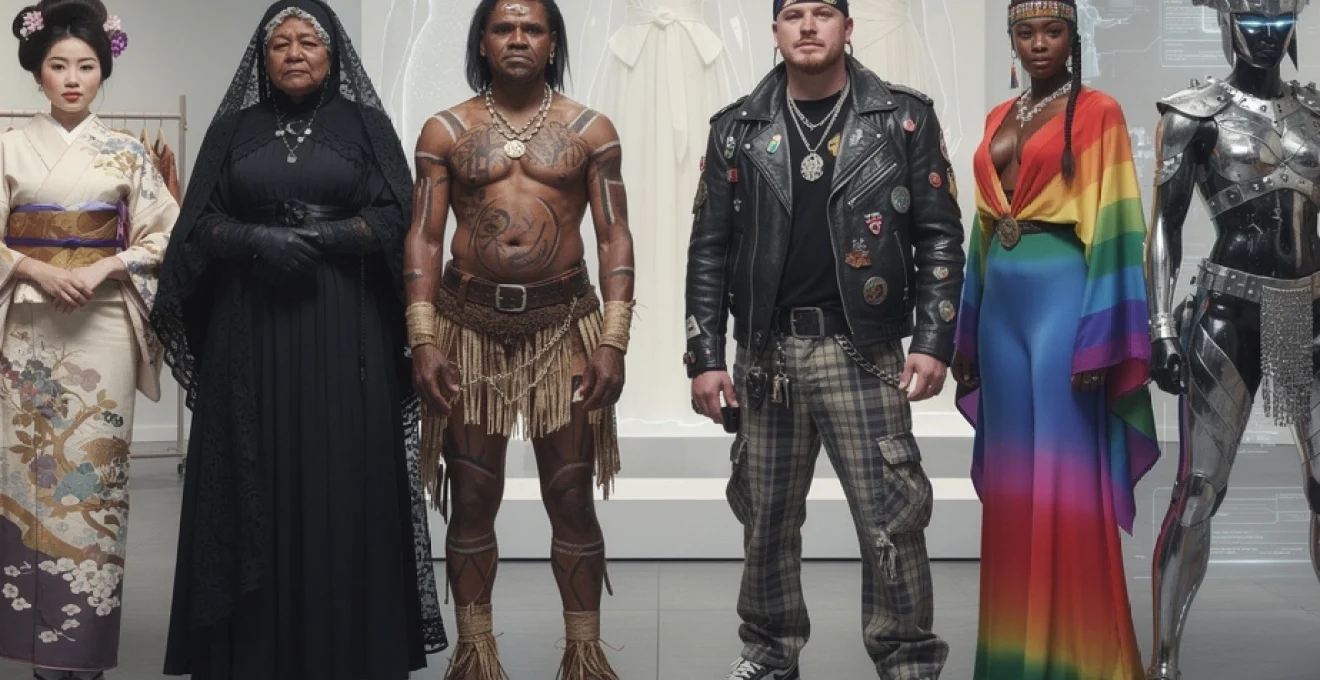
Fashion transcends the basic necessity of clothing, emerging as one of humanity’s most profound forms of cultural communication. Throughout history, garments have served as visual narratives that articulate collective values, individual beliefs, and societal transformations. From ancient civilisations to contemporary global movements, fashion remains an intricate tapestry woven with threads of tradition, rebellion, spirituality, and identity. The choices we make about what to wear reflect not merely personal preferences but deeper connections to cultural heritage, social movements, and aspirational identities that shape who we are and how we wish to be perceived by the world.
Historical evolution of sartorial signifiers across global civilisations
The relationship between fashion and cultural identity spans millennia, with clothing serving as a sophisticated language of social communication long before the written word became widespread. Archaeological evidence reveals that even prehistoric societies used body adornment and textile production to distinguish between tribes, social roles, and spiritual beliefs. This sartorial vocabulary developed independently across different continents, yet remarkably similar patterns emerged in how cultures used fashion to express identity, status, and belonging.
Ancient egyptian hieratic dress codes and social stratification
Ancient Egyptian society exemplified the power of fashion as cultural expression through its rigidly codified dress system. Linen garments weren’t merely practical choices for desert climates; they represented purity, divine connection, and social hierarchy. The quality, weave, and whiteness of linen directly correlated with one’s position in society, whilst specific accessories like golden collars and ceremonial headdresses communicated religious authority and royal lineage. Priests wore pristine white linen to symbolise spiritual cleanliness, whilst pharaohs adorned themselves with elaborate crowns that literally elevated them above their subjects.
The intricate pleating techniques and sophisticated dyeing processes demonstrated technological mastery and cultural sophistication. Tomb paintings reveal how fashion choices extended into the afterlife, with burial garments carefully selected to ensure proper spiritual transition. This integration of practical, social, and spiritual functions within clothing established fashion as a multidimensional cultural medium that influenced civilisations for thousands of years.
Traditional japanese kimono patterns as regional identity markers
Japanese kimono culture represents perhaps the most refined example of fashion as cultural storytelling. Each element—from seasonal colours to symbolic motifs—communicates specific cultural knowledge and regional identity. Cherry blossoms indicate spring celebrations, whilst crane patterns symbolise longevity and good fortune. Regional variations in weaving techniques, such as Kyoto’s elaborate brocades or Okinawa’s distinctive kasuri patterns, allowed immediate identification of the wearer’s geographical origins and cultural affiliations.
The seasonal appropriateness of kimono patterns reflects Japan’s deep connection to natural cycles, with strict protocols governing when certain designs could be worn. This temporal dimension of fashion demonstrates how clothing can embody cultural values of harmony, respect for nature, and social awareness. The declining daily use of kimono in modern Japan highlights the tension between preserving cultural identity and adapting to contemporary lifestyles.
Victorian era mourning attire and ritualistic fashion protocols
Victorian mourning dress established fashion as a vehicle for processing grief and maintaining social cohesion during personal crises. The elaborate system of mourning periods—full mourning, half mourning, and gradual return to colour—created a visual timeline of emotional healing whilst ensuring community support for the bereaved. Black bombazine, jet jewellery, and specific silhouettes communicated the wearer’s emotional state without requiring verbal explanation, allowing society to respond appropriately.
This systematic approach to grief fashion demonstrates how clothing can facilitate social support networks and emotional processing. The economic impact was substantial, creating entire industries devoted to mourning attire, from specialised dressmakers to jet mining operations. The gradual abandonment of formal mourning dress in the 20th century reflects changing attitudes towards death, privacy, and emotional expression in modern society.
Indigenous australian ceremonial body painting and textile traditions
Aboriginal Australian cultures developed sophisticated systems of body painting and ceremonial dress that encoded complex cultural knowledge spanning tens of thousands of years. Sacred designs painted on bodies during ceremonies represent
Aboriginal Australian cultures developed sophisticated systems of body painting and ceremonial dress that encoded complex cultural knowledge spanning tens of thousands of years. Sacred designs painted on bodies during ceremonies represent songlines, ancestral beings, and connections to specific Country, functioning as living maps of spiritual and geographic identity. Natural pigments such as ochre, charcoal, and clay are not merely aesthetic choices; they are drawn from the land itself, reinforcing the inseparable bond between people, place, and appearance. In some communities, woven belts, feathered adornments, and cloaks made from animal skins identify kinship groups, ceremonial roles, and stages of life. When viewed through the lens of fashion and cultural identity, these practices reveal how adornment can operate as a complex archive of law, memory, and belonging.
Contemporary Indigenous Australian designers are now reinterpreting these visual languages on textiles, streetwear, and high-fashion garments, bringing ancestral motifs into global fashion conversations. This translation from body to cloth to runway raises crucial questions: how can sacred designs be shared respectfully, and who has the authority to reproduce them? Many First Nations artists respond by maintaining strict protocols, ensuring that certain patterns remain restricted to ceremonial use while others are adapted for broader audiences. Their work demonstrates that fashion can be both a shield that protects cultural knowledge and a bridge that invites cross-cultural understanding. In this way, Indigenous fashion becomes a powerful tool for cultural survival and sovereignty in a rapidly globalising world.
Contemporary fashion movements as cultural resistance mechanisms
As we move into the late 20th and 21st centuries, fashion’s role in cultural identity expression increasingly takes the form of resistance. Clothing becomes armour against marginalisation, a banner of protest, and a stage for declaring alternative values to the mainstream. From ripped denim and safety pins to rainbow flags and futuristic silhouettes, contemporary fashion movements reveal how style can confront power structures and rewrite dominant narratives. These sartorial choices do more than follow trends; they embody lived experiences of oppression, resilience, and community building. Understanding these movements helps us see fashion not as trivial consumption, but as a serious medium of cultural politics.
Punk subculture aesthetics and anti-establishment symbolism
Emerging in the mid-1970s in the UK and US, punk fashion evolved as a visual manifesto of anger, disillusionment, and anti-establishment critique. Torn T-shirts, DIY patches, safety pins, and aggressively spiked hairstyles rejected conventional notions of beauty and respectability. Designer Vivienne Westwood and Malcolm McLaren played a pivotal role in codifying punk aesthetics, transforming bondage trousers, slogan T-shirts, and distressed leather into a visual vocabulary of resistance. These garments acted like wearable protest posters, attacking consumerism, class inequality, and political hypocrisy.
The DIY ethic at the heart of punk fashion is crucial for understanding its cultural identity function. By customising thrifted items with marker pens, studs, or razor blades, punks reclaimed creative control from corporate fashion systems. This approach sent a clear message: you did not need money or status to cultivate a powerful identity. Even today, elements of punk—ripped denim, band patches, combat boots—are recycled in streetwear and high fashion, though often stripped of their original radical intent. The ongoing challenge is whether contemporary wearers can re-infuse these aesthetics with genuine critique, or whether they become just another commodified look.
Hip-hop street style evolution from bronx origins to global phenomenon
Hip-hop street style began in the 1970s Bronx as an expression of creativity amid economic hardship, police surveillance, and urban neglect. Oversized silhouettes, sportswear, sneakers, and gold chains signalled not only affiliation with a music culture but also aspirations for visibility and success in a world that devalued Black and Latino youth. Brands such as Adidas, Kangol, and later Nike, FUBU, and Sean John became intertwined with hip-hop identity, transforming everyday clothing into cultural symbols of pride and hustle. Baggy jeans, tracksuits, and logo-heavy jackets announced presence in public space, reclaiming streets as stages.
Over the decades, hip-hop fashion has travelled from housing projects to haute couture, now shaping global youth culture from Seoul to São Paulo. Luxury houses collaborate with rap artists, and sneaker drops sell out within minutes, proving the economic power of this once-marginalised style. Yet this success raises complex questions: who profits from hip-hop aesthetics, and whose stories are being erased in the process? For many communities, maintaining elements of authentic street style—such as local brands, custom jewellery, or neighbourhood-specific trends—acts as a safeguard against cultural dilution. In this sense, hip-hop fashion remains a dynamic negotiation between commercial visibility and cultural ownership.
LGBTQ+ pride fashion iconography and visibility politics
LGBTQ+ communities have long used fashion to navigate visibility, safety, and self-affirmation in often-hostile environments. Before decriminalisation in many countries, subtle signifiers—like a particular colour of handkerchief, a coded accessory, or androgynous tailoring—functioned as quiet signals of identity. With the rise of Pride marches and queer nightlife, bolder expressions emerged: sequins, leather, drag performance costumes, and rainbow motifs transformed public space into a celebration of difference. The rainbow flag, first designed by Gilbert Baker in 1978, has since become one of the most recognisable examples of fashion iconography tied to a social movement.
Today, Pride fashion ranges from minimalist pins to elaborate, gender-fluid ensembles that challenge binary categories altogether. Inclusive sizing, gender-neutral collections, and trans-led brands are reshaping what it means to dress “according to your identity.” Yet corporate rainbow-washing—where companies release Pride collections without supporting LGBTQ+ rights—highlights the tension between visibility and commodification. When you buy or wear Pride-themed clothing, it is worth asking: does this garment merely signal inclusion, or is it connected to real advocacy and safer spaces for queer communities? Fashion here becomes a site where politics, profit, and personal safety intersect in very tangible ways.
Afrofuturism design philosophy in contemporary black fashion
Afrofuturism, as a cultural and artistic movement, blends African diasporic heritage with speculative futures, science fiction, and technology. In fashion, this philosophy appears through metallic fabrics, sculptural silhouettes, and hairstyles that merge traditional African aesthetics with cyberpunk or space-age influences. Designers like Grace Wales Bonner, Pyer Moss, and Nigerian creatives in Lagos Fashion Week explore themes of time travel, ancestral memory, and liberation through their collections. Their garments ask: what would Black futures look like if colonialism and racism did not define the narrative?
Visually, Afrofuturist fashion often juxtaposes kente patterns or cowrie shell motifs with 3D-printed accessories, holographic textiles, or armour-like constructions. This creates a powerful analogy: just as a DJ samples past tracks to invent new sounds, Afrofuturist designers remix historical references to generate radical new identities. Beyond aesthetics, Afrofuturism also promotes alternative production models that centre Black artisans, local economies, and community storytelling. By wearing Afrofuturist designs, individuals consciously participate in a reimagining of Blackness that is expansive, technologically empowered, and unconstrained by historical oppression.
Regional traditional dress codes and national identity preservation
Across the globe, regional traditional dress continues to act as a potent symbol of national and cultural identity, especially in an era of globalised fast fashion. From the Scottish kilt and the Vietnamese áo dài to the Nigerian gele and the Mexican huipil, these garments compress centuries of local history, craftsmanship, and collective memory into a single outfit. They are often worn during festivals, weddings, and state ceremonies, where clothing becomes a visual declaration of heritage. For diasporic communities, traditional dress is particularly crucial, helping second- or third-generation migrants maintain emotional ties to ancestral homelands.
Many governments and cultural organisations now actively support initiatives to keep traditional dress codes alive, recognising them as intangible cultural heritage. National costume days, folk festivals, and school programmes encourage younger generations to appreciate garments that might otherwise be seen as outdated or impractical. At the same time, contemporary designers rework these silhouettes—shortening hemlines, experimenting with fabrics, or blending them with streetwear—to make them relevant for daily wear. This process is delicate: done respectfully, it preserves and evolves national identity; done carelessly, it can dilute meaning or oversimplify complex traditions into tourist-friendly clichés. The key lies in community involvement and consent in how these symbols are adapted and displayed.
Fashion industry’s appropriation dynamics and cultural commodification
As fashion brands search for fresh inspiration, they often turn to culturally rich traditions, sometimes crossing the line from appreciation into appropriation. Cultural appropriation in fashion occurs when elements of a marginalised culture are borrowed without understanding, credit, or benefit to the originating community. This can reduce meaningful symbols to mere decoration, stripping them of context and turning identity into a commodity. In an industry projected to exceed two trillion dollars in global value, the stakes of who profits from cultural creativity are extraordinarily high. Understanding these dynamics helps you make more ethical choices as both a consumer and a creator.
Luxury maisons’ borrowing from indigenous textile techniques
High-end luxury houses routinely draw from indigenous weaving, dyeing, and embroidery traditions to infuse their collections with a sense of authenticity and craftsmanship. Runway shows have featured motifs resembling Mexican huipiles, Andean ponchos, Indian block prints, and Maasai beadwork, often without any acknowledgment of the artisans who developed these techniques over generations. In some documented cases, communities have recognised their sacred or clan-specific patterns reproduced on luxury scarves or handbags with no prior consultation. When a motif that once marked kinship or spiritual status appears in a shop window with a four-figure price tag, the cultural power dynamic becomes impossible to ignore.
However, there is a growing movement towards more ethical collaboration models. Some maisons now establish long-term partnerships with artisan cooperatives, share intellectual property rights, or invest in training and infrastructure in source communities. These efforts begin to transform one-way extraction into reciprocal exchange. For consumers, asking simple questions—who made this, who owns this design, and who benefits from its sale—can act like a compass in navigating the line between respectful homage and exploitative appropriation. In the best scenarios, luxury fashion can elevate indigenous textile traditions while helping to safeguard them for future generations.
Fast fashion retailers and traditional pattern replication ethics
Fast fashion, with its rapid design-to-shelf cycles, is particularly prone to copying traditional patterns and motifs without attribution. Social media has made it easier for communities to call out instances where mass-market brands replicate Indigenous American beadwork, West African wax print designs, or Eastern European folk embroidery. These replications are often produced at low cost in factories far removed from the original culture, undermining local artisans who rely on their unique designs for livelihood. When a pattern that took centuries to refine is sold as a disposable T-shirt print, cultural identity becomes entangled with the logic of throwaway consumption.
Ethically, the core issue is not inspiration but extraction. Fast fashion brands can choose to license patterns, commission original work, or support local designers rather than simply lifting images found online. As a consumer, you can support brands that disclose their design sources and demonstrate fair compensation practices. Think of it like citing your sources in an academic paper: acknowledgement and credit are non-negotiable if we want a fashion system that respects cultural authorship. By rewarding transparent brands with your purchases, you help shift industry norms towards more responsible engagement with traditional aesthetics.
Sacred garment commercialisation in global fashion markets
Particularly controversial is the commercialisation of garments and accessories that hold explicit religious or sacred significance. Items such as Native American warbonnets, Sikh turbans, Buddhist prayer beads, or Muslim prayer garments have appeared in runway collections and music videos as exotic props. For communities that regard these items as symbols of spiritual commitment or ritual responsibility, seeing them worn casually at festivals or in advertising can feel like a profound violation. The issue is not simply about offence; it is about the erosion of boundaries that protect sacred practices from market forces.
Responsible fashion work in this area requires more than aesthetic curiosity—it demands deep consultation with cultural and religious authorities. Some items may be deemed unsuitable for commercial adaptation altogether, while others might be reinterpreted through community-led initiatives that control production and distribution. As you navigate global fashion trends, a simple reflective question can be helpful: Is this symbol part of someone else’s sacred practice? If the answer is yes, approaching it with caution, research, and respect is essential. This mindset supports a fashion ecosystem where cultural identity is honoured rather than mined for novelty.
Digital age fashion communication and virtual identity construction
The rise of social media, digital fashion, and virtual environments has radically transformed how we construct and communicate fashion-based identities. Platforms like Instagram, TikTok, and Pinterest function as global catwalks where individuals curate personal “feeds” that broadcast their style to potentially millions. In this context, outfits become content, and cultural identity expression is shaped by algorithms as much as by physical communities. We now encounter traditional dress, subcultural aesthetics, and high fashion trends on the same scrolling screen, creating an unprecedented mash-up of visual references. This can foster cross-cultural appreciation but also accelerates the cycle of trend adoption and abandonment.
Virtual fashion—digitally rendered garments worn by avatars or edited onto photos—is expanding the possibilities of self-presentation even further. In gaming worlds and metaverse platforms, users experiment with skins, costumes, and accessories that may draw inspiration from cultural motifs without any material production. On one hand, this reduces the environmental impact of physical clothing and allows for playful, low-risk exploration of identity. On the other, it raises new ethical questions: does borrowing cultural symbols in virtual spaces carry the same responsibilities as in the physical world? As you design or select digital outfits, the same principles of respect, context, and consent still apply.
Influencers and digital-native brands also play a powerful role in shaping how cultural identity is perceived and monetised online. Viral challenges featuring traditional outfits, hashtag campaigns celebrating heritage, and educational style breakdowns can all help revive interest in ancestral garments. At the same time, digital filters and editing tools may homogenise features or reinforce narrow beauty standards, subtly erasing the very diversity that fashion purports to celebrate. Navigating this landscape requires media literacy: being aware of how platforms amplify certain looks, questioning whose identities are visible, and intentionally following creators from varied cultural backgrounds. In the digital age, your “closet” is as much on the cloud as in your wardrobe, and both spaces influence how cultural identity is expressed and understood.
Sustainable fashion practices as environmental and cultural stewardship
The conversation around sustainable fashion is often framed in terms of carbon footprints and waste reduction, but it is equally about cultural identity preservation. Many traditional fashion systems—handloom weaving, natural dyeing, repair and reuse practices—are inherently sustainable, having evolved in close relationship with local ecosystems. When these systems are displaced by mass-produced garments and synthetic fibres, we do not only lose environmental balance; we also lose languages, rituals, and technical knowledge embedded in craft. Embracing sustainable fashion can therefore be seen as an act of both environmental and cultural stewardship, protecting the conditions that allow diverse identities to flourish.
Practically, this can take many forms: supporting slow fashion labels that work directly with artisans, choosing garments made from regionally appropriate materials, or participating in clothing repair and upcycling communities. Think of each well-made, long-lasting garment as a story you choose to carry over years rather than seasons. This mindset contrasts sharply with the logic of fast fashion, where identity is constantly remade through cheap, short-lived purchases. When you buy less but better, you give yourself space to develop a more coherent sartorial identity rooted in your values, heritage, and lifestyle.
Designers are increasingly integrating circular design principles—such as modular construction, mono-material garments for easier recycling, and zero-waste pattern cutting—into collections that still honour cultural aesthetics. For example, a jacket might be cut using traditional pattern geometry from a specific culture while being constructed in a way that allows it to be easily repaired or disassembled. This kind of innovation operates like a bridge between ancestral wisdom and future needs. By choosing sustainable options where possible, you participate in a broader shift towards a fashion system that respects both the planet and the people—and cultures—who inhabit it.