
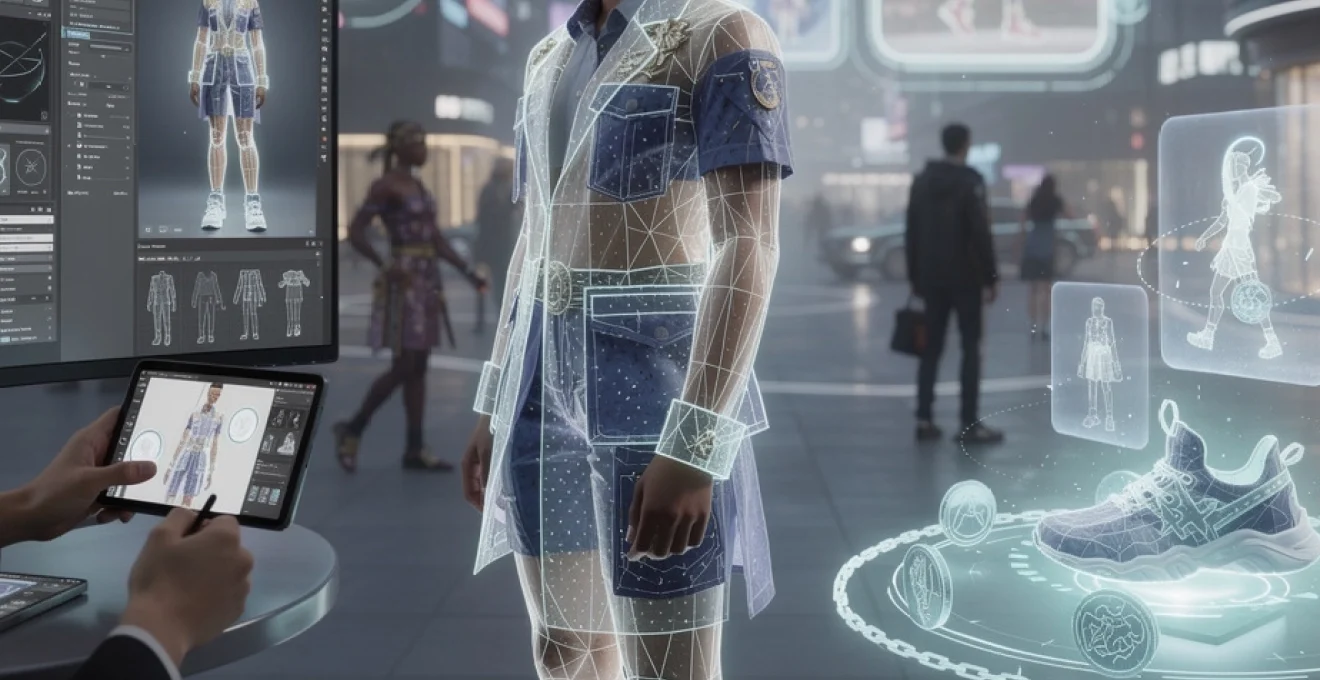
Digital fashion represents one of the most revolutionary shifts in the apparel industry since the invention of the sewing machine. Virtual garments, augmented reality accessories, and blockchain-authenticated digital wardrobes are transforming how designers create, how brands market, and how consumers experience fashion. The global digital fashion market, valued at approximately $2.4 billion in 2023, is projected to reach an astonishing $15 billion by 2030, representing a compound annual growth rate of over 30%.
This technological revolution addresses critical challenges facing the fashion industry, from sustainability concerns to personalisation demands. Virtual clothing eliminates material waste, reduces carbon footprints, and enables infinite creative possibilities unconstrained by physical limitations. As consumers increasingly live digital lives across social media platforms, gaming environments, and virtual worlds, the demand for digital fashion continues to accelerate exponentially.
3D fashion design software and digital creation platforms
The foundation of virtual fashion lies in sophisticated 3D design software that enables designers to create photorealistic digital garments with unprecedented precision. These platforms have evolved from basic modelling tools into comprehensive fashion development ecosystems that rival traditional design processes. Modern 3D fashion software incorporates advanced physics engines, realistic fabric simulation, and intuitive user interfaces that democratise digital fashion creation.
Contemporary fashion houses increasingly rely on digital prototyping to reduce development costs and accelerate time-to-market. Virtual sampling eliminates the need for multiple physical prototypes, with some brands reporting cost reductions of up to 60% in their design processes. The integration of artificial intelligence and machine learning algorithms further enhances these platforms, enabling predictive sizing, automated pattern generation, and intelligent fabric behaviour simulation.
CLO 3D and marvelous designer integration for virtual garment construction
CLO 3D stands as the industry standard for professional fashion design software, powering virtual garment creation for over 300 global fashion brands. The platform’s advanced fabric simulation engine accurately replicates material properties, draping behaviour, and fit characteristics with remarkable precision. Fashion designers can experiment with unlimited design variations without consuming physical resources, testing different silhouettes, colours, and fabric combinations in real-time.
Marvelous Designer complements CLO 3D by offering specialised tools for complex garment construction and animation. The software excels in creating intricate details like pleats, ruffles, and layered textures that would be challenging or costly to prototype physically. Integration between these platforms allows seamless workflow transitions, enabling designers to begin concepts in one application and refine them in another while maintaining design integrity throughout the process.
Browzwear VStitcher pro workflow for technical fashion development
Browzwear VStitcher Pro focuses on technical accuracy and production-ready specifications, bridging the gap between creative design and manufacturing requirements. The platform’s strength lies in its precise pattern-making capabilities and technical specification generation, essential for brands requiring exact measurements and construction details. VStitcher Pro generates comprehensive technical packages that manufacturers can interpret directly, reducing miscommunication and production errors.
The software’s collaboration features enable real-time feedback between designers, pattern makers, and production teams across different geographical locations. This collaborative approach has become particularly valuable as fashion supply chains become increasingly globalised. Teams can review, modify, and approve designs simultaneously, significantly reducing development timelines while maintaining quality standards.
Optitex 3D suite Pattern-to-Avatar rendering capabilities
Optitex 3D Suite specialises in transforming 2D patterns into realistic 3D renderings with exceptional accuracy. The platform’s unique strength lies in its pattern-based approach, allowing designers who prefer traditional pattern-making methods to seamlessly transition into digital workflows. The software automatically converts flat patterns into three-dimensional garments, maintaining precise measurements and construction details throughout the transformation process.
The avatar rendering capabilities within Optitex enable designers to visualise garments on diverse body types and poses, crucial for inclusive design practices. The platform supports custom avatar creation, allowing brands to represent their target demographics accurately. This functionality proves invaluable for sizing accuracy and fit validation across different body shapes and proportions.
Blender fashion add-ons for independent digital clothing artists
Blender’s open-source nature and
tool ecosystem make it a powerful hub for independent digital clothing artists and small studios. With dedicated fashion add-ons and physics engines, creators can build, simulate, and render complex virtual garments without investing in expensive proprietary software. This lowers the barrier to entry for emerging designers who want to experiment with digital clothing, gaming skins, or metaverse-ready outfits.
Popular Blender fashion add-ons enable pattern import, garment sewing, and cloth simulation comparable to specialised 3D fashion software. Artists can leverage Blender’s node-based materials to create hyper-realistic fabrics, from translucent organza to heavy denim, and then export assets to game engines or AR platforms. For many freelancers, this open-source workflow becomes a sandbox where they can test digital-only collections, build portfolios, and sell virtual garments on marketplaces without worrying about physical production at all.
Blockchain authentication and NFT integration in virtual fashion
As virtual garments gained value, the question of how to prove authenticity and ownership in digital fashion became impossible to ignore. Blockchain technology and NFTs (non-fungible tokens) now underpin a new layer of trust, enabling verified ownership of digital clothing in much the same way that serial numbers and certificates protect luxury handbags. For brands and creators, this means digital collections can be scarce, traceable, and tradable across platforms.
In this emerging ecosystem, each virtual dress, sneaker, or accessory can be minted as a unique token on a blockchain network. That token acts like a deed of ownership, recording who created the item, who bought it, and every subsequent resale. For consumers, this unlocks a secondary market for digital fashion; for brands, it opens new revenue streams and a powerful tool against counterfeiting in virtual worlds.
Ethereum-based wearable NFTs on the fabricant platform
The Fabricant is one of the pioneers of high-end digital couture, using the Ethereum blockchain to mint wearable NFTs that exist only in the virtual realm. Each piece on The Fabricant platform is issued as a limited-edition token, with the smart contract recording provenance and edition size. This structure mirrors the scarcity model of physical luxury fashion, where rarity and storytelling drive desirability and price.
When a collector purchases an Ethereum-based wearable NFT from The Fabricant, they are not just buying a 3D file; they are acquiring verifiable digital ownership. The garment can then be used in supported metaverse environments, worn on avatars, or composited onto photos for social media. Because Ethereum is widely adopted, these digital clothing NFTs can also be traded on major NFT marketplaces, giving fashion collectors liquidity similar to art or rare sneakers in the physical world.
Polygon network integration for RTFKT studios digital sneaker authentication
RTFKT Studios, now part of Nike, has become synonymous with digital sneakers and virtual streetwear, and it relies heavily on blockchain to authenticate its creations. To address concerns about transaction costs and environmental impact on Ethereum, RTFKT has increasingly used the Polygon network, a Layer 2 scaling solution that offers faster and cheaper transactions. This makes large-scale distribution of authenticated digital sneakers far more practical.
By minting limited-edition kicks on Polygon, RTFKT can drop thousands of digital sneakers tied to special events, collaborations, or gaming integrations without incurring prohibitive gas fees. Owners receive a cryptographic proof of authenticity and can trade or display their assets across Polygon-compatible platforms. This approach demonstrates how digital fashion brands can balance security, scalability, and sustainability while still delivering exclusive, blockchain-authenticated footwear to their communities.
Smart contract implementation for DressX virtual wardrobe ownership
DressX, a leading digital fashion marketplace, uses smart contracts to manage virtual wardrobe ownership and licensing rights. When you buy a DressX item as a digital asset, the underlying smart contract defines what you can do with that piece of virtual clothing—whether it can be resold, how it can be used across platforms, and what royalties flow back to the original designer. This programmable logic turns digital garments into dynamic assets rather than static files.
For designers, smart contracts ensure they continue to benefit financially when their creations change hands on the secondary market, with automated royalty splits executed on-chain. For consumers, this provides transparency: you know exactly what level of access or usage you are purchasing, whether that is a one-time AR “dressing” for a photo or a fully portable asset for metaverse avatars. As a result, the virtual wardrobe becomes an investable, clearly owned collection instead of a folder of unverified 3D files.
Solana blockchain gaming wearables through genies avatar ecosystem
In the Genies avatar ecosystem, gaming wearables and digital fashion items are issued on the Solana blockchain, which is designed for high throughput and low transaction costs. This makes it ideal for avatar-based platforms where users may acquire many small-ticket items, such as hats, jackets, or jewellery, to personalise their digital identity. Each wearable is represented by a token, giving users a verifiable sense of ownership over their avatar’s style.
Because Genies leverages Solana, it can support near-instant trades and large-scale drops of digital clothing without congestion. This is essential for mainstream adoption, where users expect a seamless, game-like experience rather than slow blockchain interactions. For fashion brands partnering with Genies, Solana’s infrastructure allows them to distribute large volumes of authenticated virtual accessories and track how those items move within the community, providing valuable insights into digital fashion trends and usage patterns.
Augmented reality try-on technology and computer vision
While blockchain solves the “who owns what” question, augmented reality (AR) and computer vision tackle another challenge in virtual fashion: how do we see these digital garments on ourselves in real time? AR try-on technology overlays virtual clothing and accessories onto live images or video feeds, allowing you to “wear” a dress, sunglasses, or sneakers without stepping into a fitting room. For many consumers, this is their first direct encounter with digital fashion.
Advances in smartphone hardware and computer vision algorithms now make it possible to achieve surprisingly accurate garment placement and body tracking. Retailers report that AR-powered virtual fitting rooms can increase engagement and reduce return rates, as shoppers get a clearer sense of style and proportion before buying. For brands, AR try-on becomes both a marketing tool and a data source, revealing which looks capture attention and drive conversions.
Arkit and ARCore SDK implementation for virtual fashion fitting
Apple’s ARKit and Google’s ARCore are the two dominant software development kits powering many fashion try-on experiences on iOS and Android devices. By using device cameras, motion sensors, and depth mapping, these SDKs can understand the physical environment and track body movement in real time. Developers then layer 3D garments or accessories on top of this data, synchronising the digital fashion with the user’s posture and gestures.
For fashion brands, integrating ARKit- or ARCore-based virtual fitting into their mobile apps or e-commerce sites can transform the shopping journey. Customers can point their phone at a mirror, see how a jacket drapes on their shoulders, or view a handbag from different angles as they move. Although the fit is not yet as exact as a physical fitting, ongoing improvements in depth sensing and body tracking mean AR try-ons are becoming more realistic with each hardware generation.
Mediapipe body pose estimation for accurate garment placement
MediaPipe, Google’s open-source framework for building perception pipelines, plays a crucial role in many virtual fashion experiments by providing robust body pose estimation. It detects key points on the human body—such as shoulders, hips, elbows, and knees—and tracks them as the user moves. Virtual garments can then be anchored to these points, ensuring that clothes follow the body naturally instead of sliding or distorting awkwardly.
This level of precision is vital for convincing AR fashion fittings, especially for items like dresses, coats, or tailored suits that need to respond to bending and twisting. Developers can combine MediaPipe with fabric simulation engines to mimic how materials might stretch or fold. For brands testing digital fashion for marketing or e-commerce, this technology makes the experience feel less like a gimmick and more like a genuinely useful tool for evaluating style and movement.
Snapchat lens studio integration with gucci virtual sneaker campaigns
Snapchat’s Lens Studio has become a popular platform for experimental digital fashion campaigns, with Gucci’s virtual sneaker launches being a standout example. By creating AR lenses that place Gucci sneakers directly on users’ feet in the camera view, the brand allowed fans to “try on” exclusive designs instantly. These virtual-only sneakers, available at a fraction of the physical price, demonstrated how digital fashion can create new entry points into luxury brands.
The campaign also highlighted how AR can turn social media into a virtual fitting room and marketing channel in one. Users shared videos and snaps of themselves wearing the Gucci virtual sneakers, effectively modelling the product to their networks. For marketers, this kind of Lens Studio integration shows how digital clothing can travel virally, driving brand awareness and capturing data on which designs resonate with younger, mobile-native audiences.
Instagram spark AR effects for luxury brand virtual accessories
Instagram’s Spark AR platform has enabled luxury brands to release virtual accessories as camera effects, from logo-emblazoned sunglasses to statement headpieces. Users activate these filters in Stories or Reels, instantly styling themselves with items that may be unattainable—or not yet produced—in the physical world. It is a powerful way to test new design concepts while tapping into the social currency of shareable content.
For brands, Spark AR effects serve as both a “digital sample” and a branding tool. They can monitor how often a virtual accessory is used, how long people engage with it, and how many share it with friends. This feedback loop can inform which concepts move into full digital collections or even physical production. In this sense, Instagram becomes more than a marketing channel; it acts as a real-time focus group for virtual fashion ideas.
Gaming integration and virtual world fashion economies
Gaming platforms and virtual worlds have become some of the most vibrant marketplaces for digital fashion, particularly among Gen Z and younger millennials. In environments like Roblox, Fortnite, and Decentraland, users spend billions of dollars annually on skins, outfits, and accessories for their avatars. These digital clothing items function as social signals, much like streetwear does in the physical world, broadcasting taste, status, and community affiliation.
Brands are increasingly recognising that in-game fashion is not a side project but a core part of a new fashion economy. Collaborations between luxury labels and game developers—such as Balenciaga’s partnership with Fortnite or Gucci experiences in Roblox—demonstrate how virtual fashion can reach millions of players where they already spend time. As interoperability improves, we are likely to see garments that travel with users across multiple virtual spaces, reinforcing the value of a well-curated digital wardrobe.
Sustainability metrics and carbon footprint reduction through digital fashion
Beyond creativity and commerce, one of the strongest arguments for virtual fashion is its potential to reduce the environmental impact of the apparel industry. Traditional garment production requires water, energy, chemicals, and long-distance shipping, contributing significantly to global emissions and waste. By contrast, a digital garment exists as data; its “production” involves computing resources rather than fabric and dye.
Early studies from digital fashion houses suggest that a virtual garment can generate up to 95–97% less CO₂ emissions than its physical equivalent and produces no textile waste. While server energy use and blockchain transactions are not impact-free, the overall footprint is dramatically lower, especially when you consider garments bought for single-use content, such as photos or events. Replacing even a small portion of fast-fashion consumption with digital clothing for social media could therefore have a measurable effect on fashion’s total carbon output.
Brands adopting digital fashion are also using 3D sampling and virtual prototyping to cut down on physical samples that often end up discarded. Some report reductions of 30–60% in sample production after switching to virtual workflows, which translates into fewer shipments, less fabric waste, and lower energy consumption. As sustainability reporting becomes more rigorous, we can expect fashion companies to track and publish metrics comparing the carbon intensity of digital versus physical collections, helping both industry and consumers make more informed choices.
Machine learning algorithms for personalised virtual styling recommendations
To make digital fashion feel truly personal, many platforms now rely on machine learning algorithms for styling and product recommendations. These systems analyse user behaviour—such as previous purchases, saved looks, and time spent viewing particular garments—alongside demographic or contextual data to propose outfits that match an individual’s taste. Think of it as having a digital stylist who learns your preferences over time.
In virtual fashion environments, machine learning can also factor in your avatar’s body type, preferred aesthetics, and even the virtual worlds you frequent. For example, if you spend most of your time in a cyberpunk-themed metaverse, the system may prioritise recommending neon jackets, metallic boots, and augmented accessories. As these models improve, they will not only suggest individual items but also generate complete, cohesive looks tailored to both your digital identity and real-world wardrobe, blurring the line between styling advice and creative collaboration.
Of course, this level of personalisation raises questions about data privacy and algorithmic bias. Fashion platforms must be transparent about how they use behavioural data and give users control over their profiles. At the same time, when implemented responsibly, machine learning can help you navigate the overwhelming abundance of digital clothing, surfacing the pieces that genuinely fit your style and values rather than pushing generic trends. In a world where our wardrobes span both pixels and textiles, that intelligent curation will become increasingly essential.