
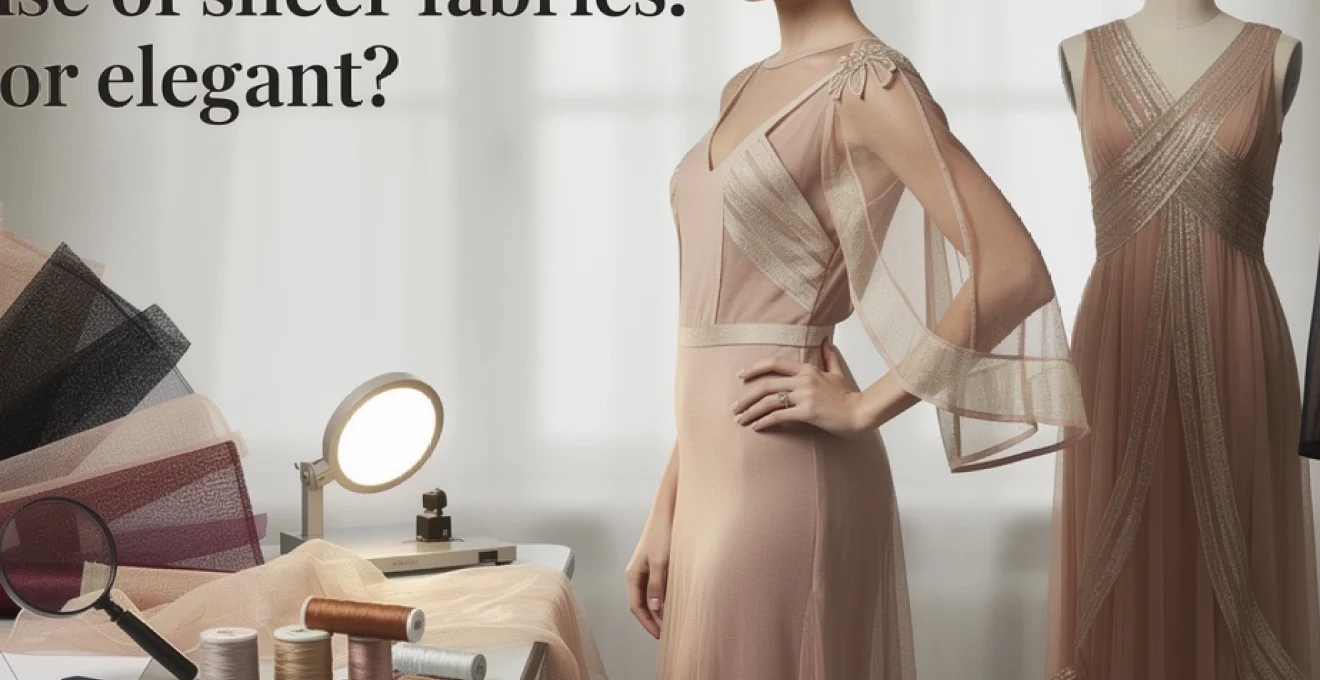
The fashion world has witnessed a remarkable transformation in recent years, with sheer fabrics emerging from the shadows of evening wear to claim their rightful place in everyday wardrobes. This textile revolution represents far more than a fleeting trend; it embodies a fundamental shift in how transparency, texture, and vulnerability are perceived in contemporary fashion. From the ethereal chiffons gracing red carpets to the structured organzas defining modern minimalism, sheer fabrics have redefined the boundaries between exposure and sophistication.
The resurgence of transparent materials reflects broader cultural movements towards authenticity, body positivity, and the celebration of craftsmanship. What was once considered provocative has evolved into an art form that demands technical precision, creative vision, and an understanding of how light interacts with fabric. This evolution challenges traditional notions of modesty whilst celebrating the human form through the lens of textile artistry.
Historical evolution of sheer textile construction techniques
The journey of sheer fabrics through history reveals a fascinating interplay between technological advancement and artistic expression. Understanding this evolution provides crucial context for appreciating how contemporary designers manipulate transparency to create both bold statements and elegant subtleties. The development of sheer textiles has been intrinsically linked to innovations in fibre production, weaving techniques, and finishing processes that have shaped the fashion landscape across centuries.
Medieval linen weaving methods and early transparency effects
During the medieval period, skilled artisans developed sophisticated linen weaving techniques that inadvertently created the first intentionally transparent fabrics. These early craftsmen discovered that by using extremely fine flax fibres and employing loose weave structures, they could produce fabrics that allowed light to filter through whilst maintaining structural integrity. The process required exceptional skill, as the delicate balance between transparency and durability demanded precise tension control during the weaving process.
Medieval linen weavers utilised a technique called plain weave variation, where alternating tight and loose sections created subtle transparency effects. This method became particularly popular in ecclesiastical garments, where the symbolic interplay of light and shadow held deep spiritual significance. The finest examples of medieval transparent linens were reserved for nobility and religious ceremonies, establishing an early association between sheer fabrics and luxury.
Industrial revolution impact on chiffon and georgette production
The Industrial Revolution fundamentally transformed sheer fabric production, introducing mechanised processes that made transparent textiles more accessible whilst maintaining their luxurious appeal. The invention of power looms specifically adapted for delicate fibres enabled mass production of chiffon and georgette, two fabrics that would become synonymous with elegant transparency. These innovations reduced production costs significantly whilst improving consistency in fabric quality.
Chiffon production during this period involved a revolutionary technique called high-twist yarn creation, where silk fibres were twisted at exceptionally high rates before weaving. This process created the characteristic crinkled texture that gives chiffon its distinctive drape and light-filtering properties. Georgette production followed similar principles but incorporated a different weaving pattern that resulted in a slightly more structured fabric with enhanced dimensional stability.
Synthetic fibre development: nylon and polyester sheers
The introduction of synthetic fibres in the mid-20th century revolutionised sheer fabric production by offering unprecedented durability combined with affordability. Nylon, first commercially produced in the 1930s, provided exceptional strength whilst maintaining the delicate appearance required for transparent applications. This breakthrough allowed designers to experiment with more daring cuts and constructions without compromising garment longevity.
Polyester development further expanded possibilities by introducing improved dye affinity and reduced shrinkage characteristics. Modern polyester sheer fabrics undergo specialised treatments including micro-denier processing, where fibres are drawn to extremely fine diameters whilst maintaining tensile strength. This technology enables the creation of fabrics that are simultaneously gossamer-light and remarkably durable, satisfying both aesthetic and practical requirements.
Contemporary Laser-Cut and digital textile manufacturing
Today’s sheer fabric production incorporates cutting-edge technologies that push the boundaries of what transparency can achieve. Laser-cutting techniques allow for precise perforation patterns that create controlled transparency effects, enabling designers to manipulate light
distribution, negative space, and edge definition with microscopic accuracy. Combined with digital textile printing, these techniques enable gradients of opacity, photographic motifs, and engineered panels that align perfectly with pattern pieces. Designers can now specify transparency almost like a graphic designer works with layers, controlling how sheer a garment appears at every square centimetre of cloth.
Digital knitting and jacquard weaving have also transformed how sheer fabrics are built from the yarn up. Programmable looms can alternate dense and open structures within a single piece of fabric, creating zones of reinforcement, ventilation, or modesty exactly where the body needs them. In performance-wear and luxury ready-to-wear alike, this marriage of data-driven design and textile craft has made sheer fabrics more comfortable, more durable, and more expressive than ever before.
Technical fabric properties and transparency classifications
Behind every ethereal sheer blouse or bold tulle skirt lies a series of precise technical decisions. Transparency is not a vague aesthetic quality; it can be measured, engineered, and consistently reproduced. Understanding the key properties that govern sheer fabric behaviour helps explain why some materials feel delicate yet strong, while others appear cloudy, crisp, or almost invisible. For designers and informed consumers, these parameters form the foundation of choosing the right sheer textile for a specific purpose.
Denier weight measurements and light transmission coefficients
One of the primary factors that determine how sheer a fabric appears is the denier of its yarns. Denier measures the linear mass of fibres: the lower the denier, the finer the yarn and the greater the potential for transparency. Ultra-sheer hosiery, for example, often uses 8–15 denier nylon, while more robust mesh or chiffon might sit around 20–40 denier. By manipulating yarn fineness, mills can fine-tune the balance between a gossamer look and everyday durability.
Beyond yarn weight, laboratories increasingly measure light transmission coefficients to categorise sheer fabrics. Using spectrophotometry, technicians quantify the percentage of visible light that passes through a textile sample. A fabric transmitting 70–80% of light will appear almost invisible in certain conditions, whereas one transmitting 40–50% offers a misted, veil-like effect. For brands positioning sheer fashion as either daring or discreet, these metrics provide a scientific way to standardise what “barely-there” really means across different product lines.
Weave density calculations for optimal drape characteristics
Transparency also depends heavily on ends per inch (EPI) and picks per inch (PPI)—the warp and weft thread counts that define weave density. Lower densities create more open structures and visible interstices, contributing to a higher see-through effect. However, if density falls too low, the fabric can become unstable, snag-prone, or prone to distortion. Mills therefore calculate weave density in relation to yarn denier to keep the fabric stable while preserving desired visibility.
Drape characteristics add another layer of complexity. A sheer georgette with a balanced but relatively loose weave will flow and pool around the body, softening contours and diffusing transparency like frosted glass. In contrast, a sheer organza with a tighter, stiffer construction holds architectural shapes, making its transparency appear sharper and more graphic. By tweaking density and weave type—plain, leno, satin, or openwork variations—textile engineers can design sheer fabrics that either cling like a second skin or stand away from the body like sculptural shells.
Fibre content analysis: natural vs synthetic transparency
Fibre chemistry plays a decisive role in how light interacts with sheer materials. Natural fibres such as silk and fine cotton have irregular cross-sections and microscopic surface scales that scatter light, creating a soft, luminous transparency. This is why silk chiffon and cotton voile often appear hazy and romantic, even when they are objectively quite see-through. Their breathability and moisture management also make them comfortable for warm-weather sheer looks.
Synthetic fibres like polyester and nylon, by contrast, are typically extruded with smoother, more uniform cross-sections. This can yield crisper, more glass-like transparency, especially when the yarns are round and the fabric is tightly heat-set. Modern filament technologies, including trilobal or hollow fibres, further refine how light is refracted or reflected within the yarn. Designers who want a “wet-look” or almost plastic sheen often gravitate towards synthetic sheers, while those aiming for understated elegance may favour natural or blended compositions that temper shine with softness.
Stretch recovery and dimensional stability testing methods
As sheer fabrics move from the runway to real-life wardrobes, mechanical performance becomes as important as visual effect. Stretch recovery—how well a fabric returns to its original dimensions after being pulled—is critical for body-hugging mesh tops, illusion panels, and sheer hosiery. Laboratories frequently use strip tensile tests and cyclic extension tests to measure elongation at break and recovery percentages after repeated stretching, ensuring that garments will not bag out at elbows, knees, or necklines.
Dimensional stability testing addresses another common concern: will a sheer blouse twist, shrink, or grow after washing? Standardised protocols such as ISO 5077 and AATCC 135 subject fabric samples to controlled laundering and drying cycles, measuring any change in length or width. Because even small distortions are highly visible in transparent garments, premium brands often specify stricter tolerances for sheer textiles than for opaque ones. For you as a wearer, this testing translates into mesh bodies that retain their shape and chiffon dresses that hang as beautifully on the tenth wear as they did on the first.
Haute couture applications across fashion decades
With the technical foundations in place, sheer fabrics have become powerful storytelling tools for haute couture and luxury fashion. Across the 20th and 21st centuries, visionary designers have used transparency to question norms, frame the body, and redefine what “elegant” or “bold” can mean. Each era offers a different answer to the central question of sheer fashion: is it about provocation, purity, or something in between?
Coco chanel’s revolutionary chiffon evening gown designs
In the early 20th century, Coco Chanel helped liberate women from the rigid structures of corsetry, and chiffon became one of her most potent allies. Her chiffon evening gowns favoured fluid silhouettes that skimmed rather than reshaped the body, using layers of semi-sheer silk to suggest form without overtly exposing it. Light and air became part of the garment, with each step revealing subtle shifts in opacity that felt radical compared to the heavy brocades and stiff satins of previous decades.
Chanel’s approach to sheer fabrics echoed her broader design philosophy: elegance should appear effortless. By layering multiple veils of chiffon in tonal shades, she created depth similar to watercolour washes, softening sharp lines and blurring the boundary between the dress and the wearer. What might have seemed daring in terms of transparency was tempered by impeccable cut and restraint, proving that sheer fashion could be both comfortable and sophisticated rather than purely ornamental or scandalous.
Valentino’s signature organza layering techniques
Where Chanel championed relaxed fluidity, Valentino became synonymous with romantic structure—often achieved through masterful use of organza. From the 1960s onwards, the house of Valentino refined a language of layered sheer fabrics that floated around the body yet held a precise silhouette. Organza, with its crisp hand and subtle sheen, allowed designers to build gowns like three-dimensional sketches in air, each layer adding volume without heaviness.
Signature Valentino looks frequently juxtapose opaque under-dresses with sheer organza overlays embellished with embroidery, appliqué, or lace inlays. This technique turns transparency into a framing device: skin, fabric, and negative space converse in carefully orchestrated proportions. The effect can be ethereal, as in blush-toned couture ballgowns, or intensely dramatic when executed in saturated reds or blacks. In both cases, sheer fabric is not an afterthought; it is the architectural skeleton that holds the entire design narrative together.
Tom ford’s contemporary sheer tailoring innovations
In the late 1990s and 2000s, Tom Ford injected a new kind of sensuality into fashion by applying sheer principles to tailoring. Instead of reserving transparency for gowns and lingerie, he experimented with gauzy shirts, mesh inserts, and see-through panels integrated into sharply cut jackets and dresses. This hybrid of precision tailoring and deliberate exposure challenged traditional ideas of power dressing. Could a sheer blouse under a tuxedo jacket be as authoritative as a crisp cotton shirt? Ford argued yes.
His work at Gucci and later under his own label showcased how strategically placed sheers could highlight musculature, jewellery, or lingerie as integral parts of the outfit. Opaque lapels, waistbands, and pocket flaps were often contrasted with transparent bodices or sleeves, creating a visual rhythm of reveal and conceal. For many modern consumers, this approach crystallised a new aesthetic: sheer fashion as confident, urban, and unapologetically adult rather than purely decorative or demure.
Jacquemus and modern minimalist transparency aesthetics
More recently, designers like Jacquemus have embraced sheer fabrics through a minimalist lens, stripping away excess to let transparency speak with a quieter, more intimate voice. In his collections, sheer linen, voile, and fine mesh appear in sun-bleached palettes and simple silhouettes inspired by Mediterranean life. Rather than complex gowns, we see sheer shirting, slip dresses, and skirts that feel like extensions of everyday dressing, reimagined for a generation comfortable with visible bra straps and layered underwear.
This contemporary sheer aesthetic leans into asymmetry, negative space, and clever layering rather than heavy embellishment. A sheer shirt over a bralette, a gauzy skirt over high-waisted briefs, or a translucent knit worn with tailored shorts invites you to style transparency as a daily language rather than a special-occasion dialect. In this context, the debate of “bold or elegant” becomes less binary; sheer fabrics become tools for self-expression that can be dialled up or down depending on mood, setting, and personal comfort.
Manufacturing challenges and quality control standards
Despite their weightless appearance, sheer fabrics demand some of the most rigorous manufacturing controls in the textile industry. Their very transparency exposes every flaw: a broken filament, a missed pick, or an uneven dye line is immediately visible to the naked eye. This places significant pressure on mills and garment factories to invest in specialised machinery, trained operators, and stringent inspection protocols.
Weaving and knitting ultra-fine yarns requires precise tension management, often at lower machine speeds than standard fabrics. Any variation can cause barré (subtle striping), skewing, or fabric deformation that becomes glaring once the cloth is draped over the body. To mitigate these risks, many manufacturers implement 100% inspection using backlit frames, allowing quality controllers to assess uniformity of transparency, check for holes, and spot contamination particles. For premium sheer textiles, acceptance criteria can be stricter than those for opaque goods, with entire lots rejected if they fail to meet visual standards.
Dyeing and finishing present additional complexities. Sheer fabrics are highly sensitive to chemical concentrations, temperature, and mechanical agitation; excessive handling can cause snagging or fibrillation, while aggressive finishes may stiffen the fabric beyond the designer’s intent. Mills often rely on low-liquor-ratio jets, gentle padding systems, and soft handle finishes tailored to specific fibre blends. Standards aligned with ISO and AATCC protocols—covering colour fastness, pilling resistance, and dimensional stability—are routinely applied, but with modified parameters to account for the extreme lightness of the cloth.
From a sustainability perspective, achieving consistent sheerness while reducing water and energy use is an ongoing challenge. Innovative solutions include digital colour management systems to minimise re-dye cycles, enzyme-based finishing in place of harsh resins, and recycled synthetics processed into micro-denier filaments. For brands, partnering with mills that document their quality control and environmental management through certifications and audits provides reassurance that sheer collections meet both aesthetic and ethical expectations.
Market positioning strategies for luxury versus ready-to-wear segments
How sheer fabrics are presented to consumers varies dramatically between luxury houses and mass-market or ready-to-wear labels. In the luxury segment, transparency is often framed as an expression of artisanal mastery and exclusivity. Marketing emphasizes hand-finished hems on chiffon, bespoke embroidery on tulle, or custom-engineered organza developed in collaboration with historic mills. Limited production runs and couture-level fittings turn sheer garments into collectible objects rather than simple seasonal purchases.
Price positioning in this tier reflects not only fabric cost but also the time-intensive handling sheer garments require. Brands may highlight the number of hours spent on hand-applied lace or the unique weave structure of a particular voile. Storytelling focuses on heritage, craftsmanship, and the emotional resonance of wearing something akin to wearable light. For clients, the perceived value lies in the combination of rarity, narrative, and flawless execution.
In the ready-to-wear and high-street sectors, sheer fashion is typically marketed as accessible experimentation. Polyester chiffon, nylon mesh, and blended georgettes keep price points approachable while allowing trend-led designs to reach a broad audience. Here, communication often centres on versatility—how a sheer blouse can transition from office to evening with a change of underlayer, or how a mesh dress can be styled over jeans for a more modest look. Capsule collections and influencer collaborations frequently spotlight “how to wear sheer” guides to reduce perceived risk for hesitant shoppers.
Between these poles, premium contemporary brands occupy a hybrid space, leveraging higher-quality fabrics and more nuanced patterns while still offering relative affordability. They may differentiate through responsible sourcing, using recycled or organic fibres for sheer pieces, or through thoughtful design that accounts for diverse body types and lifestyle needs. Across all tiers, the key strategic question remains: will transparency be sold as a daring fashion statement, a subtle layering tool, or a symbol of ethical and aesthetic clarity? The most successful brands often manage to combine all three narratives in ways that resonate with their specific audience.
Consumer psychology and cultural reception patterns
Ultimately, the appeal of sheer fabrics rests not just on technical brilliance or design ingenuity, but on how wearers feel when they put them on. Transparency engages deeply with questions of comfort, confidence, and cultural norms. In some contexts, a sheer blouse might be read as empowering self-expression; in others, it may still be viewed as provocative or inappropriate. These varied interpretations form the psychological backdrop against which brands craft their messaging and consumers make purchasing decisions.
Many style-conscious consumers are drawn to sheer fashion because it offers control over visibility, much like adjusting the dimmer switch in a room. Layering lets you decide exactly how much skin to reveal and under what lighting conditions, which can foster a sense of agency rather than vulnerability. At the same time, social media and celebrity culture have normalised the “barely-there” look on red carpets and street style feeds, subtly shifting what is considered acceptable in everyday life. We see this particularly among younger generations, who often approach sheer fabrics with a spirit of experimentation rather than anxiety.
Cultural and regional differences, however, remain significant. In more conservative societies or professional settings with strict dress codes, sheer garments may be embraced primarily as underlayers—long-sleeved mesh tops worn beneath dresses, or illusion panels used to provide coverage while mimicking bare skin. In such contexts, the elegance of sheer fabric is prized, while overt boldness is dialled back. Conversely, nightlife and festival cultures frequently celebrate sheer fashion’s provocative potential, treating transparency as a form of visual performance and identity play.
Psychologically, the most successful sheer designs tend to strike a balance between exposure and security. When a garment feels thoughtfully engineered—reinforced seams, strategic lining, and stable stretch recovery—you are more likely to experience its transparency as liberating rather than risky. This is where all the technical, historical, and design considerations converge. Sheer fabrics become more than a question of “bold or elegant”; they become a personalised tool for negotiating how you wish to be seen, moment by moment, in a world increasingly comfortable with both visibility and nuance.