
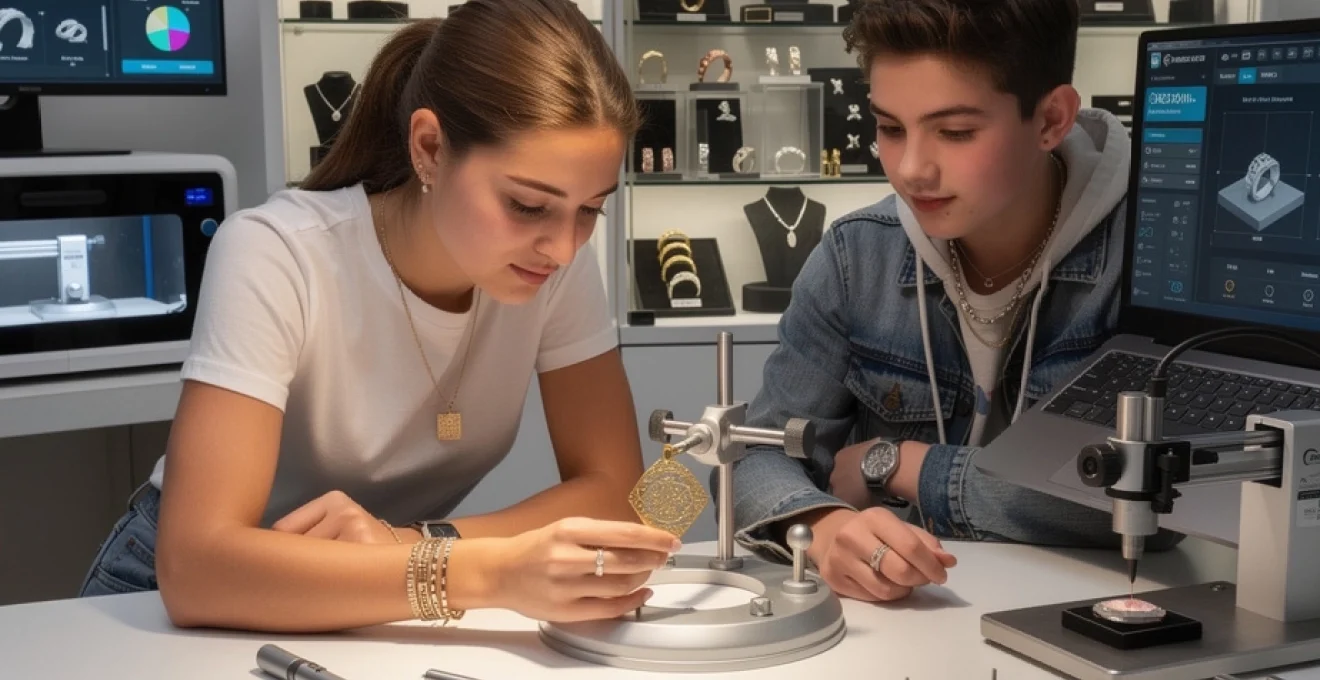
The jewelry industry has undergone a dramatic transformation in recent years, with personalised pieces becoming the cornerstone of modern consumer preferences. Custom engravings and bespoke designs have evolved from niche luxuries to mainstream essentials, driven by a generation that values individuality and meaningful connections over mass-produced items. This shift reflects deeper cultural changes, where personal expression through carefully crafted accessories has become a powerful statement of identity. The integration of advanced manufacturing technologies with traditional craftsmanship has opened unprecedented possibilities for creating truly unique pieces that resonate with individual stories and experiences.
Today’s jewelry market is experiencing exponential growth in personalisation demand, with consumers increasingly seeking pieces that reflect their personal narratives. The convergence of digital design tools, precision manufacturing techniques, and evolving consumer expectations has created a perfect storm for innovation in custom jewelry creation. From laser engraving systems that can reproduce the most intricate designs to AI-powered recommendation algorithms, the industry has embraced technology whilst maintaining the artisanal quality that makes personalised jewelry so compelling.
Market evolution and consumer demographics driving personalised jewellery demand
The personalised jewelry market has experienced remarkable growth, with industry analysts reporting a compound annual growth rate of 15-18% over the past five years. This expansion is fundamentally reshaping how consumers approach jewelry purchases, moving away from traditional retail patterns towards more considered, meaningful acquisitions. Market research indicates that 68% of consumers now prefer personalised accessories over standard retail offerings, representing a significant shift in purchasing behaviour that extends across all age demographics and income brackets.
Consumer spending patterns reveal fascinating insights into this market evolution. The average transaction value for personalised jewelry has increased by 23% since 2020, whilst purchase frequency has remained relatively stable, suggesting that buyers are investing more substantially in fewer, more meaningful pieces. This trend aligns with broader sustainability concerns and the growing preference for quality over quantity in luxury goods purchasing decisions.
Millennial and gen Z purchasing patterns in bespoke jewellery markets
Millennials and Generation Z consumers represent the driving force behind personalised jewelry demand, accounting for approximately 72% of all custom jewelry purchases. These demographics demonstrate distinct preferences for pieces that tell personal stories, commemorate significant life events, or express individual values and beliefs. Their purchasing decisions are heavily influenced by emotional connectivity and the ability to create something uniquely their own.
Research indicates that younger consumers are willing to spend 35-40% more on personalised pieces compared to standard jewelry options. This willingness to invest reflects their perception of personalised jewelry as investment pieces rather than disposable fashion accessories. The typical Gen Z customer spends between £180-£450 on custom jewelry, whilst Millennials typically invest £300-£800 per purchase, often for milestone celebrations or meaningful gifts.
Social media influence on custom jewellery design preferences
Social media platforms have become powerful catalysts for personalised jewelry trends, with Instagram and TikTok driving approximately 45% of all custom jewelry inspiration. Visual platforms enable consumers to discover unique design possibilities and share their personalised pieces, creating viral trends around specific customisation techniques or styles. The hashtag #PersonalisedJewellery has generated over 2.8 million posts, demonstrating the significant social media engagement surrounding custom pieces.
Influencer collaborations have particularly impacted design preferences, with micro-influencers showcasing personalised pieces generating 3.2 times more engagement than traditional jewelry advertising. This organic promotion has led to increased demand for specific customisation techniques, including birthstone incorporation, coordinate engraving, and meaningful symbol integration. The visual nature of these platforms allows consumers to see personalised jewelry in real-world contexts, building confidence in purchasing decisions.
E-commerce platform growth for personalised jewellery sales
Online sales channels now account for 58% of all personalised jewelry transactions, representing a 340% increase since 2019. E-commerce platforms have successfully addressed traditional barriers to custom jewelry purchasing by implementing sophisticated design tools and virtual consultation services. Advanced visualisation technologies allow customers to see realistic renderings of their personalised pieces before production, significantly reducing purchase anxiety and return rates.
The integration
The integration of streamlined checkout processes, robust customer reviews, and clear return policies has further accelerated consumer confidence in purchasing bespoke jewellery online. Market data from 2024 suggests that brands offering end-to-end digital customisation journeys see conversion rates up to 27% higher than those relying on static product catalogues alone. As mobile commerce continues to grow, responsive design interfaces and app-based configurators are becoming essential tools for capturing on-the-go personalised jewellery sales.
Price point analysis across custom jewellery market segments
Price structures in the personalised jewellery market vary significantly depending on materials, complexity of design, and level of customisation. Entry-level pieces such as simple name necklaces or initial pendants typically range from £40–£150, appealing to younger buyers and gift purchasers. Mid-market personalised designs, including engraved engagement bands, birthstone jewellery, and mixed-metal pieces, usually fall within the £200–£800 bracket, where consumers balance emotional value with long-term wearability.
At the premium and luxury end, fully bespoke jewellery that involves original design work, advanced engraving techniques, and high-value gemstones can easily exceed £1,500 and often moves into five-figure territory. Interestingly, while unit volume is highest in the entry-level segment, revenue growth is strongest in the mid to upper tiers, where clients are more willing to pay for superior craftsmanship and unique design rights. Retailers that clearly explain how factors such as metal purity, stone quality, and engraving complexity affect pricing tend to experience higher average order values and reduced price resistance.
Advanced engraving technologies and manufacturing processes
The rise of personalised jewellery is inseparable from rapid advances in engraving and manufacturing technology. Contemporary workshops now combine traditional hand skills with digital machinery to deliver high-precision, repeatable results at scale. This hybrid approach enables brands to offer a wide range of custom engraving options—from delicate script inside a wedding band to complex patterns across an entire pendant—while maintaining consistent quality and turnaround times.
Laser engraving systems: fiber vs CO2 technology applications
Laser engraving has become a cornerstone of modern personalised jewellery production due to its speed, accuracy, and flexibility. Fiber laser systems are typically used for metals such as gold, silver, platinum, and stainless steel, delivering extremely fine detail with minimal heat distortion. They are ideal for deep marking inside rings, micro text on tags, and intricate line work on dense metals where durability is critical.
CO2 laser systems, by contrast, are better suited to non-metallic materials like leather, wood, acrylic, and certain coated metals often used in fashion jewellery or packaging. These lasers excel at surface engraving and can create rich contrasts on organic substrates, making them popular for branded jewellery boxes, leather bracelet straps, and display plates. Many workshops operate both fiber and CO2 units, selecting the appropriate technology based on substrate type and the desired aesthetic, much like a photographer chooses between lenses for different lighting conditions.
CNC machine integration in precision metal engraving
Computer Numerical Control (CNC) machines bring industrial-grade precision to metal engraving for personalised jewellery. By following digital tool paths generated from CAD files, CNC mills and routers can carve text, monograms, and decorative motifs with consistent depth and width across large batches. This makes them invaluable for manufacturers who need to maintain exact brand standards on thousands of pieces while still offering individual customisation.
In high-end bespoke workshops, smaller CNC units are often used for pre-engraving complex relief patterns or layout guides that are then refined by hand. This combination of automated roughing and manual finishing reduces production time without sacrificing artisanal character. For jewellers looking to scale their custom offerings, integrating CNC engraving into their workflow is akin to adding an extra pair of perfectly steady hands that never tire or deviate.
Hand engraving techniques: bright-cut and relief engraving methods
Despite the rise of digital tools, hand engraving remains the gold standard for collectors seeking truly unique personalised jewellery. Bright-cut engraving involves carving angled facets into the metal using burins or gravers, producing mirror-like surfaces that catch and reflect light. This technique is especially effective for decorative borders, initials, and flourishes on rings and bangles, adding a subtle brilliance that machine engraving often cannot replicate.
Relief engraving reverses the typical process by carving away the background metal so that the design stands proud of the surface. The result is a sculptural, three-dimensional effect that transforms monograms, crests, and heraldic motifs into miniature works of art. Because these methods are highly labour-intensive, they are usually reserved for premium commissions and heirloom pieces. Clients drawn to hand engraving often value the visible traces of the engraver’s craft—the slight variations that confirm each item has been shaped by human skill rather than mass production.
Diamond drag engraving for hardened metal surfaces
Diamond drag engraving, also known as diamond scribing, uses an unpowered diamond-tipped tool to physically scratch the surface of the metal under pressure. Unlike laser or rotary engraving, this method produces a fine, bright line without removing significant material, making it particularly suitable for harder metals such as steel, titanium, and tungsten carbide. It is widely used for personalising watch backs, medical alert tags, and industrial-grade accessories that experience daily wear.
Because diamond drag systems are relatively compact and cost-effective, they are popular in retail environments where customers expect while-you-wait engraving services. The process is quiet, clean, and requires minimal setup, enabling jewellers to add names, dates, and short messages to off-the-shelf pieces in minutes. For many entry-level personalised jewellery items, diamond drag engraving provides a reliable balance of speed, legibility, and longevity.
Photochemical etching processes for complex design reproduction
Photochemical etching, or photo-etching, is a process that uses light-sensitive resists and chemical baths to dissolve unprotected areas of metal according to a pre-printed pattern. In personalised jewellery, this technique is invaluable for reproducing extremely detailed artwork—such as fingerprints, signatures, sound waves, or intricate mandala designs—that would be difficult or uneconomical to engrave by hand. It allows for consistent replication of complex motifs across multiple pieces while preserving fine linework.
The workflow typically begins with a high-resolution digital image, which is converted into a mask and applied to the metal surface. After exposure and development, the unmasked regions are etched away to the desired depth. Because photo-etching removes material uniformly, it can create crisp, flat-bottomed recesses that are ideal for subsequent enamelling or inlay work. For brands seeking to offer advanced customisation, photochemical etching functions like a printing press for metal, transforming digital designs into precise, tangible patterns.
Material science and substrate selection for custom engravings
Choosing the right material for personalised jewellery engravings is as crucial as selecting the design itself. Different substrates respond in distinct ways to heat, pressure, and chemical exposure, influencing the clarity, depth, and durability of the finished engraving. Precious metals such as 9ct and 18ct gold, sterling silver, and platinum remain the primary choices for fine jewellery due to their workability and long-term stability, particularly for laser and hand engraving.
More contemporary materials, including titanium, stainless steel, and tungsten carbide, appeal to customers seeking modern aesthetics and enhanced scratch resistance. However, their hardness can limit certain engraving methods and often necessitates diamond drag or high-powered fiber laser systems. Beyond metals, alternative substrates like ceramic, enamel-coated brass, and even high-performance polymers are used for fashion-forward personalised pieces, key tags, and accessories. By understanding the interaction between engraving technology and substrate properties—thermal conductivity, hardness, reflectivity—manufacturers can recommend the most suitable personalised jewellery solutions for everyday wear or special occasions.
Digital design software and customer interface solutions
The digital backbone of today’s personalised jewellery market lies in sophisticated design software and intuitive customer-facing tools. These solutions bridge the gap between a client’s idea and a production-ready file, reducing misunderstandings and speeding up approval cycles. Well-designed interfaces not only empower customers to experiment with fonts, layouts, and symbols but also enforce technical constraints so that every approved design is feasible to manufacture.
CAD software integration: rhinoceros 3D and matrix applications
Professional jewellers increasingly rely on advanced CAD platforms such as Rhinoceros 3D and Matrix to create and refine bespoke designs. Rhino offers robust modelling capabilities for complex organic forms, while Matrix—built specifically for jewellery—adds specialised tools for stone setting layouts, ring sizing, and production-ready detailing. When it comes to custom engravings, these platforms allow designers to map text and motifs accurately onto curved surfaces, ensuring that spacing and legibility remain consistent around the entire piece.
By working directly in 3D, designers can preview how light interacts with engraved recesses, raised reliefs, and bright cuts before any material is cut. This preview function significantly reduces the risk of misaligned inscriptions or distorted logos on challenging geometries such as signet rings and bangles. Once the client approves the virtual model, the same CAD file can be exported for 3D printing, CNC machining, or laser engraving, creating a seamless pipeline from concept to finished personalised jewellery.
Web-based design configurators and real-time visualisation tools
For consumers, web-based jewellery configurators are often the first touchpoint with the custom design process. These browser-based tools let you choose metal type, gemstone options, and engraving content while previewing the piece in real time. Many platforms now support 360-degree rotation, zoom functionality, and dynamic updates as you type names or change fonts, which helps bridge the gap between imagination and reality.
Advanced configurators can simulate surface finishes, depth of engraving, and even finger size proportions, making it easier to judge whether a script font will be readable or if a design appears too crowded. Some retailers extend this experience with augmented reality, allowing customers to “try on” rings or pendants using their smartphone camera. This level of interactivity not only increases engagement but also reduces post-purchase disappointment, as clients feel they have genuinely co-designed their personalised jewellery piece.
Ai-powered design recommendation algorithms
Artificial intelligence is rapidly becoming a quiet but powerful partner in personalised jewellery design. Using historical purchase data, browsing behaviour, and even social media trends, AI-driven systems can suggest engraving styles, motifs, and product categories that align with a customer’s tastes. For example, if you frequently view celestial-themed pieces, the platform might recommend star-map engravings or lunar phase pendants as custom options.
In more advanced implementations, AI tools can analyse uploaded handwriting, drawings, or fingerprints and automatically optimise them for engraving, smoothing lines and adjusting scale while preserving the original character. This process is similar to having a digital assistant that translates your ideas into a technically sound blueprint. For brands, AI-powered recommendations improve upsell opportunities and help guide customers who may feel overwhelmed by the sheer volume of customisation choices.
File format optimisation for manufacturing workflows
Behind every successful personalised jewellery order lies a series of well-structured digital files. Common formats such as .AI, .SVG, and .DXF are used for 2D engraving paths, while .STL, .3DM, and .STEP files handle 3D model data. Optimising these files is crucial: line weights must be standardised, overlapping paths removed, and text converted to outlines to avoid unexpected font substitutions during production.
Manufacturers often maintain strict file preparation protocols to ensure compatibility with laser, CNC, and photo-etching equipment. This can include setting explicit tolerances, minimum stroke widths, and engraving depths, much like setting print specifications for high-end publishing. When jewellery brands educate customers and designers on preferred file formats and resolution requirements, they reduce back-and-forth communication and minimise errors, resulting in faster lead times and more reliable personalised jewellery outcomes.
Quality control standards and durability testing in personalised jewellery
As personalised jewellery becomes more integral to everyday wear, robust quality control and durability testing are no longer optional—they are expected. Each engraving must not only look precise on delivery but also withstand years of contact with skin, clothing, and environmental factors. To achieve this, manufacturers implement inspection protocols at multiple stages, from verifying engraving content and spelling before production to checking alignment, depth, and finish under magnification after completion.
Durability testing for engraved jewellery often includes abrasion tests, simulated wear cycles, salt spray or sweat exposure for plated items, and hardness verification for treated surfaces. For laser-darkened markings, lightfastness and chemical resistance are evaluated to ensure that blackened text does not fade prematurely. Many brands align their processes with international standards such as ISO 9001 for quality management and REACH or RoHS regulations for material safety. For customers, these measures translate into confidence that a wedding date, child’s name, or family crest engraved today will remain legible and beautiful for decades.
Market leaders and emerging players in custom jewellery manufacturing
The personalised jewellery landscape is now populated by a mix of global leaders, specialised ateliers, and agile start-ups. Established fine jewellery houses have expanded their engraving and bespoke offerings, leveraging their heritage and in-house craftsmanship to attract clients seeking high-end customisation. At the same time, digitally native brands have carved out strong positions with user-friendly online interfaces, transparent pricing, and rapid turnaround times, particularly in segments like name necklaces, coordinate jewellery, and minimalist engraved bands.
Emerging players often differentiate themselves through niche focus—such as memorial jewellery, pet-themed pieces, or culturally specific motifs—or through innovations in sustainability, like using fully recycled metals and lab-grown stones for every custom order. Many of these companies operate on a “made-to-order” basis, reducing inventory waste and aligning with conscious consumer values. As competition intensifies, the brands most likely to succeed are those that combine reliable manufacturing, intuitive personalisation tools, and authentic storytelling, ensuring that each personalised jewellery piece feels less like a product and more like a chapter in the wearer’s life story.