
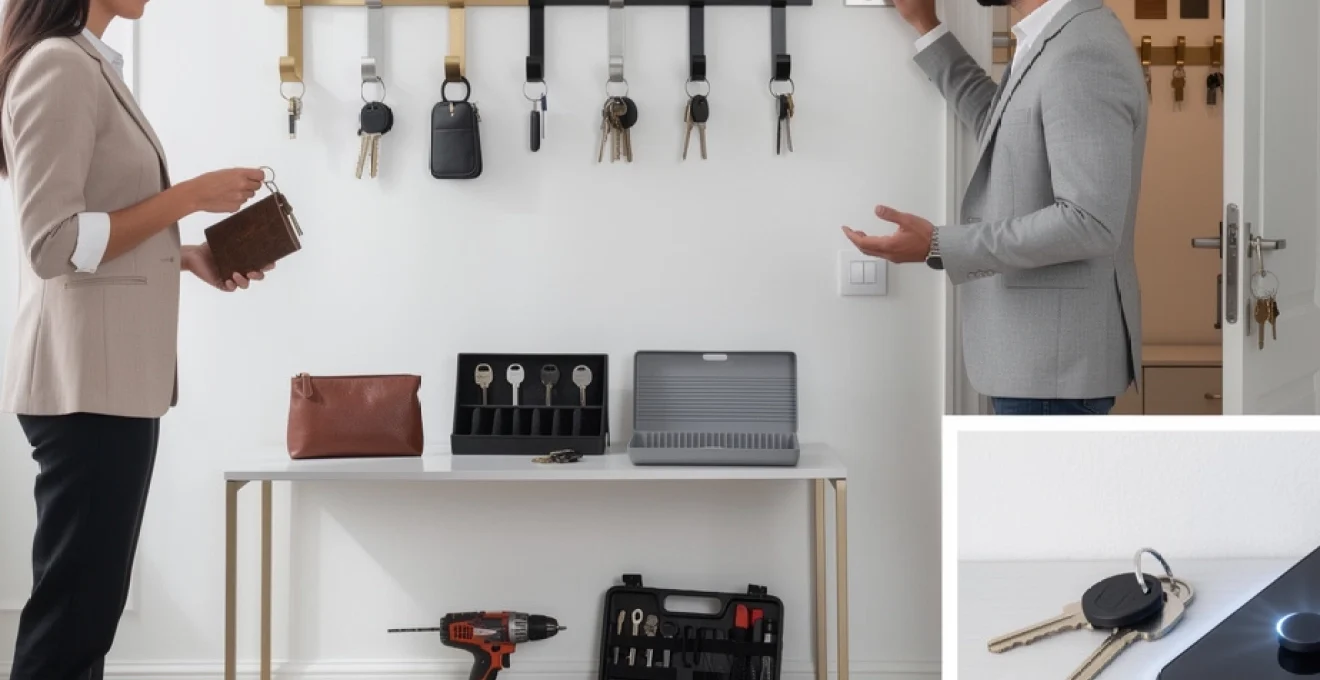
Key holders represent one of those essential household accessories that often get overlooked until you’re frantically searching for missing keys whilst running late for an important appointment. The right key storage solution can transform chaotic entryways into organised, stylish spaces whilst ensuring your keys are always exactly where you expect them to be. Modern key holders have evolved far beyond simple wall hooks, now incorporating sophisticated materials, smart technology, and innovative designs that complement contemporary home décor.
Selecting the perfect key holder involves balancing functionality with aesthetic appeal, considering factors such as household size, installation requirements, security needs, and budget constraints. Whether you’re furnishing a minimalist studio flat or organising a busy family home, understanding the various types, materials, and features available will help you make an informed decision that serves your practical needs whilst enhancing your interior design.
Essential key holder types: Wall-Mounted, magnetic, and portable solutions
The key holder market offers diverse solutions designed to accommodate different lifestyle requirements and spatial constraints. Understanding these fundamental categories helps narrow down options based on your specific circumstances and preferences.
Wall-mounted key hooks: brass, chrome, and wooden variations
Wall-mounted key holders remain the most popular choice for permanent installations, offering reliable storage in high-traffic areas like hallways and kitchens. These fixtures typically feature multiple hooks or pegs arranged on backing plates, providing designated spaces for different family members or key sets. The mounting system ensures keys stay put even in bustling households where doors slam frequently.
Traditional brass models offer timeless elegance with their warm, golden tones that complement period properties and classic interior schemes. Chrome versions provide contemporary appeal with their reflective surfaces and clean lines, making them ideal for modern homes with minimalist aesthetics. Wooden variations bring natural warmth to spaces, with oak offering durability and rich grain patterns, whilst walnut provides sophisticated dark tones perfect for upscale environments.
Magnetic key holders: neodymium strip models and hidden cabinet systems
Magnetic key holders utilise powerful rare-earth magnets to secure keys without traditional hooks or clips. These innovative solutions work particularly well in spaces where visual clutter must be minimised, such as offices or rental properties where permanent mounting isn’t permitted. Neodymium magnets provide exceptional holding strength whilst maintaining compact profiles that blend seamlessly into existing décor.
Strip models mount discreetly under cabinets or inside cupboards, keeping keys completely hidden from view whilst maintaining easy access. This concealed approach appeals to security-conscious homeowners who prefer not to advertise key locations to visitors or delivery personnel. Hidden cabinet systems often incorporate additional storage compartments for small items like coins or garage remote controls.
Portable key cases: leather pouches and metal organiser boxes
Portable key storage solutions cater to individuals who prefer carrying organised key collections rather than leaving them in fixed locations. High-quality leather pouches offer sophisticated storage with soft interiors that prevent scratching and jingling. These cases often feature snap closures or zip compartments that secure contents whilst traveling.
Metal organiser boxes provide maximum protection with rigid construction that shields keys from damage during transport. These professional-grade solutions often incorporate foam inserts that customise to specific key shapes, ensuring each piece has a designated position. The structured approach particularly benefits tradespeople or property managers who handle numerous keys daily.
Smart key storage: Bluetooth-Enabled tile mate integration options
Technology integration has revolutionised key storage with smart systems that track locations and send alerts when keys move unexpectedly. Bluetooth-enabled solutions connect to smartphone applications, allowing remote monitoring and location tracking within typical household ranges. These advanced systems appeal to tech-savvy users who appreciate comprehensive home automation.
Tile Mate integration represents the current standard for consumer-grade key tracking, offering reliable connectivity and user-friendly applications. The small tracking devices attach easily to existing key rings whilst maintaining reasonable battery life through efficient low-energy protocols. Smart storage systems often incorporate charging stations that maintain device power whilst keys remain docked.
Material selection criteria for durability and aesthetic appeal
Material choice significantly impacts both the longevity and visual appeal of
the key holder, influencing resistance to daily wear, maintenance requirements, and how well the piece integrates with existing furniture and fixtures. When choosing between metal, wood, or synthetic options, it helps to think in terms of both performance and how you want the key holder to “read” visually in your entryway. Below we break down the most common materials and finishes you’ll encounter when comparing functional yet stylish key holders.
Metal construction: stainless steel versus powder-coated aluminium
Metal key holders offer excellent durability and are particularly suitable for busy households, rental properties, and light commercial settings. Stainless steel remains a top choice thanks to its corrosion resistance, strength, and low maintenance requirements. A stainless steel wall-mounted key hook will withstand years of use in humid areas such as porches or utility rooms without rusting, which is crucial if you’re hanging wet coats or umbrellas nearby.
Powder-coated aluminium delivers similar visual impact at a lighter weight, making it easier to mount on plasterboard or older walls. The powder coating process bonds a coloured layer to the metal, creating a tough, chip-resistant finish available in a wide range of colours from minimalist white to bold accent tones. If you’re aiming for a lightweight, modern key holder that won’t strain weaker walls, aluminium is often the more practical choice, especially in larger multi-hook or rail-style designs.
When comparing stainless steel to aluminium, consider the environment and how heavily the key holder will be used. Stainless steel suits high-traffic, hard-wearing spaces and coastal locations where salt air can quickly attack lesser metals. Aluminium excels where weight is a concern or where you want a coloured key holder that doubles as a design feature, for instance a matte black rail against a pale hallway wall. In either case, opting for a quality grade of metal will reduce the risk of bending, warping, or surface pitting over time.
Natural wood options: oak, walnut, and bamboo grain considerations
Natural wood key holders introduce warmth and texture, making them ideal for Scandinavian, rustic, or mid-century inspired interiors. Oak is a perennial favourite thanks to its hard-wearing nature and attractive, visible grain. An oak key rail or panel will typically age gracefully, developing a subtle patina rather than obvious wear marks, much like a good dining table. If you already have oak skirting boards or furniture, selecting an oak key holder helps create a cohesive design story as soon as you step through the door.
Walnut suits those seeking a deeper, more luxurious tone. Its naturally dark, chocolatey hues pair well with brass hooks or antique bronze finishes, resulting in a key holder that feels more like a piece of furniture than a purely functional accessory. Walnut does require a little more care to avoid scratches showing on the darker surface, so it’s best suited to adult-only households or quieter corners of the home where keys aren’t being constantly tossed around.
Bamboo has gained popularity as an eco-conscious alternative, offering a fine, uniform grain and excellent dimensional stability. Because bamboo is technically a grass, it grows rapidly, making it a sustainable choice for anyone conscious of their environmental impact. Bamboo key holders often come in minimalist designs with simple slots or pegs, aligning well with contemporary interiors. Whichever wood species you choose, ensure the piece is sealed with a suitable oil, lacquer, or varnish to protect against moisture and everyday handling, especially if it will sit near an exterior door.
Synthetic materials: ABS plastic and silicone grip technologies
Synthetic materials offer practical advantages where impact resistance, colour flexibility, and cost-effectiveness are priorities. ABS plastic is widely used in compact wall key holders and portable organiser boxes due to its toughness and ability to be moulded into intricate shapes. A well-designed ABS holder can incorporate integrated trays for coins, slots for access cards, and even channels for magnetic key fobs, all while keeping the unit lightweight and easy to mount with adhesive strips.
Silicone grip technologies are particularly useful in portable key cases and magnetic key strips. Soft silicone sleeves or over-moulded sections provide a non-slip surface that stops keys sliding around, which is especially helpful with minimalist designs that lack traditional hooks. If you’ve ever had keys slide off a smooth metal rail, you’ll appreciate the extra friction that silicone provides. In addition, silicone helps dampen noise, reducing the metallic clatter that can occur when multiple keys are hung or removed at once.
One consideration with synthetics is long-term appearance. Lower-quality plastics may discolour under UV light or show scratches more readily than metal or wood. To maintain a stylish look, opt for higher-grade ABS in neutral tones, or silicone in colours that won’t quickly look dated. For households with children, synthetics can be an excellent choice: they’re less likely to chip if knocked and can often be wiped clean with a damp cloth, making them practical in busy family entryways.
Premium finishes: brushed nickel, matte black, and antique bronze treatments
Even when the base material is the same, the finish you choose has a dramatic effect on how your key holder contributes to the overall space. Brushed nickel provides a soft, satin sheen that hides fingerprints and minor scratches better than polished chrome. It pairs particularly well with modern taps, door handles, and light fittings, so if you’re aiming for a coordinated look, matching your key hooks to your hardware is a simple yet effective design strategy.
Matte black finishes have become a hallmark of contemporary interiors, especially in industrial and minimalist schemes. A matte black wall-mounted key rail can either disappear against a dark wall or provide a sharp contrast on a lighter surface. Because the finish absorbs rather than reflects light, it creates a calm, understated presence—ideal if you want functional key storage without visual fuss. To keep matte black looking smart, avoid abrasive cleaners and instead use a soft cloth; harsh scouring can create shiny patches that spoil the uniform finish.
Antique bronze and similar “living” finishes introduce depth and character, often designed to age gracefully with use. These treatments are perfect when you want a key holder that feels at home in a period property or traditional hallway. Over time, high-contact areas may polish slightly while recesses remain darker, adding to the sense of history. If you prefer a more stable appearance, choose lacquered versions that protect the patina. In every case, selecting a premium finish allows your key holder to act as a subtle bridge between functional hardware and decorative accessory.
Capacity assessment: single key storage to multi-user household systems
Before falling in love with a particular design, it’s worth asking a practical question: how many keys do you actually need to store? Capacity is one of the most important, and most often overlooked, criteria when choosing a key holder. A compact three-hook rail may look elegant, but it will become frustrating very quickly if four or five people live in the home or if you manage several sets of keys for work, vehicles, and outbuildings.
For individuals or couples, small key holders with three to five hooks or a single magnetic strip are usually sufficient. You might allocate one hook for everyday house keys, one for car keys, and one for less frequently used sets such as a shed or bike lock. In these cases, designs that double as decorative pieces—such as carved wooden panels or sculptural metal racks—can comfortably prioritise style without sacrificing practicality.
Larger households, house shares, or properties with multiple external doors will benefit from more structured systems. Consider key holders offering eight to twelve hooks or a small wall-mounted cabinet with labelled rows. Being able to assign each family member their own hook, or group keys by function (front door, back door, vehicles, garden access, spare keys for guests), dramatically reduces confusion and the dreaded “whose keys are these?” conversation. For landlords and property managers, dedicated key cabinets with numbered tags and lockable doors may be the most efficient route, ensuring both organisation and basic security.
It’s also wise to think about future needs. Are you likely to acquire an additional car, rent out a room, or take responsibility for an elderly relative’s keys? Choosing a key holder with two or three spare positions gives you room to grow without needing to upgrade immediately. As a simple rule of thumb, count your current key sets, add at least two extra hooks for future expansion, and then check that your preferred key holder’s capacity matches or exceeds that total.
Installation requirements: mounting hardware and space considerations
Even the most elegant key holder will disappoint if it’s poorly installed or positioned in an awkward spot. Thinking carefully about mounting hardware, wall type, and available space ensures your new key organiser feels like an integrated part of your home rather than an afterthought. In many ways, installing a key holder is similar to hanging a small shelf or picture frame, but with the added requirement that it must withstand regular handling.
Screw-mount systems: drywall anchors and masonry drill specifications
Screw-mounted key holders offer the most secure installation, especially for heavier metal or solid wood designs. If your walls are plasterboard (drywall), using appropriate drywall anchors is essential to prevent the screws pulling out under the weight of keys and daily use. Many quality key holders now include suitable plugs and screws in the box, but it’s still worth checking that they match your wall type. For hollow walls, toggle or expansion anchors usually provide better long-term stability than simple plastic plugs.
In solid masonry or brick walls, you’ll need a suitable drill bit (often 5–6 mm for standard plugs) and a hammer drill if the material is particularly dense. Mark the mounting holes accurately using a spirit level to avoid a wonky rail—something that will be obvious every time you reach for your keys. When in doubt, drilling slightly smaller pilot holes first can help you avoid over-enlarging the fixings. Once installed, a screw-mounted system will comfortably handle not only everyday keys but also occasional extra weight from items such as lanyards or small torches.
For renters or those less confident with power tools, it can be tempting to skip screw-mounts entirely, but if your chosen key holder is heavy or has a large number of hooks, screws are usually the safest and most reliable option. Many tenancy agreements allow minor fixings as long as walls are repaired at the end of the lease, so it’s worth checking your contract; a secure, functional key station often justifies a couple of carefully filled holes later on.
Adhesive solutions: 3M command strips and removable mounting options
Adhesive mounting is ideal when drilling isn’t possible or desirable, such as in newly plastered walls, tiled surfaces, or short-term rental properties. 3M Command strips and similar removable fixings are designed to hold surprisingly high loads when used correctly. For lightweight key rails, magnetic strips, or small entryway organisers, they can provide a clean, damage-free installation that peels away without leaving residue when it’s time to move.
To maximise adhesion, you’ll need to clean the surface thoroughly with isopropyl alcohol and allow it to dry before applying the strips. It’s also important to respect the manufacturer’s weight ratings; if your key holder can theoretically hold ten heavy key sets, but the adhesive is only rated for 2 kg, you’ll need to be disciplined about what you actually hang. For peace of mind, some homeowners combine a central screw with additional adhesive pads, gaining both security and ease of removal by filling only a single small hole when the key holder is removed.
Adhesive solutions work best on smooth, non-porous surfaces such as painted plaster, sealed wood, metal, and tiles. Textured walls, bare brick, or dusty surfaces can significantly reduce holding strength. If you’re unsure, a simple test is to mount the empty key holder, gradually add weight over a day or two, and monitor for any movement before trusting it with your everyday keys.
Clearance measurements: door swing radius and traffic flow analysis
Beyond the method of fixing, location is critical. A well-placed key holder should feel intuitive—you arrive home, close the door, and your keys have a natural landing spot within one or two steps. However, it also needs to respect door swing, nearby furniture, and the natural flow of people through the space. Installing a protruding key rail directly behind a door, for example, can lead to chipped paint, bent hooks, or even bruised knuckles.
Before committing to a position, open and close any nearby doors fully and note the door swing radius. Ensure the key holder sits outside this arc or is shallow enough that the door won’t collide with it. Similarly, think about traffic flow: will people brush past the key holder regularly, perhaps when carrying shopping bags or pushing a buggy? In narrow hallways, slimmer, low-profile designs or recessed key cabinets are often more practical than deep shelves with projecting hooks.
It can be helpful to temporarily tape a piece of cardboard to the wall in the proposed location to simulate the footprint of your chosen key holder. Live with this mock-up for a day or two, paying attention to whether it feels natural to reach for that spot and whether it interferes with light switches, intercoms, or alarm panels. This quick “traffic test” often reveals subtle issues that aren’t obvious on paper, ensuring your final installation is both functional and unobtrusive.
Security features: locking mechanisms and tamper-resistant designs
While many domestic key holders are primarily about convenience, security still deserves consideration, particularly in shared properties, home offices, or when storing keys for external buildings. A visible array of keys near the front door can be tempting for opportunistic thieves, so it’s worth thinking about how much you are comfortable putting on display and whether a lockable or at least partially concealed design would be wiser.
Lockable key cabinets are the simplest solution when you require controlled access. These usually feature a small cylinder lock or combination mechanism on a metal or reinforced wooden door. Inside, rows of numbered hooks and matching tags allow you to catalogue keys systematically, which is essential for landlords, small businesses, or anyone managing multiple properties. The lock won’t stop a determined intruder, but it will prevent casual tampering and make it harder for visitors or tradespeople to pocket a key unnoticed.
For everyday household use, subtle security measures can still make a meaningful difference. Concealed magnetic strips mounted under shelves or inside cupboards keep keys out of sight without slowing down authorised users. Some premium key holders incorporate tamper-resistant fixings, such as security screws that cannot be easily removed with standard tools, reducing the likelihood of the entire unit being taken from the wall. Others use coded hooks or key tags that avoid directly labelling keys with obvious descriptions like “front door”, which could be misused if a set falls into the wrong hands.
Smart key storage solutions add another layer by integrating Bluetooth trackers or Wi‑Fi enabled sensors that alert you if a set of keys moves unexpectedly. While these technologies are not foolproof, they can form part of a wider home security ecosystem alongside alarms and cameras. The key is to strike a balance: you want your key holder to be convenient enough that everyone actually uses it, while still mitigating avoidable risks such as leaving every key in the house hanging in full view of a window.
Price point analysis: budget models under £15 to premium designer options
Key holders span a wide price range, from simple plastic strips costing just a few pounds to handcrafted designer pieces that rival small artworks. Understanding what drives these differences helps you decide where to invest and where to economise. At the budget end, under around £15, you’ll typically find ABS plastic rails, basic metal hooks on thin backing plates, and small adhesive magnetic strips. These options are perfectly adequate for light use in student flats, secondary entrances, or utility rooms, provided you accept simpler styling and potentially shorter lifespans.
Moving into the mid-range—roughly £20 to £50—opens up a much broader selection of functional yet stylish key holders. Here you’ll see solid oak or bamboo rails, powder-coated aluminium racks, compact locking key cabinets, and portable leather key cases with quality stitching. This bracket often offers the best value for most households: materials are robust enough for daily use, finishes are more refined, and designs start to incorporate thoughtful touches such as integrated shelves, mail slots, or small trays for wallets and phones.
Above £50, you enter the realm of premium designer options. These might include sculptural metal pieces from boutique brands, artisan-crafted hardwood panels with inlaid hooks, or modular entryway systems that combine coat storage, seating, and key organisation in a single installation. You may also find higher-end smart key storage solutions here, particularly those integrating Bluetooth tracking hardware or custom app support. At this level, you’re paying not just for functionality but also for craftsmanship, unique design, and brand reputation—ideal if your key holder will be a focal point in an open-plan living area.
When deciding how much to spend, it’s helpful to think of a key holder in the same way you might consider a good wallet or everyday watch. You’ll interact with it several times a day, every day, often for many years. A very cheap model that fails or looks tired after a few months is rarely a saving in the long term. Conversely, there is little point in investing in an expensive, heavily featured key cabinet if you only have two keys and live alone. Matching the price point to your actual needs, the level of finish in the surrounding space, and the lifespan you expect will help you choose a functional yet stylish key holder that genuinely earns its place by your door.