
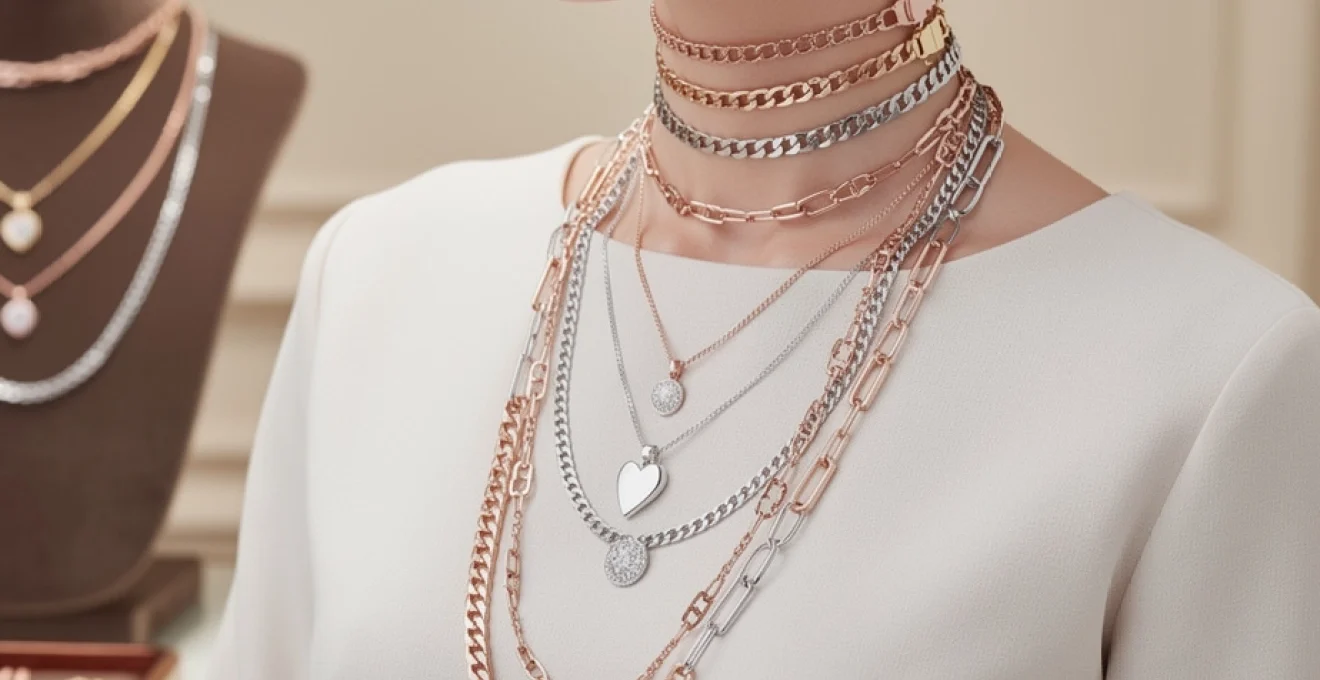
Necklace layering has evolved from a bohemian afterthought to a sophisticated art form that defines contemporary jewellery styling. This technique transforms simple chains into statement-making ensembles that reflect personal taste whilst demonstrating mastery of proportion, balance, and visual harmony. The modern approach to layering requires understanding not only aesthetic principles but also technical considerations such as weight distribution, metal compatibility, and chain mechanics.
Professional jewellery stylists recognise layering as one of the most versatile techniques for creating visual interest and personalising any outfit. Whether you’re building a minimalist stack for daily wear or crafting an elaborate arrangement for special occasions, the principles remain consistent: thoughtful selection, strategic positioning, and careful attention to proportion create the foundation for elegant layering success.
Fundamental necklace length classifications and chain proportions
Understanding necklace lengths forms the cornerstone of successful layering technique. Each length classification serves specific aesthetic purposes and creates distinct visual effects on different body types and necklines. Professional stylists rely on these standardised measurements to create balanced, harmonious arrangements that enhance rather than overwhelm the wearer’s natural proportions.
The relationship between necklace lengths determines how successfully pieces will layer together. Strategic spacing prevents tangling whilst ensuring each piece maintains its individual character within the overall composition. Proper length selection can transform a collection of individual necklaces into a cohesive, professionally styled ensemble that appears effortlessly curated.
Choker length (14-16 inches) styling techniques for delicate chains
Choker-length necklaces create the foundation layer for most successful stacking arrangements. These pieces sit close to the neck, providing a structured base that prevents longer chains from shifting excessively during wear. Delicate chains in this length range work particularly well with fine pendants or subtle textural elements that add interest without overwhelming the throat area.
When selecting choker-length pieces for layering, consider chain thickness carefully. Ultra-fine chains may disappear visually beneath heavier pieces, whilst overly chunky chokers can dominate the entire arrangement. The ideal choker weight allows the piece to hold its position whilst remaining visually balanced with accompanying longer necklaces.
Princess length (18 inches) as foundation layer positioning
Princess-length necklaces occupy the versatile middle ground that makes them invaluable for layering applications. This length typically falls just below the collarbone, creating an ideal anchor point for both shorter chokers above and longer chains below. Professional stylists often select this length for statement pendants, as it provides optimal visibility without interfering with neckline styling.
The strategic positioning of princess-length pieces allows for maximum flexibility in building layered arrangements. These necklaces can function as either primary focal points or supporting elements, depending on their design characteristics and the overall styling objective. Their central positioning makes them particularly effective for showcasing meaningful pendants or significant gemstone elements.
Matinee length (20-24 inches) integration methods
Matinee-length necklaces bridge the gap between classic shorter styles and dramatic longer pieces. This length range offers particular advantages for professional environments where subtle elegance is preferred over bold statement styling. The proportions work exceptionally well with business attire and provide sophisticated layering options without appearing excessive or attention-seeking.
Integration of matinee-length pieces requires careful consideration of pendant weight and chain style. Heavier elements at this length can pull the entire layered arrangement off-centre, whilst overly delicate chains may become lost amongst more substantial pieces. Successful matinee integration often involves selecting pieces that complement rather than compete with shorter foundation layers.
Opera length (28-34 inches) dramatic layering applications
Opera-length necklaces introduce dramatic vertical elements that elongate the torso and create sophisticated visual interest. These pieces work particularly effectively with deep V-necklines and open collars, where their extended length can be fully appreciated. Professional styling often reserves this length for special occasions or evening wear, where their dramatic impact aligns with the overall aesthetic goals.
The substantial length of opera pieces allows for creative styling techniques including doubling
or knotting to create the illusion of multiple shorter layers. When doubled, an opera-length necklace often sits at both princess and matinee positions simultaneously, delivering a tiered effect with a single piece. This makes it a valuable tool when you want the look of necklace layering without adding excessive weight to the neckline.
For refined necklace layering with elegance, opera pieces should be balanced with lighter, shorter chains to avoid visual heaviness in the lower torso area. Opt for slimmer profiles or graduated beads that retain movement without overpowering the stack. When styled over fine knits or high-neck dresses, an opera-length chain can act almost like a sartorial seam, guiding the eye and subtly lengthening the silhouette.
Rope length (36+ inches) wrapping and doubling techniques
Rope-length necklaces, typically 36 inches and beyond, offer the greatest flexibility for creative layering techniques. Their extended length allows for multiple wraps around the neck, transforming a single piece into the equivalent of two or three shorter chains. Professional stylists often use rope-length strands of pearls or fine chains to build volume while maintaining a cohesive material story.
When working with rope-length pieces, the key is controlled drape. You can create a polished, layered necklace effect by combining one high wrap (sitting at choker or princess length) with one or two longer loops that fall into the matinee or opera range. Strategic use of small hidden clasps or discreet knots can keep each loop in place, preventing the rope from slipping into a single long strand during wear.
Chain weight distribution and metal compatibility analysis
Beyond length, the technical success of necklace layering relies heavily on chain weight distribution and metal compatibility. An elegant layered necklace arrangement behaves almost like a well-engineered suspension system: each component must support, rather than strain, the others. Uneven weight can cause lighter pieces to ride up, twist, or wear prematurely, while poorly matched metals may tarnish or scratch more quickly.
Analysing chain gauges, alloys, and clasp mechanics helps you build stacks that are both beautiful and structurally sound. Understanding how 14k gold, sterling silver, and platinum perform in daily wear allows you to design layered looks that age gracefully and maintain their brilliance over time. This technical awareness is what separates casual stacking from truly professional necklace layering.
14k gold chain gauge calculations for balanced layering
For 14k gold chains, gauge and overall gram weight determine how comfortably a piece can be layered without pulling or distorting the neckline. As a general guideline, many professional jewellers recommend keeping the total combined weight of layered everyday necklaces between 10 and 25 grams for prolonged comfort. Within that range, the heaviest chain should typically sit lowest to stabilise the stack.
When planning a layered necklace look, think of chain gauge like font size on a page: you need a clear hierarchy. A 0.7–0.9 mm cable chain works well at choker length, a 1.1–1.3 mm chain is ideal around princess or matinee, and anything 1.5 mm and above can provide visual anchor at matinee or opera length. This stepwise increase in thickness prevents the common mistake of pairing a very fine long chain beneath a much heavier short one, which can cause buckling and tangling.
Sterling silver oxidation prevention in multi-layer arrangements
Sterling silver brings beautiful luminosity to layered necklaces but is more prone to oxidation than high-karat gold. In multi-layer arrangements, this can create inconsistency if some chains darken more quickly than others. To preserve a cohesive appearance, you may want to prioritise rhodium-plated sterling silver for frequently layered pieces, as the plating provides a protective barrier against tarnish.
From a practical standpoint, it is wise to keep sterling silver away from direct contact with untreated copper alloys, perfumes, and body lotions when building necklace layers. Store silver chains individually in anti-tarnish pouches and clean them regularly with a non-abrasive polishing cloth. When mixing sterling silver with 14k gold in a layered necklace stack, placing the silver at mid or upper positions often reduces friction and helps maintain surface brilliance over time.
Mixed metal coordination: rose gold, yellow gold, and platinum pairings
Thoughtful mixed metal layering can make a necklace stack look deliberate and modern rather than accidental. The most successful combinations usually rely on one dominant tone with one or two accent metals. For example, you might build a base of yellow gold chains, highlight the collarbone with a platinum or white gold pendant, and introduce rose gold as a subtle accent at choker length.
When coordinating rose gold, yellow gold, and platinum, treat the metals as colour values on a gradient. Platinum and white gold act as “cool highlights,” yellow gold as the warm mid-tone, and rose gold as a soft blush accent. Repeating each metal at least once in your layered necklace look—perhaps via a small charm, a clasp, or a fine spacer chain—creates visual continuity so the combination feels cohesive rather than chaotic.
Chain link style harmonisation: cable, curb, and figaro integration
Chain link style has as much impact on a layered necklace composition as metal colour or gemstone choice. Cable chains offer a clean, rhythmic structure that makes them ideal as neutral supporting layers. Curb chains provide more surface area to catch the light, lending weight and presence, while Figaro chains introduce a distinctive pattern that can serve as a focal design element.
Professional stylists often use the principle of “one statement texture per stack.” If you choose a bold Figaro or oversized curb link as your hero chain, balance it with simpler cable or trace chains in adjacent lengths. This prevents the neckline from feeling visually noisy. Think of link styles as different brushstrokes in a painting: contrasting them adds depth, but repeating one or two styles across the stack maintains harmony.
Pendant size scaling and visual weight management
Pendant selection is one of the most critical factors in successful necklace layering. The relative size, thickness, and visual weight of each pendant determine where the eye lands first and how it travels across the neckline. A well-executed layered look often follows a clear hierarchy: the main pendant acts as the focal point, while smaller charms and tags provide supporting detail.
To manage visual weight, consider both the physical dimensions and the optical impact of each pendant. A small but highly faceted diamond solitaire can draw as much attention as a larger matte disc, much like a bright spotlight can outshine a larger, dimmer lamp. As a rule of thumb, position your most significant pendant at princess or matinee length, then scale down in size as you move upwards towards the choker area or downwards into opera length. This creates a natural sense of flow rather than competition between elements.
Neckline-specific layering configurations
Aligning necklace layering with your neckline is essential for a polished, intentional appearance. The goal is to let the jewellery echo, frame, or strategically contrast the lines of your clothing. When the neckline and necklace architecture work together, the result is elegance that looks effortless, whether you are wearing a crisp shirt, a minimalist knit, or an evening gown.
For V-necklines, a cascading arrangement that mirrors the “V” shape—choker, princess with pendant, then a subtle matinee—enhances the natural vertical line of the torso. With high neck or turtleneck styles, the most refined necklace layering usually occurs above the fabric (short chokers and collar-length chains) or well below it (opera and rope lengths), avoiding an awkward cluster at mid-level. Strapless and off-the-shoulder cuts invite bolder stacks around the collarbone, where multiple delicate layers can create a soft, jewellery “collar” that frames the décolletage.
Advanced clasp positioning and tangling prevention systems
Even the most beautifully curated necklace layering loses impact if chains constantly knot or rotate. Advanced clasp positioning and anti-tangle systems ensure that the technical side of your stack matches the visual sophistication. By considering how clasps, extenders, and separators interact, you can dramatically reduce tangling and make everyday wear more comfortable.
Think of the back of your neck as the control panel for your layered necklace arrangement. Strategically staggered clasps, considered use of magnetic closures, and purpose-built necklace separators all work together to keep each strand in its designated place. The result is a layered look that moves with you instead of fighting against you throughout the day.
Magnetic clasp placement for seamless layer adjustment
Magnetic clasps are particularly useful in layered necklaces where frequent on-and-off changes are expected. They allow you to connect or disconnect multiple strands quickly without twisting delicate chains. However, their placement requires care: situating the magnet too close to another clasp can cause unwanted attraction and misalignment.
For the most seamless experience, assign magnetic clasps to the outermost or longest chains in your stack. This keeps the closure slightly away from the densest cluster of clasps at the nape, making it easier to locate by touch. In heavier necklace layering combinations, choose high-quality, high-pull-force magnets encased in smooth housings to prevent accidental opening while still allowing elegant, single-handed removal.
Extender chain integration for length customisation
Extender chains function as precision tools for fine-tuning necklace layering proportions. By adding 1–3 inches of adjustable length to a chain, you can shift where it falls relative to your neckline and to other pieces in the stack. This small adjustment can make the difference between pendants colliding awkwardly and resting in a graceful stagger.
When integrating extenders, match the metal and link style as closely as possible to the original chain for a seamless look. Place extenders on the mid-length or longest necklaces rather than on every strand; this reduces visual clutter at the clasp area and simplifies adjustments. Over time, you may find yourself relying on a set of trusted extenders to convert standalone necklaces into layering-ready essentials.
Anti-tangle techniques using necklace separators
Necklace separators (also called layering clasps or multi-strand connectors) are among the most effective tools for preventing tangling in complex stacks. These devices attach to the ends of two or more necklaces, spacing each strand a few millimetres apart at the back of the neck. This small separation dramatically reduces friction and crossover as you move.
For refined results, choose separators with a slim profile and a finish that matches your primary metal. Attach the shortest chain to the top loop and work downwards in length, mirroring how the necklaces will sit on the front of your body. This structured arrangement helps each strand maintain its own “lane,” much like marked lines on a road, and is especially helpful when layering multiple fine chains or combinations of beads and metal links.
Lobster clasp positioning for easy single-handed removal
Lobster clasps remain the professional standard for secure necklace fastening in layered looks due to their reliability and discreet profile. However, when several are clustered together, they can become difficult to manage. Strategic positioning helps maintain usability: aim to align all lobster clasps at roughly the same point along the nape, then stagger them slightly vertically to avoid a bulky stack of metal.
To enable single-handed removal, train yourself to fasten each lobster clasp in the same orientation—typically with the opening mechanism facing the same side. Over time, your fingers will find the correct angle by muscle memory, making it easier to take off or adjust individual necklaces without a mirror. This is particularly valuable when you are working with layered necklaces in 14k gold or delicate chains, where excessive handling can lead to unnecessary wear.
Celebrity-inspired layering formulas and designer techniques
Celebrity styling and heritage jewellery houses offer valuable blueprints for necklace layering with elegance. While personal expression should always guide your choices, analysing how public figures and designers structure their stacks can accelerate your own learning curve. These formulas act like “recipes”: once you understand the proportions and principles, you can substitute your own ingredients.
From minimalist three-layer combinations on the red carpet to protocol-conscious royal styling and brand-specific guidelines from Cartier, Tiffany & Co., and contemporary labels, there is a wealth of inspiration to draw upon. Studying these approaches reveals consistent themes: controlled focal points, disciplined use of texture, and an emphasis on timeless rather than trend-dependent arrangements.
Jennifer aniston’s minimalist three-layer signature style
Jennifer Aniston is frequently cited as a reference for understated, everyday necklace layering. Her signature look often consists of three chains: a fine choker or collar-length necklace, a slightly longer pendant at princess length, and a subtle third chain falling into the matinee range. The overall effect is quietly luxurious and remarkably versatile.
To emulate this minimalist three-layer style, focus on consistency in metal and restraint in pendant size. Aniston’s stacks rarely feature more than one prominent charm; instead, she lets slight variations in chain style—perhaps a cable paired with a delicate bar or small disc—provide interest. This formula is particularly effective if you prefer jewellery that transitions effortlessly from daytime meetings to evening plans without appearing over-styled.
Meghan markle’s royal protocol layering approach
Meghan Markle’s layering choices illustrate how to navigate necklace stacking within more formal or conservative dress codes. Her combinations tend to favour slim, delicate chains in yellow gold, often featuring personal motifs such as initials or symbolic pendants. The key is subtlety: pieces are scaled small enough to respect royal protocol while still conveying individuality.
If you need your layered necklaces to feel polished and professional—suitable for corporate environments or formal events—Markle’s approach offers a useful template. Limit yourself to two or three layers, keep pendants modest in scale, and avoid excessive sparkle during daytime engagements. By focusing on refined details and personal symbolism, you create a meaningful yet regulation-friendly necklace stack that enhances rather than dominates your overall look.
Cartier and tiffany & co. professional layering guidelines
Heritage maisons such as Cartier and Tiffany & Co. frequently showcase necklace layering in their campaign imagery and in-store styling, providing implicit guidelines on proportion and combination. A common technique at both houses is to pair an iconic hero piece—such as a Cartier Love pendant or a Tiffany T motif—with simpler chains from the same collection. This creates brand cohesion while demonstrating how to build a stack around one recognisable design.
Another professional guideline evident in their styling is the use of consistent metal families. You will often see a full yellow gold story or a fully white metal story, with variations introduced through gemstone colour or chain architecture rather than mixed metals. For those building a fine jewellery capsule wardrobe, adopting this discipline can help you invest in pieces that layer seamlessly for years without feeling dated.
Monica vinader’s contemporary stacking philosophy
Monica Vinader has become synonymous with modern, mix-and-match jewellery, and the brand’s necklace layering philosophy is distinctly contemporary. Instead of rigid sets, the collections encourage combining vermeil, sterling silver, and gemstones in relaxed, wearable stacks. Adjustable chains are a recurring feature, allowing you to fine-tune length and create bespoke layering configurations for different necklines.
Adopting this contemporary perspective means viewing your necklaces as a modular toolkit rather than fixed sets. You might pair a personalised engraved pendant with a coloured gemstone station chain and a simple choker, adjusting each piece by a centimetre or two until the stagger feels right. This approach embraces experimentation and underscores an important truth about elegant necklace layering: with a solid grasp of length, weight, and proportion, you are free to break traditional rules and let your personal style lead the way.