
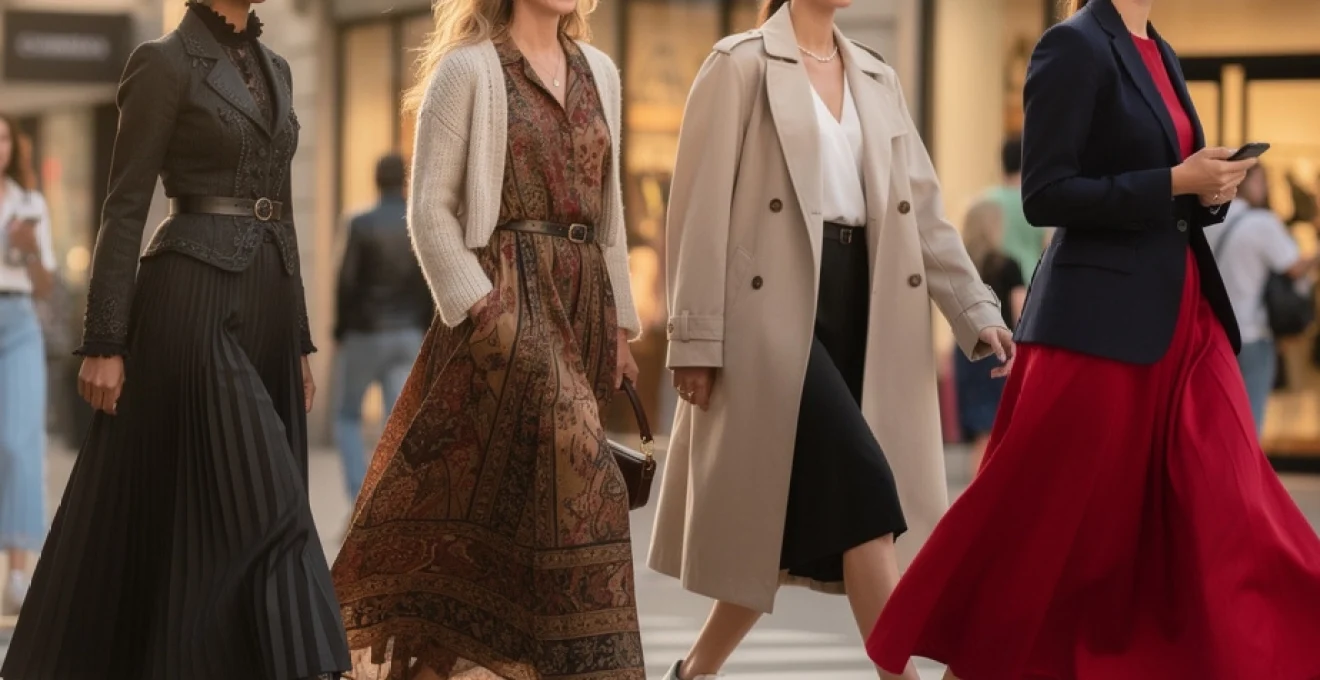
Fashion’s pendulum swings with predictable yet surprising rhythm, and nowhere is this more evident than in the current renaissance of long skirts. After years of mini dominance and dress obsession, the fashion landscape is witnessing a remarkable shift towards extended hemlines that cascade past the knee, embracing everything from flowing maxis to structured midis. This revival isn’t merely about nostalgia; it represents a fundamental change in how contemporary women approach dressing, prioritising versatility, comfort, and sophisticated elegance over fleeting trends.
The transformation has been swift and decisive. Fashion capitals from Milan to Copenhagen are showcasing street style photography dominated by extended silhouettes, whilst retail analytics reveal unprecedented sales spikes for longer hemline options. Design houses are reimagining their approach to feminine dressing, moving beyond the traditional dress-and-trouser binary to embrace the nuanced sophistication that long skirts uniquely provide. This shift signals not just a seasonal trend, but a lasting evolution in women’s wardrobe architecture.
Historical fashion cycles: understanding the long skirt revival pattern
Fashion operates on cyclical patterns that historians have documented for centuries, with hemline fluctuations serving as reliable barometers of cultural and economic shifts. The current long skirt renaissance follows these established patterns whilst responding to contemporary lifestyle demands that previous generations never encountered. Understanding these cycles provides crucial insight into why extended hemlines have captured the collective fashion imagination with such intensity.
Victorian era influence on contemporary midi and maxi silhouettes
The Victorian era’s emphasis on modesty and structured elegance continues to influence modern skirt design, particularly in the architectural approach to volume and proportion. Contemporary designers are drawing inspiration from Victorian silhouettes whilst adapting them for modern mobility and lifestyle requirements. The high-waisted positioning that characterises many current midi styles directly references Victorian tailoring techniques, creating elongated lines that flatter diverse body types whilst maintaining historical authenticity.
Modern interpretations of Victorian-inspired skirts incorporate contemporary fabric technologies and construction methods that weren’t available to 19th-century dressmakers. This fusion creates garments that honour historical precedent whilst meeting current performance expectations. The structured underpinnings that once defined Victorian skirts have been reimagined through strategic seaming and innovative fabric choices that provide shape without restricting movement.
1970s bohemian movement: direct parallels to current aesthetic trends
The 1970s bohemian aesthetic provides the most direct historical precedent for today’s long skirt obsession, with flowing maxi silhouettes and prairie-inspired details experiencing remarkable contemporary relevance. Designers are deliberately referencing this era’s free-spirited approach to femininity whilst updating construction techniques and styling approaches for modern sensibilities. The decade’s emphasis on natural fabrics, flowing lines, and romantic detailing resonates strongly with current sustainability concerns and comfort priorities.
Contemporary interpretations of 1970s bohemian styling incorporate updated proportional relationships and sophisticated colour palettes that reflect current aesthetic preferences. The peasant-inspired details that defined the original movement have been refined through modern tailoring techniques, creating pieces that capture the era’s romantic essence without appearing costume-like. This evolution demonstrates fashion’s ability to honour historical inspiration whilst meeting contemporary sophistication standards.
Cyclical fashion theory: predictive models for hemline fluctuations
Fashion theorists have developed sophisticated models for predicting hemline fluctuations based on economic indicators, cultural shifts, and generational preferences. Current data suggests that the long skirt revival represents more than temporary trend cycling, indicating a fundamental shift in fashion consumption patterns. Economic uncertainty often correlates with longer hemlines, as consumers seek versatile pieces that provide extended wear value and timeless appeal.
The predictive models also account for demographic influences, with millennials and Generation Z demonstrating distinct preferences for sustainable, versatile wardrobe pieces. These generations prioritise cost-per-wear calculations and multi-functional garments that adapt to various lifestyle demands. Long skirts perfectly align with these priorities, offering styling versatility that extends from professional environments to casual social settings.
Post-pandemic comfort dressing: sociological factors driving length preferences
The global pandemic fundamentally altered fashion priorities, creating lasting preference shifts towards comfort-focused dressing that maintains professional appearance standards. Long sk
The global pandemic fundamentally altered fashion priorities, creating lasting preference shifts towards comfort-focused dressing that maintains professional appearance standards. Long skirts sit at the intersection of these needs, offering the ease of loungewear with the polish of traditional office attire. After years of remote work and relaxed dress codes, many of us are reluctant to relinquish comfort entirely, even as we return to physical workplaces and social events. Extended hemlines in breathable fabrics such as cotton poplin, soft wool blends, and fluid viscose allow for unrestricted movement whilst signalling intention and care in outfit planning. In this sense, long skirts function as a sartorial bridge between our at-home wardrobes and our re-emerging public lives.
Sociologically, longer hemlines also reflect a recalibrated relationship with body display and personal boundaries. As we renegotiated public space after lockdowns, many consumers gravitated towards silhouettes that felt protective yet not frumpy, elegant yet not overly formal. The long skirt answers this brief by providing coverage without sacrificing style, enabling subtle self-expression through print, texture, and cut rather than overt exposure. Moreover, the ability to restyle a single maxi or midi skirt across multiple seasons and contexts supports a more considered, slower approach to consumption, which has become a post-pandemic priority for a growing segment of fashion-conscious consumers.
Designer collections pioneering the long skirt renaissance
Runway collections over the past few seasons have been instrumental in repositioning the long skirt from supporting act to lead protagonist. Rather than treating maxi and midi skirts as purely seasonal or resort-specific, major houses are embedding them into their core ready-to-wear narratives. This shift is evident across diverse aesthetic vocabularies, from minimalist tailoring to maximalist print stories, signalling that the long skirt has secured its place as a foundational category. By examining the work of key designers championing extended hemlines, we gain a clearer understanding of why this silhouette now feels both aspirational and entirely practical.
Gabriela hearst’s sustainable maxi collections: eco-conscious luxury positioning
Gabriela Hearst has emerged as a pivotal figure in framing the long skirt as an emblem of eco-conscious luxury. Her maxi skirts often feature responsibly sourced cashmere, merino wool, recycled materials, and deadstock fabrics, demonstrating that considered fabrication can coexist with refined, directional design. The elongated silhouettes in her collections are rarely ornamental; they are engineered to offer warmth, movement, and durability, aligning with her philosophy that true luxury should be built to last. For consumers seeking a sustainable long skirt option that still feels investment-worthy, Hearst’s work sets a powerful benchmark.
From a design perspective, Hearst frequently uses long skirts as canvases for subtle craftsmanship rather than overt branding. Panelled construction, intricate ribbing, and carefully placed godets create volume where needed and streamline where not, producing maxis that skim rather than swamp the figure. This approach resonates strongly with buyers evaluating cost-per-wear and environmental impact, as a single well-cut maxi can be worn with boots and knits in winter, then sandals and tank tops in summer. In effect, Hearst’s collections have helped reposition the long skirt as a core sustainable wardrobe pillar rather than a passing trend piece.
The row’s minimalist midi approach: architectural tailoring techniques
The Row has been equally influential in popularising long skirts, particularly through its architectural midi silhouettes. Mary-Kate and Ashley Olsen frequently treat skirts as structural elements within a look, using precise tailoring to create clean lines and controlled volume. Their midis often sit just above the ankle, striking a deliberate balance between coverage and practicality, which makes them ideal for urban dressing. If you have ever wondered why a simple black midi can look so elevated in street style imagery, The Row’s pattern cutting and fabric choice are often the answer.
Technical details define these pieces: darts that contour without clinging, invisible side zips that preserve uninterrupted lines, and heavy yet fluid fabrics that drape rather than collapse. The brand’s commitment to proportion—pairing elongated skirts with elongated coats, or juxtaposing them against shrunken knits—has influenced countless contemporary labels. As a result, the minimalist long skirt has become a staple for professionals who want to move away from trousers without sacrificing a sharp, modern aesthetic. The Row proves that long skirts can be as rigorously tailored and architecturally considered as any suit.
Zimmermann’s romantic prairie aesthetic: print integration and fabric manipulation
At the other end of the aesthetic spectrum, Zimmermann has transformed the long skirt into a vehicle for romantic storytelling. Drawing from prairie and Victorian references, the brand’s maxi skirts frequently feature tiered constructions, soft ruffles, and intricate floral or paisley prints. Rather than leaning into costume, however, Zimmermann uses advanced fabric manipulation—cutwork, placement printing, and textural contrasts—to keep the silhouettes firmly in the realm of contemporary luxury. For those attracted to the idea of a bohemian long skirt but wary of looking dated, these design strategies offer a compelling path forward.
Print integration is particularly sophisticated in Zimmermann’s collections. Large-scale motifs may be concentrated at the hem to draw the eye downward and elongate the body, whilst softer, smaller prints are reserved for areas that benefit from visual subtlety. Strategic use of sheer overlays and lining depths ensures that even the most whimsical maxi length remains wearable in real life. This attention to detail explains why Zimmermann’s long skirts transition so seamlessly from resort destinations to city streets, and why they have become a staple in editorial shoots exploring modern boho-chic style.
Jacquemus’ structural experimentation: volume control and proportion innovation
Jacquemus approaches the long skirt from a more experimental, sculptural angle, playing with volume, asymmetry, and negative space. His collections frequently showcase skirts with exaggerated side splits, asymmetric hemlines, or unexpected draped panels, inviting us to reconsider what a maxi or midi can look like. Rather than simply extending the hemline, Jacquemus manipulates fabric as if it were soft architecture, creating movement and drama even in relatively simple colour palettes. For fashion-forward consumers, these designs answer the question: how can a long skirt feel directional rather than conservative?
Volume control is central to this experimentation. A skirt may hug the hips closely before exploding into a fluted hem, or it might appear almost columnar from the front while revealing generous volume and slit work from the side. Proportional innovation continues in styling: tiny crop tops, oversized blazers, or sculptural accessories shift the visual centre of gravity, ensuring the look remains dynamic. This approach has filtered down to contemporary brands and high-street labels, which increasingly offer long skirts with unexpected cut-outs, wrap constructions, and adjustable hemlines, widening the appeal of extended lengths for a generation that prizes individuality.
Technical construction elements defining modern long skirt design
Beyond aesthetics, the resurgence of long skirts is underpinned by technical construction choices that optimise fit, comfort, and movement. Modern maxi and midi designs rely on a combination of strategic seaming, fabric engineering, and functional details to deliver silhouettes that work in real life rather than just on the runway. Understanding these construction elements helps you evaluate quality and choose long skirts that will integrate smoothly into your wardrobe.
Key factors include waistband architecture, slit placement, and panel configuration. Contoured waistbands and partial elastication, often hidden at the back, provide ease without compromising clean lines at the front. Slits—whether centre, side, or back—are calibrated not only for aesthetic effect but also for stride length, with many brands now testing garments for walking, stair-climbing, and sitting comfort. Panelled construction, bias-cut segments, and godets are used to control how fabric moves around the body, preventing the clinging or twisting that can plague poorly designed long skirts. Advances in lightweight linings, stretch-infused weaves, and recycled fibres further support all-day wearability, even in floor-sweeping lengths.
Street style documentation: global fashion capitals embracing extended hemlines
While runways introduce concepts, it is street style that confirms whether a trend truly resonates. Over the last few seasons, street photography from global fashion capitals has consistently spotlighted long skirts as a go-to choice for editors, influencers, and industry insiders. From pared-back monochrome maxis in Milan to layered, eclectic interpretations in Tokyo, extended hemlines are proving remarkably adaptable. Analysing these visual case studies offers valuable insight into how you can translate the long skirt trend into everyday outfits tailored to your lifestyle.
Milan fashion week 2024: editorial photography analysis of long skirt styling
Milan Fashion Week 2024 provided some of the clearest evidence that the long skirt has become an editorial favourite. Street style images captured showgoers pairing sleek column maxis with oversized leather jackets, or styling pleated midis with sharp blazers and pointed-toe boots. The overarching narrative was one of controlled drama: silhouettes were elongated and fluid, but never chaotic. Many looks relied on a restrained colour palette—think black, camel, charcoal, and deep burgundy—allowing the skirt’s movement and cut to take centre stage.
From a styling-analysis standpoint, Milan underscored the importance of material contrast. Shiny satin skirts were grounded with matte wool coats; structured suiting fabrics were softened by slouchy knitwear. Photographers repeatedly focused on the way hems interacted with footwear—barely skimming the top of a boot or revealing a precise slice of ankle. This attention to detail shows how crucial micro-proportions are when wearing long skirts in a city context. If you are aiming for a similarly polished effect, consider how your hemlines align with your shoe height and coat length; even a few centimetres can transform the overall impression.
Copenhagen street style: scandinavian minimalism in extended silhouettes
Copenhagen has become synonymous with functional minimalism, and its street style offers a masterclass in relaxed long skirt outfits that still feel intentional. Outside the shows, editors frequently opted for A-line or straight-cut maxis in robust fabrics like denim, wool, and technical blends, paired with practical outerwear and sneakers or chunky boots. The vibe was less about drama and more about ease: skirts that could realistically be cycled in, worn to the office, and then taken straight to dinner. This reflects the Scandinavian preference for pieces that blend form and function seamlessly.
Colour usage in Copenhagen also merits attention. Neutral bases—stone, navy, ecru—were often punctuated with a single accent, such as a bright knit or sculptural bag, allowing the long skirt to act as a quiet anchor. Layering was key, with quilted vests, cropped puffers, and tailored coats all sitting comfortably over extended hemlines. For anyone wondering how to incorporate long skirts into a capsule wardrobe, Copenhagen’s street style suggests a simple formula: choose a versatile, minimal maxi, then rotate tops and outerwear around it to accommodate changing weather and occasions.
Tokyo harajuku district: kawaii culture’s interpretation of maxi length fashion
In Tokyo’s Harajuku district, long skirts take on an entirely different personality, filtered through kawaii culture and eclectic subcultural styling. Here, maxi and midi lengths are often layered—tulle over denim, ruffled cotton over lace petticoats—to create volume and texture rather than streamlined minimalism. Prints range from pastel plaids to whimsical illustrations, and hemlines may be intentionally uneven or adorned with bows, charms, or contrasting panels. The result is a visual language that treats the long skirt as a creative playground rather than a purely practical garment.
What can we learn from this maximalist approach, even if our personal style is more restrained? Harajuku fashion underscores that long skirts are uniquely suited to experimentation. Because they provide ample surface area, they can carry bold motifs, unexpected fabric combinations, and playful detailing without feeling skimpy or exposed. For those seeking to inject individuality into their wardrobes, borrowing a single element from Harajuku styling—a tulle overlay, a statement print, or a layered petticoat—can transform a basic maxi into a standout piece while still remaining wearable in everyday contexts.
New york SoHo: professional styling integration of long skirts in corporate wardrobes
In New York’s SoHo and neighbouring business districts, long skirts have become increasingly visible in corporate and creative-professional wardrobes. Street style images frequently show tailored wool or structured knit midis styled with crisp shirts, fine-gauge turtlenecks, and sharp blazers. The effect sits somewhere between traditional suiting and more relaxed creative dressing, offering a polished alternative to trousers that still feels modern. For many professionals navigating hybrid work environments, this “elevated ease” hits exactly the right note.
A notable pattern in SoHo is the use of monochrome or near-monochrome outfits to maximise the long skirt’s elongating effect. Black-on-black, navy with tonal stripes, or camel layered with slightly deeper browns create clean vertical lines that flatter a wide range of body types. Footwear choices lean towards block-heel boots, sleek loafers, and minimalist pumps, all of which provide stability for city walking. If you work in a setting with a business-casual dress code, adopting this New York approach—anchoring your look with a tailored long skirt and building tonal layers around it—can help you appear both current and work-appropriate.
Retail data analytics: sales performance and consumer adoption metrics
The visual prominence of long skirts is strongly supported by retail data. Over the last two to three years, many multi-brand e-commerce platforms and department stores have reported double-digit percentage growth in maxi and midi skirt categories, often outpacing traditional trouser and dress segments. Search trends echo this rise: queries for phrases such as “black satin maxi skirt outfit” or “work-appropriate midi skirt” have surged, indicating not only interest but specific intent to integrate these pieces into daily life. When we look at sell-through rates, long skirts in neutral colours and versatile fabrics perform particularly well, confirming their role as wardrobe foundations rather than impulse buys.
From an adoption-curve perspective, we appear to be moving from early-majority to late-majority uptake of extended hemlines. Initially championed by influencers, editors, and niche labels, long skirts are now ubiquitous across high-street brands, premium contemporary lines, and luxury houses. This broad availability feeds a positive feedback loop: as more consumers see long skirts styled in relatable contexts—from social media to office corridors—they are more likely to view them as practical purchases. For retailers, this shift encourages deeper assortments, improved size runs, and investment in better-quality fabrics, all of which further consolidate the long skirt’s position as a long-term category rather than a short-lived trend.
Styling methodology: technical approaches to long skirt proportional balance
Successfully incorporating long skirts into your wardrobe is as much about styling methodology as it is about the garments themselves. Because extended hemlines alter your body’s visible proportions, they require considered choices around footwear, outerwear, and accessories. Rather than relying on vague advice to “balance” a look, we can think in terms of simple, repeatable rules—almost like style algorithms—that make it easier to achieve harmonious proportions. By approaching long skirt outfits with a more technical mindset, you gain the confidence to experiment while still looking intentional and put-together.
Footwear selection algorithms: heel height and ankle exposure ratios
Footwear is arguably the most critical variable when styling long skirts, as it directly influences perceived leg length and overall silhouette. One practical way to think about this is in terms of heel height and ankle exposure ratios. As a general guideline, the more your skirt covers your shoe, the more helpful a slight heel becomes to avoid a visually “heavy” base. For full-length maxis that skim the top of the foot, a 3–6 cm block heel or platform can subtly elongate the leg without compromising comfort. In contrast, mid-calf or ankle-skimming midis often pair beautifully with flat boots or sneakers, provided a sliver of ankle or sock is visible to break up the line.
Consider adopting a simple decision tree: if your long skirt covers more than 80% of your shoe, lean towards some elevation; if it reveals at least 5–10 cm of lower leg or ankle, flats are usually safe. Pointed or almond-toe shoes will always extend the leg line more than rounded toes, which can be useful if you are petite or wearing a particularly voluminous skirt. By treating shoe choice as a small styling equation rather than guesswork, you can quickly identify combinations that feel proportionally balanced for your height, body type, and walking needs.
Layering techniques: outerwear integration with extended hemline silhouettes
Outerwear integration is another area where long skirts demand strategic thinking. Coats and jackets that hit at awkward points—such as mid-thigh over a mid-calf skirt—can unintentionally shorten the body and create visual bulk. A more considered approach is to choose one of two clear proportional strategies: cropped over long, or long over long. Cropped jackets, leather bikers, and waist-length puffers work well with high-waisted maxis because they emphasise the waist and allow the skirt to create a continuous vertical line. Alternatively, full-length coats that extend to a similar or slightly longer length than the skirt produce a sleek, column-like effect.
When in doubt, pay attention to where your outerwear hem falls in relation to the fullest part of your hips and thighs. Ending a coat just above or just below this point is usually more flattering than cutting across it directly. Lightweight trench coats, duster jackets, and tailored wool coats are particularly versatile companions for long skirts, transitioning smoothly across seasons. By thinking of outerwear as the architectural frame around your skirt rather than a separate layer, you can avoid the common pitfall of looking swamped or disproportionate in extended hemlines.
Accessory coordination: belt placement and bag scale proportional theory
Accessories may seem secondary, but they play a crucial role in refining the proportions of long skirt outfits. Belt placement, in particular, can dramatically alter how your body is visually divided. High-waisted skirts benefit from belts positioned at the narrowest part of the torso, creating a clear waist definition and preventing the eye from getting lost in fabric. Medium-width belts—neither ultra-thin nor extremely wide—tend to be the most versatile, offering structure without overwhelming the look. If your skirt has built-in seaming or waistband detailing, you can use a belt to highlight or slightly adjust where the visual waistline appears.
Bag scale follows a similar proportional logic. Oversized totes and slouchy hobos pair naturally with fluid maxis, maintaining balance between the volume of the skirt and the accessory. In contrast, if you are wearing a more streamlined pencil or column midi, a structured medium-sized shoulder bag or crossbody often feels more in sync. As a rule of thumb, avoid pairing extremely tiny bags with floor-sweeping skirts unless the rest of the outfit is very minimal; the contrast can make the skirt appear overly dominant. By consciously matching belt width and bag size to your skirt’s volume and length, you create a cohesive, well-calibrated silhouette.
Body type adaptation: tailoring modifications for optimal fit characteristics
Finally, optimising long skirts for different body types often comes down to small tailoring modifications rather than entirely different designs. If you have a petite frame, shortening a maxi by just a few centimetres so it hits at the slimmest part of your ankle can make a transformative difference, preventing the fabric from overwhelming your proportions. For those with curvier hips, adding a discreet back slit or side godet can improve walking ease and reduce pulling across the seat. Straight or H-shaped body types may benefit from skirts with subtle A-line flares or diagonal seaming to suggest more waist definition.
Do not underestimate the impact of adjusting waistbands and darts. A slightly lowered or raised waistband can change how fabric falls over the midsection, while repositioned darts can contour to your unique shape more accurately. Many modern long skirts are designed with simple hemlines and clean seams precisely so that alterations are easier and more cost-effective. Viewing a long skirt as a starting point rather than a finished product—one that you can fine-tune to your specific proportions—ensures better comfort, greater confidence, and ultimately a much higher likelihood that the piece will become a true wardrobe workhorse rather than a trend-led experiment.