
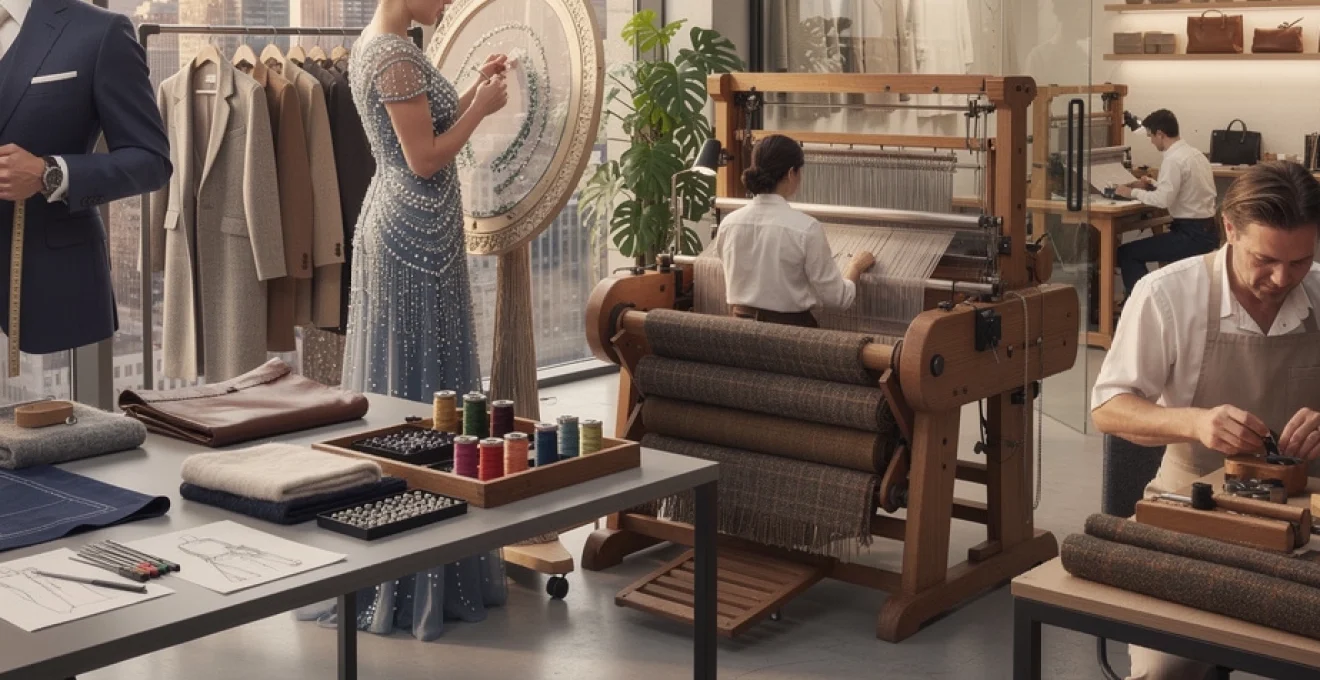
The fashion industry stands at a fascinating crossroads where centuries-old artisanal techniques are experiencing an unprecedented renaissance. This revival isn’t merely nostalgia-driven; it represents a sophisticated response to consumer fatigue with mass production, environmental concerns, and a growing appetite for authenticity. From Savile Row’s bespoke tailoring to Maison Lesage’s intricate embroidery, traditional craftsmanship is being rediscovered, refined, and integrated with cutting-edge technology to create a new paradigm in fashion production. The movement encompasses everything from heritage weaving processes to luxury leather working, fundamentally challenging the fast fashion model while offering consumers something genuinely precious: garments with soul, story, and unparalleled quality.
Artisanal manufacturing techniques reshaping contemporary fashion production
The resurgence of artisanal manufacturing techniques represents more than a trend; it’s a fundamental shift in how the fashion industry approaches production. Traditional methods, once considered obsolete in our digital age, are proving their enduring relevance by delivering quality, uniqueness, and environmental sustainability that mass production simply cannot match. This transformation is being driven by consumers who increasingly value the human touch, the imperfections that speak of authentic handwork, and the stories embedded within each carefully crafted piece.
Hand-finishing methods in savile row tailoring revival
Savile Row continues to set the global standard for bespoke tailoring, with its hand-finishing methods representing the pinnacle of sartorial craftsmanship. The revival of these techniques has seen a remarkable 35% increase in interest over the past five years, with younger clientele particularly drawn to the personalisation and quality that only hand-finishing can provide. Master tailors employ techniques passed down through generations, including hand-sewn buttonholes, floating chest pieces, and meticulous pressing methods that create the distinctive drape and fit that machines simply cannot replicate.
The process involves over 80 hours of skilled handwork for a single suit, with craftspeople dedicating years to perfecting their technique. What makes this revival particularly interesting is how these traditional methods are being adapted for contemporary lifestyles. Modern Savile Row houses are incorporating performance fabrics and updated silhouettes while maintaining their commitment to hand-finishing techniques. The result is clothing that bridges the gap between heritage craftsmanship and modern functionality, appealing to discerning customers who refuse to compromise on either quality or contemporary relevance.
Traditional embroidery techniques from maison lesage and tambour beading
Maison Lesage, founded in 1924 and now part of Chanel’s Métiers d’Art collection, represents the apex of embroidery craftsmanship. Their tambour beading technique, which involves using a hooked needle to create intricate beadwork and embroidery, requires artisans to undergo years of training to achieve mastery. The house employs over 200 craftspeople who can create up to 1,000 hours of work on a single haute couture garment, demonstrating the incredible investment in time and skill that traditional embroidery demands.
The revival of these techniques has seen fashion houses increasingly commissioning Maison Lesage for ready-to-wear collections, not just haute couture pieces. This democratisation of high-end embroidery techniques has made artisanal embellishment more accessible while maintaining the integrity of traditional methods. The atelier’s work now spans from delicate floral motifs requiring microscopic precision to bold, sculptural pieces that push the boundaries of what embroidery can achieve. Their techniques include not just tambour work, but also Lunéville embroidery, goldwork, and innovative mixed-media approaches that incorporate everything from feathers to metallic threads.
Heritage weaving processes at harris tweed authority mills
The Harris Tweed Authority maintains one of the most stringent protection systems for traditional weaving in the world. Under the Harris Tweed Act of 1993, authentic Harris Tweed must be hand-woven by islanders in their own homes using virgin wool dyed and spun in the Outer Hebrides of Scotland. This protection has preserved not just a technique, but an entire way of life that produces approximately 1.2 million metres of tweed annually. The process begins with local wool
that is carefully sorted, washed, carded and spun before being warped and woven on traditional looms. Each weaver operates from their own home or small shed, often on equipment that has been in the family for generations, giving every bolt of cloth a literal sense of place. The resulting fabric is then finished in local mills, where it is washed, pressed and inspected before receiving the iconic Orb certification mark that guarantees its origin and quality.
What makes Harris Tweed particularly relevant to modern fashion production is its alignment with slow fashion values. The cloth is naturally durable, repairable and weather-resistant, meaning garments made from it are designed to last for decades rather than seasons. Contemporary brands are reinterpreting this heritage textile in lightweight suiting, streetwear silhouettes and technical outerwear, pairing the traditional weave with modern linings and construction. In doing so, they demonstrate how heritage weaving can sit comfortably within contemporary wardrobes while offering a powerful alternative to disposable, trend-driven fabrics.
Cordwaining craftsmanship in northampton shoemaking districts
Northampton and its surrounding towns have been the heartland of English shoemaking since at least the 15th century, and the district’s cordwaining craftsmanship remains a benchmark for quality footwear worldwide. Traditional Goodyear-welted construction, pioneered and perfected here, allows shoes to be resoled multiple times, dramatically extending their lifespan compared to cemented, mass-produced alternatives. Each pair of high-end Northampton shoes can pass through more than 200 individual operations, many of which still rely on skilled handwork, from clicking (cutting the leather) to hand-burnishing and polishing.
In the face of global competition and cheaper overseas production, Northampton makers have doubled down on what sets them apart: meticulous construction, premium leathers and repairability. Several historic factories have opened their doors to tours and workshops, allowing consumers to see first-hand the labour and expertise embedded in a pair of handcrafted shoes. This transparent approach not only justifies the higher price point but also taps into the growing consumer desire for traceability and craft-led fashion. For designers seeking to build more sustainable collections, partnering with Northampton cordwainers offers a way to integrate heritage quality into contemporary sneakers, boots and hybrid footwear without sacrificing modern aesthetics.
Luxury fashion houses integrating traditional craftsmanship methodologies
Heritage techniques are not confined to small ateliers or regional workshops; they are increasingly central to the strategies of the world’s leading luxury fashion houses. In an era where brand stories are scrutinised as closely as products themselves, these maisons are realising that their most compelling narrative asset is often their craftsmanship. By placing artisans at the heart of their identity and integrating traditional methods with modern design and marketing, luxury brands are differentiating themselves from both fast fashion and mid-market competitors. The result is a renewed focus on authenticity, provenance and long-term value.
Hermès leather atelier integration with contemporary design processes
Hermès is frequently cited as the gold standard for leather craftsmanship, and for good reason. Each iconic bag, from the Birkin to the Kelly, is made by a single artisan who oversees every step of construction, from selecting the hide to stitching and finishing. This one-craftsperson-one-bag approach can require 15 to 20 hours or more of meticulous work, with saddle stitching techniques that are significantly stronger than machine seams. Artisans undergo years of training in the company’s workshops, and only a small number reach the level required to work on the most coveted pieces.
What is particularly notable today is how Hermès integrates this slow, artisanal production model with contemporary design and demand. Rather than scaling through automation, the brand scales by training new craftspeople and opening regional ateliers closer to key markets, such as its workshops in France and, more recently, expanded facilities in the wider European region. At the design stage, creative teams collaborate directly with artisans to understand technical constraints and possibilities—ensuring that new silhouettes, hardware and functions respect the integrity of traditional methods. For consumers, this integration of craft and design translates into a tangible perception of value: you are not simply buying a logo, but a piece of living craftsmanship that can be repaired, maintained and cherished for decades.
Chanel métiers d’art acquisitions and artisan workshop preservation
Chanel’s Métiers d’Art initiative offers one of the most comprehensive examples of how a major luxury house can preserve, protect and modernise artisanal workshops. Since the late 1980s, Chanel has quietly acquired and invested in specialist maisons—from embroiderer Maison Lesage and feather maker Lemarié to milliner Maison Michel and bootmaker Massaro—bringing them under the umbrella of Paraffection, a dedicated entity whose name literally means “for the love of”. Rather than absorbing these ateliers into a faceless corporate structure, Chanel allows them to retain their identity, archives and specific know-how while providing financial stability and long-term orders.
This ecosystem approach does more than secure Chanel’s own supply of rare skills; it also keeps entire crafts alive for the wider fashion industry. Many Métiers d’Art houses work with other brands and independent designers, spreading the benefits of investment and innovation. Annual Métiers d’Art collections, showcased in locations from Dakar to Tokyo, double as storytelling platforms that spotlight artisan techniques on a global stage. For emerging creatives wondering how to access high-level craftsmanship, the Chanel model illustrates an important lesson: strategic partnerships and long-term commitments are key to sustaining artisan communities in a globalised fashion economy.
Brunello cucinelli cashmere processing and italian solomeo workshops
Brunello Cucinelli has built an entire brand philosophy around “humanistic capitalism”, with craftsmanship at its core. Based in the medieval village of Solomeo in Umbria, Italy, the company has revitalised local communities by restoring historic buildings and turning them into workshops, design studios and training centres. Here, cashmere garments are produced using a blend of traditional handwork and carefully selected modern machinery, with an emphasis on gentle processing that protects fibre quality and softness. Many finishing steps—from hand-linking knitwear to final steaming and inspection—are still performed by skilled craftspeople.
What sets the Solomeo model apart is its explicit linkage between ethical working conditions, craft quality and brand value. Artisans are paid fairly, trained extensively and encouraged to see themselves as custodians of a tradition rather than invisible labour in a supply chain. For consumers, this translates into a powerful narrative: choosing a cashmere sweater becomes an act of supporting a specific place, community and way of working. For other brands exploring how to elevate their own craftsmanship, Brunello Cucinelli demonstrates that investing in rural workshops, upskilling local talent and slowing down production can be both ethically sound and commercially successful.
Loro piana vicuña fibre processing and andean sourcing networks
Loro Piana’s reputation in luxury fashion rests heavily on its mastery of rare fibres, particularly vicuña—the “fibre of the gods” sourced from a wild camelid native to the high Andes. Working with vicuña is an exercise in extreme craftsmanship at every stage: the animals can only be shorn every two to three years, yielding minuscule quantities of ultra-fine fibre that then require meticulous sorting, dehairing and spinning. From raw fleece to finished cloth, the process can take over a year, and only a handful of highly trained technicians handle the most delicate steps.
Crucially, Loro Piana has invested heavily in long-term relationships with Andean communities and conservation programmes, helping reintroduce managed shearing practices that protect the animal and provide stable income for local people. This integrated sourcing network is a blueprint for how luxury brands can combine environmental stewardship with heritage craft. For designers and product developers, vicuña underscores a broader point: when you work with extraordinary materials in a respectful, traceable way, the resulting garments carry a depth of story and intrinsic value that mass-market fibres simply cannot rival. The premium paid by consumers is not just for softness or warmth, but for a transparent chain of skilled labour and ecological care.
Sustainable craftsmanship models disrupting fast fashion production
As fast fashion continues to face criticism for overproduction, waste and opaque labour practices, sustainable craftsmanship is emerging as a powerful counter-model. Instead of chasing volume and speed, craft-based brands prioritise longevity, repairability and emotional attachment to garments. This shift is not only ethical; it is also strategic. Studies from McKinsey and the BoF indicate that younger consumers are increasingly willing to pay more for products that are transparently made and environmentally responsible, especially when they understand the craft processes behind them.
Many of the most compelling sustainable fashion labels now operate on made-to-order or small-batch production systems, drastically reducing unsold inventory and allowing for more thoughtful use of resources. By limiting runs and focusing on pre-orders, these brands can invest in higher-quality materials and pay artisans fairly while still maintaining viable margins. You can see this approach in labels that work with handweaving cooperatives, natural dyers or bespoke shoemakers, where each piece is created with a clear end customer in mind. In practice, this often means longer lead times—but also a stronger emotional bond between buyer and garment, which in turn encourages repair and long-term use.
Another disruptive element is the integration of circular design principles into artisanal processes. Instead of treating craft as an inherently static tradition, forward-thinking makers are experimenting with modular construction, upcycled textiles and take-back schemes. For example, a handwoven coat might be designed with removable panels that can be replaced or reworked over time, or a pair of handcrafted boots may come with a lifetime resole guarantee. These models challenge the default assumption that “new” is always better and invite us to see fashion ownership more like maintaining a classic car: a long-term relationship built on care, repair and incremental upgrades rather than constant replacement.
Digital technology integration with traditional artisanal processes
The comeback of craftsmanship in modern fashion does not mean rejecting technology; instead, the most interesting innovations happen where digital tools and hand skills intersect. 3D design software, for instance, allows pattern cutters and tailors to visualise complex silhouettes, test fabric drape and minimise sampling waste before a single toile is cut. When a Savile Row tailor or independent designer uses these tools, they can preserve the nuance of hand-drafted patterns while speeding up iterations and improving fit accuracy for international clients.
Similarly, digital archives and high-resolution scanning are being used to preserve endangered techniques and document the work of ageing artisans. Workshops can record every step of a hand-embroidered motif or a specific weaving pattern, creating training resources for the next generation and ensuring that knowledge is not lost when a master retires. Some maisons are also experimenting with augmented reality experiences that let customers virtually “enter” an atelier, watching a bag being stitched or a jacket being canvassed. Used thoughtfully, these experiences build appreciation for the value of craftsmanship without reducing artisans to mere marketing props.
On the production side, technologies like laser cutting and digital printing can work hand-in-hand with manual processes to optimise both precision and creativity. A leatherworker might use laser cutting for the initial pattern pieces, then rely on hand-skiving, stitching and finishing to bring a bag to life. A weaver can collaborate with a CAD designer to translate traditional motifs into new jacquard designs that are then finished by hand. In this sense, digital tools act less like a replacement for artisans and more like an expanded toolbox—akin to giving a painter new pigments or brushes rather than swapping them for a printer.
Consumer psychology behind handcrafted fashion premium positioning
Why are more consumers willing to pay a premium for handcrafted fashion in an age of endless choice and price competition? The answer lies as much in psychology as in product specs. Handcrafted garments and accessories tap into our desire for uniqueness, story and connection in a world saturated with anonymous goods. When you know that a specific artisan cut, stitched or embroidered your piece—and perhaps even see their initials on the label—it transforms a purchase into a relationship. This perceived intimacy and rarity are key drivers behind the “handmade premium”.
Behavioural research indicates that people naturally attribute higher value to items that show visible signs of human labour or slight imperfections, a phenomenon sometimes described as the “IKEA effect” extended to luxury. The knowledge that “someone like me” has invested time and care triggers a sense of respect and reciprocity: you feel more responsible for looking after the garment, repairing rather than discarding it. This is why brands that successfully communicate their craftsmanship narrative often see higher levels of customer loyalty and lower return rates. The product becomes part of your identity and story, not just your wardrobe.
At the same time, there is a status component that goes beyond logos. In a social media landscape filled with identical “it” items, owning something visibly handcrafted—an unusual handwoven textile, a pair of bespoke shoes, a made-to-measure jacket—signals discernment and individuality. It suggests that you have invested not only money but also time and curiosity to seek out specialist makers. For brands, the challenge is to harness this desire without slipping into empty “craftwashing”. Clear information about materials, hours of work, origin and repair options helps consumers distinguish between genuine craftsmanship and surface-level marketing.
Economic impact analysis of craft-based fashion manufacturing renaissance
The renaissance of craftsmanship in modern fashion is not just a cultural phenomenon; it also carries significant economic implications. At a macro level, the global handicrafts market is projected to reach over USD 1.3 trillion by 2028, growing far faster than many segments of conventional apparel. This growth reflects shifting consumer spending from volume-based purchases to fewer, better items—an evolution that favours brands and regions with strong craft traditions. For countries such as Italy, the UK, Japan, India and Peru, where artisanal fashion production is deeply embedded, this trend supports exports, tourism and rural employment.
On a local scale, craft-based manufacturing can have a regenerative effect on communities that were previously hollowed out by offshoring and industrial decline. Revitalised weaving mills, leather workshops or knitwear factories create skilled jobs that cannot easily be automated or relocated. Because many artisanal businesses source materials locally and rely on regional supply chains, a greater share of value remains in the area, stimulating ancillary services from logistics to hospitality. When a heritage shoemaking town or textile village becomes known globally, it can attract visitors, apprentices and collaborations, turning what once seemed like an obsolete industry into a future-facing asset.
For brands and investors, the economics of craftsmanship require a mindset shift away from traditional fast fashion metrics. Output per worker may be lower, and lead times longer, but average selling prices, gross margins and customer lifetime value can be significantly higher. A well-made coat or pair of shoes, sold with repair services and a compelling story, generates recurring revenue over many years through aftercare, resales or trade-in programmes. In that sense, craft-based fashion behaves more like the luxury watch or fine jewellery sectors than seasonal apparel. As we look ahead, the real economic opportunity lies in building business models that respect the natural pace of artisanal production while leveraging technology, storytelling and new ownership concepts to unlock long-term, sustainable growth.