
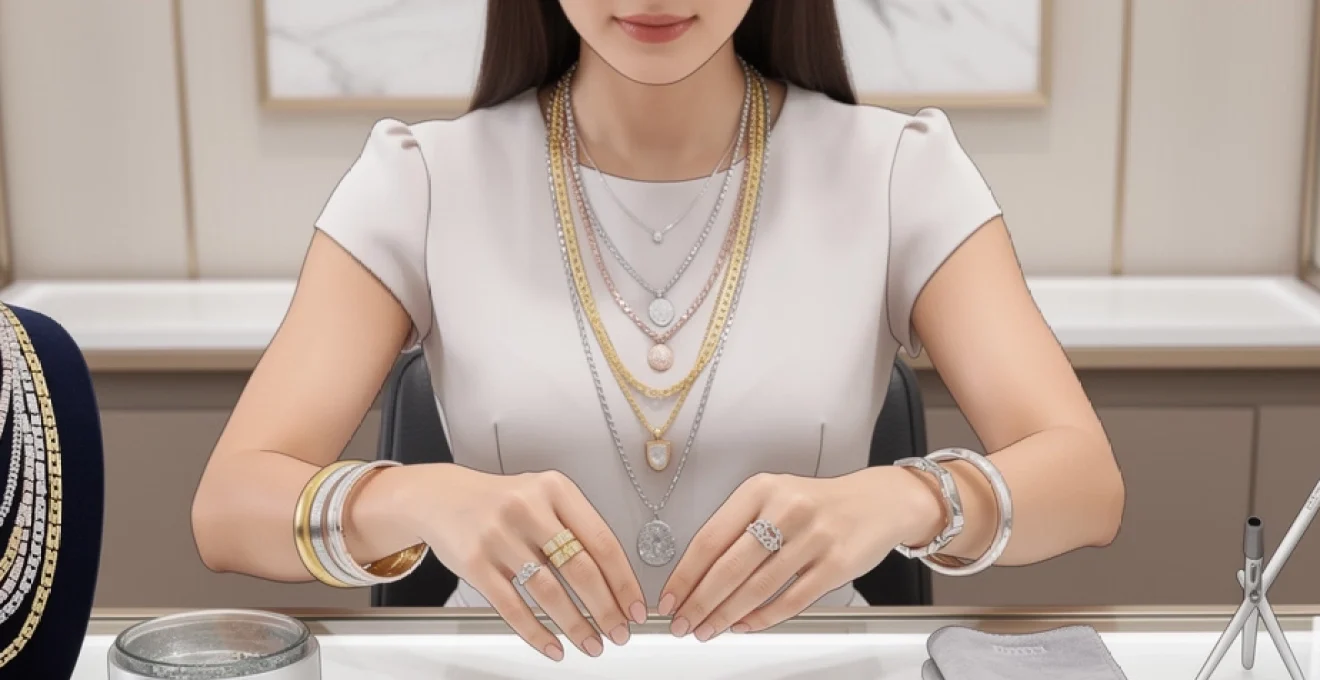
The fashion world has witnessed a dramatic shift in jewellery etiquette, with the once-rigid rule against combining gold and silver pieces now considered antiquated. Today’s sophisticated approach to accessorising embraces the dynamic interplay between warm and cool metals, creating visually compelling combinations that demonstrate both technical understanding and personal style. This evolution reflects a broader movement towards individuality in luxury accessories, where traditional boundaries dissolve in favour of creative expression.
The mastery of mixed-metal styling requires more than simply pairing disparate pieces together. Professional jewellers and style consultants recognise that successful combinations depend on understanding fundamental principles of colour theory, proportional balance, and material compatibility. The contemporary approach to bi-metal compositions draws from architectural design principles, where contrasting elements create visual tension that enhances rather than detracts from the overall aesthetic.
Modern jewellery enthusiasts are increasingly drawn to the versatility that mixed-metal styling offers. Rather than maintaining separate collections for different occasions or outfits, savvy collectors can create cohesive looks that transcend traditional categorisation. This approach not only maximises the utility of existing pieces but also opens new avenues for creative expression that were previously considered taboo.
Understanding metal compatibility: colour temperature theory in Mixed-Metal jewellery design
The foundation of successful mixed-metal styling lies in understanding the fundamental differences between warm and cool metal tones. This knowledge extends beyond simple aesthetic preferences to encompass the scientific principles that govern how different metals interact with light and skin tones. Professional jewellery designers rely on colour temperature theory to create harmonious combinations that enhance rather than compete with each other.
Warm gold undertones versus cool silver reflectance properties
Gold’s inherent warmth stems from its atomic structure, which absorbs blue wavelengths whilst reflecting yellow and red spectrum light. This creates the characteristic warm glow that has made gold a symbol of luxury across cultures for millennia. The intensity of this warmth varies significantly based on alloy composition, with higher karat weights displaying more pronounced yellow undertones. Understanding these reflectance properties becomes crucial when pairing gold with cooler metals, as the contrast can either create sophisticated tension or overwhelming discord.
Silver’s cool reflectance properties operate on entirely different principles, with its crystalline structure creating a mirror-like surface that reflects the full spectrum of visible light. This comprehensive reflection gives silver its characteristic bright, cool appearance that can appear almost blue-white under certain lighting conditions. The pristine clarity of properly maintained silver creates an excellent counterpoint to gold’s warmth, but requires careful consideration of proportions to achieve balance.
Karat weight impact on gold colour saturation and silver pairing
The karat system provides essential information for successful mixed-metal combinations, as different gold purities create varying intensities of yellow saturation. Twenty-four karat gold presents the most intense yellow coloration, making it challenging to pair with silver without creating jarring contrast. However, eighteen karat gold, with its subtle alloy content, offers sufficient warmth whilst maintaining compatibility with silver’s cool tones.
Lower karat weights, particularly fourteen and ten karat gold, contain increased amounts of copper and silver alloys that moderate the yellow intensity. These compositions often prove more versatile for mixed-metal applications, as their subdued warmth creates gentler transitions when combined with pure silver pieces. The strategic selection of appropriate karat weights can make the difference between amateur-looking combinations and professionally styled ensembles.
Rose gold and white gold as transitional bridge metals
Rose gold serves as nature’s perfect bridge between traditional yellow gold and silver, with its copper content creating warm pink undertones that complement both extremes of the metal spectrum. This unique position makes rose gold invaluable for creating cohesive mixed-metal looks, as it shares warmth characteristics with yellow gold whilst offering sufficient neutrality to harmonise with silver elements.
White gold presents a more complex proposition, as its appearance depends heavily on the specific alloys used and whether rhodium plating has been applied. Palladium-based white gold maintains inherent warmth that creates subtle connections to yellow gold, whilst rhodium-plated surfaces can appear virtually indistinguishable from platinum or silver. Understanding these distinctions becomes crucial when incorporating white gold into mixed-metal compositions, as the wrong combination can create muddy or
muddy or visually confusing transitions between neighbouring pieces. When used thoughtfully, however, white gold can function as a subtle mediator between bright silver and saturated yellow gold, particularly in settings such as engagement rings and fine bracelets where you may want the overall impression to remain refined rather than high-contrast.
Oxidation patterns and patina development in mixed compositions
Beyond colour, the long-term appearance of mixed-metal jewellery is shaped by how each metal oxidises and develops patina. Sterling silver naturally tarnishes as it reacts with sulphur compounds in the air, shifting from bright white to soft grey and eventually to deep charcoal tones if left unpolished. Gold, by contrast, is chemically inert in its pure form and does not tarnish; any visible colour change in gold alloys is usually due to the behaviour of copper, nickel, or zinc within the mixture.
In a mixed-metal bracelet or necklace, this means your silver components will usually darken faster than the gold, creating stronger visual contrast over time. For some collectors, that evolving contrast is part of the charm, giving the piece an antique or lived-in character that highlights engraving, chain texture, and stone settings. For others, uneven patina can make a curated stack look unbalanced or visually “dirty,” especially when high-polish yellow gold is paired with heavily oxidised silver elements.
Professional jewellers manage this by anticipating oxidation patterns in the design phase. Highly detailed silver sections may be deliberately left to darken, creating depth behind high-polish gold accents that are regularly maintained. Conversely, contemporary minimalists may prefer rhodium-plated silver or white gold that resists tarnish, keeping the entire composition crisp and reflective. Understanding how each metal will age helps you decide whether you want your mixed-metal jewellery to look pristine and architectural, or soft and time-worn.
Professional layering techniques for necklaces and pendant combinations
Layering gold and silver necklaces is where theory becomes practice. When you move from a single chain to three or four, tiny decisions about length, weight, and clasp style determine whether your mixed-metal jewellery looks curated or chaotic. Professional stylists treat the neckline almost like a vertical gallery wall: each necklace occupies its own visual “zone” while contributing to an overall composition that flatters both face and outfit.
To master mixed-metal necklace layering, you need to consider not just the colours of gold and silver, but also the geometry of each chain, the scale of the pendants, and the way they move on the body. A well-designed stack uses contrast—between warm and cool metals, between fine and chunky links—to create rhythm without tangling or competing focal points. When in doubt, we start with structure: mapping chain lengths, then working outwards into weight distribution, clasp mechanics, and skin tone placement.
Chain length mathematics: creating visual balance with graduated sizing
Effective necklace layering starts with simple “chain length mathematics.” Rather than choosing lengths at random, professionals space necklaces in deliberate intervals, usually 2–5 cm apart, to avoid overlap of focal points. For example, a classic three-chain mixed-metal stack might sit at 38 cm (choker), 43 cm (collarbone), and 50 cm (mid-chest), with each successive chain slightly heavier or more detailed than the last. This graduated sizing allows the eye to travel smoothly from neck to décolleté, taking in each piece in turn.
When mixing gold and silver jewellery, you can use length to control where each metal is most visible. A short, bright silver choker acts almost like a reflector under the jawline, while a mid-length yellow gold pendant draws attention towards the centre of the torso. If you add a longer, delicate silver chain below, it frames the look without visually overpowering the gold. Think of it as composing a sentence: the top necklace is the capital letter, the central pendant is the main clause, and the longest layer is the elegant full stop.
For more complex stacks of four or five necklaces, we often follow a simple rule: alternate “statement” and “supporting” roles. A bold gold rope chain at 40 cm might be followed by a minimal silver box chain at 45 cm, then a mixed-metal pendant at 55 cm that visually ties both tones together. By keeping the length increments consistent and assigning each necklace a clear function, you avoid the cluttered look that can make even the most beautiful pieces feel unintentional.
Pendant weight distribution across multi-metal chain systems
Once lengths are set, pendant weight becomes the next critical factor in mixed-metal necklace design. Heavy pendants on fine chains tend to pull forward and fight for dominance, especially when several pieces share similar drop points. In professional styling, we usually allocate the heaviest pendant to the middle layer, where the chest can support it comfortably, and keep the shortest and longest chains lighter and more flexible.
When combining gold and silver pendants, it often works best to designate a single “hero” piece—perhaps a substantial yellow gold medallion or a mixed-metal locket—and then surround it with subtler accents. Lighter silver charms on upper or lower chains can echo shapes or motifs from the central pendant without competing for attention. This hierarchy is particularly important if you are wearing sentimental jewellery such as a diamond solitaire or religious symbol that you want to remain the visual focus.
From a practical perspective, distributing weight thoughtfully also reduces tangling and friction between metals. A heavy 18k gold pendant on a robust curb chain will resist twisting around a delicate silver cable chain, especially if the lighter piece sits closer to the neck. As a rule of thumb, imagine you are building a suspension bridge: the strongest “pillars” belong in the middle, while the outer spans remain lighter and more flexible to support movement.
Clasp mechanics and security considerations for layered designs
Beautiful mixed-metal layers mean little if the clasp mechanics are not secure. Different metals and chain styles require different closures, and when you combine several necklaces, the back of your neck can quickly become a tangle of lobster clasps, spring rings, and extension chains. Professional jewellers minimise this by standardising clasp sizes where possible and positioning the heaviest chains closest to the skin so lighter necklaces can move over them rather than under.
A practical strategy for multi-layer gold and silver jewellery is to use a multi-strand connector or layering clasp. These devices allow several chains to attach to a single closure, keeping lengths fixed and preventing individual strands from spinning around each other. They are particularly valuable when combining high-karat gold with softer sterling silver, as they reduce the metal-on-metal abrasion that can wear links over time.
Security is also a question of environment. If you are wearing several fine necklaces for an evening event, a discreet yet robust lobster clasp in 14k gold or rhodium-plated silver is preferable to delicate spring rings that may open under tension. For everyday wear, especially if you’re frequently changing between gold and silver chains, consider having your most-used pieces adjusted by a jeweller so that clasp types and positions align. This kind of behind-the-scenes engineering is what makes a professional mixed-metal stack feel effortless on the body.
Skin tone analysis for optimal metal placement hierarchy
Colour temperature theory returns when we consider where each metal sits against the skin. Because the shortest necklace is visually closest to your face, its metal tone has the greatest impact on how your complexion appears. If you have warm or olive undertones, placing yellow or rose gold closest to the neck can enhance natural radiance, while cooler, high-reflectance silver can be used in mid or lower layers as a framing element. For cool undertones, the reverse strategy often proves most flattering.
In professional styling consultations, we often treat mixed-metal jewellery like contouring cosmetics. Gold acts as the “bronzer,” adding warmth and drawing attention to specific features, while silver functions like highlighter, bringing clarity and brightness to other areas. You might choose a slim silver choker to sharpen the jawline, then a slightly longer rose gold pendant to add softness across the collarbones. By thinking in terms of light and shadow rather than simple preference, you can place each metal where it will do the most aesthetic work.
Of course, rules bend when personal significance enters the picture. If your most important piece—a wedding pendant or heirloom locket—is in a metal that technically contrasts with your undertone, you can still build a flattering hierarchy around it. Introduce bridge metals such as rose or white gold and supportive accents in your most flattering tone. This way, your mixed-metal jewellery honours both emotional value and visual harmony.
Strategic bracelet and ring stacking methodologies
Bracelet and ring stacks are where mixed gold and silver jewellery becomes most personal. Hands and wrists are constantly visible as you work, gesture, and interact, so even subtle changes in metal placement can shift how polished or relaxed your overall look appears. Professional methodologies for stacking focus on three core principles: distribution, repetition, and anchor points.
Distribution refers to how you allocate gold and silver across both hands and wrists. Rather than wearing all your yellow gold rings on one hand and all your silver on the other, aim for cross-body dialogue: perhaps a dominant gold ring stack on the right hand balanced by a silver cuff and mixed-metal bracelet stack on the left wrist. Repetition, meanwhile, means echoing a particular metal or motif at least twice. A single silver ring among eight gold bands can look accidental, but repeating silver in a bracelet or watch instantly makes the choice feel deliberate.
Anchor points are the pieces that define each stack—a signet ring, a tennis bracelet, a statement cuff. When you mix metals, give each area of the body one clear anchor. For example, a bold yellow gold signet ring on your index finger can be surrounded by slimmer silver bands on adjacent fingers, while a substantial sterling cuff on your wrist is softened by fine gold bangles. By assigning a lead role to one piece at a time, you prevent the visual “noise” that can occur when every item tries to be the star.
From a technical perspective, comfort and wear patterns matter just as much as visual strategy. On fingers that flex frequently, such as the index and middle fingers, harder alloys like 14k gold and rhodium-plated silver tend to withstand daily friction better than ultra-soft 24k gold. When stacking multiple rings in different metals on one finger, place the most durable band closest to the knuckle, where impact is greater, and use smoother interior profiles to prevent one metal’s edges from cutting into another. Applied carefully, these methodologies let you build gold and silver ring stacks that feel as good as they look.
High-end designer approaches: cartier love bracelet and tiffany T collection integration
Luxury houses have embraced mixed-metal styling for decades, often long before it became mainstream again. Iconic pieces such as the Cartier Love Bracelet and the Tiffany T Collection are designed with enough visual clarity to coexist with other metals without losing their identity. Understanding how designers intend these pieces to be worn can help you integrate them seamlessly into your own bi-metal jewellery wardrobe.
The Cartier Love Bracelet, available in yellow, white, and rose gold, functions as a structural anchor on the wrist. Because of its solid form and symbolic permanence—it is famously secured with screws—stylists often treat it as the constant around which other bracelets rotate. If your Love Bracelet is yellow gold, you might introduce slim sterling silver bangles or a steel watch on the same wrist to create intentional contrast, using a rose or white gold ring elsewhere as a quiet bridge between metals. The key is to let the Love remain the visual “cuff” while silver adds movement and texture.
The Tiffany T Collection, with its architectural T motif and clean lines, lends itself particularly well to mixed-metal layering. Slim T bracelets in rose gold can sit comfortably beside a high-polish silver bangle, echoing the same geometric language across different colour temperatures. Many collectors also pair Tiffany T wire bracelets or rings with stainless steel or titanium pieces, using the cooler industrial metals to sharpen the warmth of the gold. Because the T form is so recognisable, it maintains its presence even when surrounded by diverse finishes.
At the highest end of the market, we see maisons deliberately releasing dual-tone pieces—Cartier’s Trinity rings, Bulgari’s B.zero1 in combined metals, or Rolex’s Rolesor watches—to encourage more experimental stacking. These designs act almost like passports in a mixed-metal ecosystem, granting you license to wear yellow gold, rose gold, and silver together with intention. When you use an iconic two- or three-tone piece as your starting point, the rest of your jewellery—whether vintage silver cuffs or contemporary gold hoops—tends to fall into place around it with surprising ease.
Maintenance protocols for bi-metal jewellery collections
Maintaining a collection that combines gold and silver requires a more nuanced care routine than looking after a single-metal wardrobe. Different alloys have different hardness, porosity, and chemical sensitivities, and the very act of wearing them together can accelerate wear if you do not follow basic protocols. Professional jewellers think in terms of preservation, not just shine: the goal is to keep each metal performing at its best without compromising the other.
At home, this begins with tailored cleaning routines and considered storage. Mixed-metal jewellery should be stored in individual compartments or soft pouches to prevent harder pieces from scratching softer ones, particularly when high-karat gold sits near sterling silver. When cleaning, we recommend treating each metal separately wherever possible, even if they are part of the same look on the body. Understanding galvanic relationships, cleaning frequencies, and polishing compounds will help you protect both investment pieces and daily-wear favourites.
Galvanic corrosion prevention between dissimilar metals
One of the less-discussed technical risks in mixed-metal jewellery is galvanic corrosion, a process where two dissimilar metals in contact with each other in the presence of moisture form a tiny electrical circuit. In that circuit, the “less noble” metal (often silver or base-metal components) can slowly corrode, leading to pitting, discolouration, or weakened links over time. While this effect is usually subtle in fine jewellery, it can accumulate in pieces worn daily in humid climates or during exercise.
To minimise galvanic interaction between gold and silver, jewellers often introduce physical barriers: rhodium plating on silver, protective lacquer on base metal components, or even micro-thin solder joints that limit direct contact. From a wearer’s perspective, the simplest prevention is behavioural. Avoid wearing tightly stacked gold and silver bracelets or rings in chlorinated pools, hot tubs, or saltwater, where electrolyte-rich solutions accelerate the process. Remove mixed-metal stacks before intense workouts where sweat may be trapped between pieces.
Regular inspection is also crucial. Examine contact points—where one bangle constantly rubs another or where a silver ring sits flush against a gold band—for early signs of wear or colour change. If you notice pitting or unusual darkening around specific areas, a professional jeweller can assess whether replating, refinishing, or minor structural adjustments are needed. Addressing these issues early protects both the structural integrity and the visual harmony of your gold and silver jewellery collections.
Ultrasonic cleaning frequency adjustments for mixed materials
Ultrasonic cleaners are a staple in professional workshops because they remove embedded dirt and oils by sending high-frequency sound waves through a cleaning solution. However, not all metals and gemstones tolerate this process equally, and mixed-metal pieces introduce extra variables. Silver is generally safe in ultrasonic cleaning if free from heavy oxidation, while high-karat gold tends to respond well. But solder joints, pavé settings, and softer stones can be vulnerable to vibration.
For bi-metal jewellery, we recommend a conservative schedule: reserve ultrasonic cleaning for structurally sound pieces without fragile stones, and limit sessions to a few times per year for items worn frequently. In between, use targeted methods such as a soft-bristled brush with mild detergent for silver areas and a dedicated gold polishing cloth for warmer metals. This dual approach keeps both tones bright without exposing the entire piece to unnecessary mechanical stress.
When in doubt, consult a professional before placing mixed-metal jewellery in an ultrasonic machine, especially if it includes antique components, glued elements, or opals, pearls, and emeralds. Many ateliers now combine ultrasonic cleaning with steam and hand-polishing in carefully sequenced steps, taking into account the specific alloys in each piece. Treat your home routine with the same respect: gentler, more frequent surface cleaning usually serves mixed gold and silver jewellery better than aggressive, infrequent deep cleans.
Professional polishing compound selection for multi-metal pieces
Polishing compounds are not one-size-fits-all. Formulas designed to cut through heavy silver tarnish can be too abrasive for softer, high-karat gold, while ultra-fine gold polishes may not adequately brighten oxidised sterling. In a mixed-metal context, the wrong compound can create uneven surfaces where one metal becomes overly shiny and the other remains dull, disrupting the carefully balanced interplay of warm and cool tones.
Professional workshops address this by masking or isolating sections during polishing. Silver elements may be treated first with a slightly more aggressive compound on a separate wheel, then gold sections are refined with a finer rouge that brings out depth without removing excessive material. When polishing at home, you can mimic this approach on a smaller scale by using distinct cloths or creams labelled for specific metals and avoiding all-in-one products unless they are explicitly formulated for bi-metal jewellery.
Another consideration is texture preservation. Brushed or matte finishes, common in contemporary gold and silver jewellery, can be permanently altered by the wrong compound or technique. If your mixed-metal bracelet or ring features contrasting textures—say, a satin-finish white gold band intersecting with a high-polish silver inlay—it is usually safer to leave professional refinishing to an experienced bench jeweller. They can restore each finish precisely, maintaining the designer’s original intent while refreshing the overall look.
Investment value considerations in mixed-metal luxury timepieces and statement pieces
As collectors increasingly view jewellery as both adornment and asset, the investment profile of mixed-metal pieces has become more important. Luxury timepieces in combined metals—such as steel-and-gold Rolex or Omega models—have seen strong demand in recent years, in part because they offer aesthetic versatility alongside brand heritage. These watches bridge the gap between casual and formal wear, pairing as easily with silver bracelets as with solid gold cuffs, which broadens their appeal on the secondary market.
When assessing investment value in mixed gold and silver jewellery, we look at four main factors: brand provenance, material composition, design longevity, and condition. High-recognition maisons with a documented history of mixed-metal design, like Cartier, Bulgari, and Van Cleef & Arpels, tend to hold value more reliably than unbranded pieces of equal metal weight. Within those portfolios, bi-metal creations that have become signature—Trinity rings, two-tone bangles, dual-metal watches—often perform best because they embody the brand’s design language while remaining easy to wear with a variety of other metals.
Material composition plays a subtler role. Solid gold paired with stainless steel or platinum generally commands higher resale than vermeil or plated combinations, where the underlying base metal may limit lifespan. For silver-and-gold jewellery, buyers increasingly favour designs where each metal is structurally integral rather than decorative plating that can wear through. If you are acquiring a mixed-metal timepiece or statement necklace as a long-term asset, request clear documentation of alloy purity and construction methods.
Design longevity is where aesthetics and economics intersect. Minimalist two-tone bracelets, classic mixed-metal hoop earrings, and bi-metal watches with understated dials tend to weather trend cycles better than hyper-specific statement pieces. That does not mean you should avoid bold designs—you may love a sculptural gold-and-silver collar, and its emotional value can far exceed future resale—but if investment is a priority, consider balancing such purchases with more timeless mixed-metal staples. As always, impeccable maintenance and original packaging further support value retention.
Ultimately, the most successful investments in mixed gold and silver jewellery are those you genuinely enjoy wearing. Pieces that live in a safe deposit box may preserve their finish, but they do not develop the personal narratives that increasingly influence collectors’ decisions. By understanding the technical, aesthetic, and economic dimensions of bi-metal design, you can curate a collection that serves as both a daily pleasure and a considered, long-term asset.