
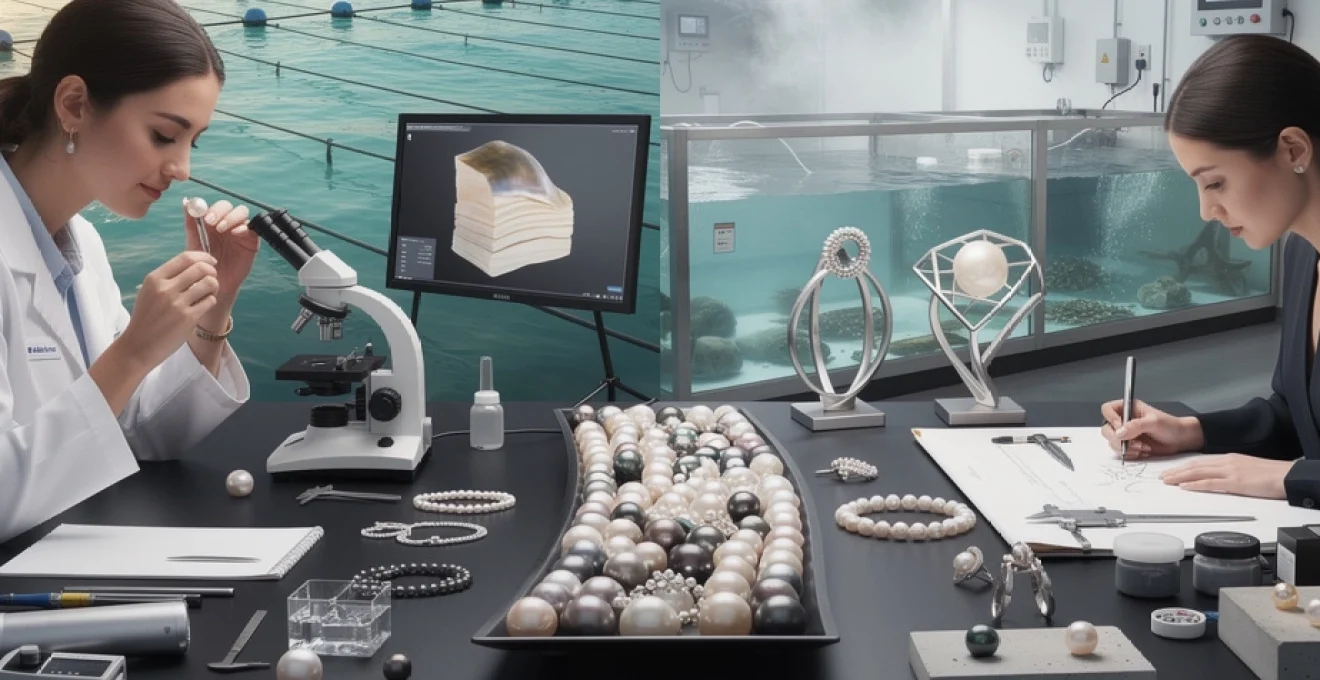
The pearl industry has undergone a remarkable transformation in recent years, evolving from a market dominated by traditional round Akoya strands to a diverse landscape celebrating irregularity, innovation, and sustainability. This shift reflects broader changes in consumer preferences, with buyers increasingly valuing authenticity, environmental responsibility, and personal expression over conventional notions of perfection. Modern pearl cultivation techniques, architectural jewellery designs, and sophisticated gemological assessments have positioned pearls as one of the most dynamic segments in contemporary fine jewellery. What makes pearls particularly compelling is their unique status as the only gem created by living organisms, a biological marvel that connects wearers to the natural world in ways synthetic or mined gemstones cannot match.
Pearl formation science: nacre composition and crystalline structure
Understanding pearl formation begins with nacre, the lustrous substance that gives pearls their characteristic iridescence. Nacre consists of aragonite crystals, a form of calcium carbonate, arranged in thin hexagonal platelets and bound together by conchiolin, an organic protein matrix. This composite structure creates a material that is both remarkably strong and optically complex. When light enters a pearl’s surface, it refracts through multiple translucent layers of aragonite, creating the optical phenomenon known as orient—the subtle play of colours that distinguishes fine pearls from imitations.
The crystalline architecture of nacre follows a precise arrangement often described as a “brick-and-mortar” structure. Each aragonite platelet measures approximately 0.5 micrometres thick, and these platelets stack in layers separated by even thinner sheets of conchiolin measuring just 10-20 nanometres. This alternating arrangement creates an interference pattern that produces the pearl’s lustre and overtone colours. Research published in materials science journals has demonstrated that nacre’s structure provides exceptional toughness, making it roughly 3,000 times more resistant to fracture than pure aragonite crystals. This natural engineering excellence has inspired biomimetic materials research, with scientists attempting to replicate nacre’s structure for applications ranging from aerospace components to medical implants.
The formation process begins when an irritant—whether a natural parasite or an intentionally implanted nucleus—triggers the mollusc’s defence mechanism. Epithelial cells from the mantle tissue migrate to surround the foreign object, forming a pearl sac that secretes nacre in concentric layers. This deposition occurs at varying rates depending on water temperature, nutrient availability, and the mollusc species. South Sea oysters, for instance, typically deposit nacre at approximately 2-4 micrometres per day, considerably faster than Japanese Akoya oysters, which average 0.3-0.5 micrometres daily. This difference explains why South Sea pearls develop thicker nacre coatings in comparable cultivation periods, contributing to their superior lustre and durability.
Temperature plays a crucial role in nacre deposition rates and crystalline quality. Warmer waters generally accelerate metabolic processes, leading to faster nacre secretion, but excessively high temperatures can compromise crystal formation, resulting in chalky or poorly lustrous pearls. Recent studies have identified optimal temperature ranges for different species: 24-28°C for Pinctada maxima (South Sea oysters), 26-30°C for Pinctada margaritifera (Tahitian oysters), and 15-23°C for Pinctada fucata (Akoya oysters). These narrow ranges underscore the importance of site selection and increasingly, climate-controlled cultivation systems.
Contemporary pearl cultivation techniques beyond traditional akoya methods
Traditional Akoya pearl cultivation, refined in Japan throughout the 20th century, established fundamental practices that modern farmers still employ: controlled seeding procedures, suspended basket cultivation, and periodic cleaning protocols. However, contemporary cultivation has expanded far beyond these foundations, incorporating technologies and methodologies that would have seemed impossible just decades ago. The global pearl farming industry now represents a sophisticated integration of marine biology, materials science, and precision aquaculture management. Have you ever considered how technological advances in completely different fields might influence something as seemingly traditional as pearl farming?
Grafting innovations in south sea and tahitian pearl farming
Grafting—the surgical implantation
Grafting—the surgical implantation
of a nucleus and a small piece of donor mantle tissue—has become far more precise in South Sea and Tahitian pearl farming. Where early techniques relied heavily on the individual grafter’s intuition, many farms now employ digital microscopes, biomechanically optimised tools, and standardised protocols to improve graft success rates. In some Australian and French Polynesian operations, real-time imaging is used to verify nucleus placement and tissue orientation, significantly reducing rejection and mortality. The result is not only higher yields but a measurable improvement in nacre deposition symmetry, which directly influences lustre and surface quality.
Another major innovation is multi-grafting and staged grafting. Rather than producing a single pearl over a long cultivation cycle, experienced grafters can now perform sequential nucleations in the same oyster, sometimes up to three times for robust Pinctada maxima. This approach maximises each mollusc’s productive lifespan and reduces the environmental footprint per pearl produced. Farmers are also experimenting with alternative nucleus materials—such as bioceramic and polymer-composite beads—to achieve finer control over growth rates and shape outcomes. These advanced grafting techniques are particularly important for cultivating larger South Sea and Tahitian pearls that meet the demands of modern high-jewellery design.
Temperature-controlled culturing in freshwater pearl production
Freshwater pearl farming, particularly in China, has embraced temperature-controlled culturing to a degree that would have been unthinkable in traditional Akoya operations. Many large-scale farms now use controlled-depth rafts, adjustable net cages, and data-logging sensors to keep mussels within optimal temperature bands throughout the year. By monitoring seasonal temperature fluctuations and adjusting depth or farm location accordingly, producers can maintain more consistent nacre deposition, which translates into more uniform lustre and colour across each harvest. You can think of this as climate control for pearls, similar to how greenhouses optimise conditions for high-value crops.
In regions where surface water temperatures are increasingly affected by climate change, farmers are turning to deeper reservoirs, thermally stratified lakes, and even partially recirculating aquaculture systems (RAS) to protect mussels from thermal stress. Some experimental facilities integrate solar-powered aeration and shading systems to prevent overheating during summer peaks. These freshwater pearl cultivation techniques not only stabilise production but also open creative possibilities, such as fine-tuning nacre growth for specific baroque shapes or thicker coatings suited to artisanal polishing. For designers seeking consistent quality in large batches of freshwater pearls, temperature-controlled culturing has become a quiet but powerful ally.
Sustainable aquaculture practices at paspaley and jewelmer operations
At the high end of the market, sustainability is no longer a marketing afterthought; it is a core operational principle. Australian producer Paspaley and Philippine-based Jewelmer are often cited as benchmarks for environmentally responsible pearl farming. Both operate in remote, pristine environments—Paspaley in the Kimberley region and Jewelmer in Palawan—where the health of local ecosystems directly determines pearl quality. Rather than pushing stocking densities to the limit, they maintain relatively low oyster numbers per hectare, which helps preserve water quality and reduces disease pressure.
Sustainable practices at these operations extend beyond simple environmental management. Paspaley, for example, invests heavily in long-term oceanographic monitoring, tracking parameters such as salinity, temperature, and plankton levels to anticipate ecological shifts. Jewelmer integrates organic farming principles, avoiding chemical antifouling agents and relying instead on manual cleaning and biological control methods. Both companies also adopt a “whole-of-oyster” utilisation philosophy: shells are repurposed for decorative objects or biomaterials, and non-edible by-products are diverted from landfill. For consumers who care about traceability and ethical luxury, pearls from such sustainable aquaculture systems represent a compelling alternative to mined gemstones.
Nucleation technology advances in biwa and kasumiga pearl development
Japanese lake pearls, including those historically associated with Lake Biwa and more recently with Kasumigaura (“Kasumiga” pearls), have benefited from quieter but significant advances in nucleation technology. Early Biwa pearls were mostly tissue-nucleated, resulting in highly baroque shapes and thin nacre. Modern Kasumiga farmers, by contrast, use a combination of small bead nuclei and precisely cut mantle tissue pieces to guide both shape and nacre orientation. This hybrid approach allows them to produce larger, intensely coloured pearls—often in shades of lavender, apricot, and deep rose—that appeal to designers seeking alternatives to classic white Akoyas.
Recent research collaboratives between Japanese universities and pearl cooperatives have explored bio-compatible nucleus materials with surface textures engineered at the micro-scale. These textured beads encourage even mantle cell adhesion and reduce early-stage detachment, which in turn increases the percentage of pearls with symmetrical nacre layers. Some Kasumiga farms are also experimenting with off-round and button-shaped nuclei to intentionally produce softly baroque or coin-like pearls tailored to modern statement jewellery. For collectors interested in technically sophisticated yet artistically expressive pearls, Biwa-inspired and Kasumiga pearls offer a fascinating glimpse into the future of freshwater nucleation technology.
Architectural pearl jewellery design: mikimoto to contemporary ateliers
As cultivation techniques have evolved, so too has the language of pearl jewellery design. Early 20th-century Mikimoto pieces codified the idea of perfectly matched, symmetrical strands as the pinnacle of refinement. Today, many designers still honour that heritage, but increasingly interpret pearls through an architectural lens, treating them as structural elements rather than mere embellishments. Instead of being confined to uniform rows, pearls now appear as negative-space anchors, counterweights, and focal “nodes” within sculptural metal frameworks. This shift echoes broader trends in contemporary jewellery, where form, volume, and spatial tension matter as much as the gemstones themselves.
From Mikimoto’s own experimental high-jewellery lines to cutting-edge ateliers in Copenhagen, Paris, and Tokyo, we see pearls interacting with geometry and asymmetry in new ways. Some collections juxtapose single South Sea pearls against sharp, linear gold bars, while others suspend delicate Akoyas within open cage-like structures, almost like miniature architectural models. For wearers, this architectural pearl jewellery offers a way to enjoy the gem’s organic softness within designs that feel distinctly modern, gender-neutral, and urban.
Asymmetrical pearl settings in minimalist scandinavian designs
Minimalist Scandinavian design has played a particularly influential role in reimagining how pearls can be worn every day. Brands from Denmark, Sweden, and Norway often embrace clean lines, negative space, and subtle asymmetry, placing a single pearl off-centre on a ring band or allowing one earring in a pair to feature a pearl while the other remains purely metallic. This approach treats pearls less as status symbols and more as quiet punctuation marks within an otherwise pared-back visual sentence. Have you noticed how a single well-placed pearl can transform an all-black outfit without overpowering it?
Technically, these asymmetrical settings demand careful engineering. When a large baroque or South Sea pearl is set off-centre, the designer must balance weight distribution so the piece sits comfortably and doesn’t rotate during wear. Scandinavian studios often use hollow but structurally reinforced gold or silver elements to keep pieces lightweight, while precise drilling and pin-setting ensure the pearl’s nacre is not overstressed. The end result is jewellery that feels almost effortless: streamlined silhouettes, gentle curves, and one or two luminous pearls that draw the eye without shouting.
Baroque pearl integration in sculptural metalwork
Baroque pearls are natural allies for sculptural metalwork, where irregular forms are not a problem to be concealed but a feature to be celebrated. Contemporary goldsmiths and silversmiths often design their pieces around a specific baroque specimen, sketching and modelling settings that echo its folds, ridges, and undulations. The process can resemble collaborating with nature: the pearl dictates the starting point, and the metal framework responds, wrapping around it like an exoskeleton or emerging from it like architectural “scaffolding.” This design philosophy aligns beautifully with consumers’ growing appetite for one-of-a-kind jewellery.
In technical terms, sculptural baroque pearl jewellery relies on a combination of partial bezels, custom claws, and tension settings that hug the pearl without completely enclosing it. Some designers cast wax models directly over temporary replicas of the baroque pearl’s shape, then refine the resulting metal shell to create seamless connections. Others use open-backed structures that allow light to interact with the pearl from multiple angles, enhancing orient and depth. For those who prefer bold, gallery-worthy pieces, baroque pearl integration in sculptural metalwork offers wearable art rather than mere decoration.
Keshi pearl applications in avant-garde collections
Keshi pearls—essentially “happy accidents” of the culturing process—have become stars of avant-garde pearl collections. Their small size, irregular silhouettes, and intense lustre make them ideal for experimental compositions that would be impractical with larger, heavier pearls. Designers often cluster keshis into organic, reef-like formations or scatter them along fine chains like metallic dew drops. Because each keshi is composed entirely of nacre, they interact with light in a way that can rival far more expensive gemstones, yet remain accessible enough for creative, large-scale use.
Avant-garde ateliers also use keshi pearls to break the visual hierarchy of traditional jewellery. Instead of one central stone, a piece might feature dozens of tiny keshis flowing along a cuff or erupting from a ring like a miniature landscape. Some high-fashion houses pair dark Tahitian keshis with oxidised silver and blackened gold for a moody, almost industrial aesthetic, while others contrast white or pastel keshis against brightly coloured enamel. For anyone exploring modern pearl jewellery trends, keshi-based designs offer an entry point into more unconventional, art-forward styling.
Mixed-media approaches: combining pearls with resin and concrete
One of the most radical developments in architectural pearl jewellery is the rise of mixed-media designs that combine pearls with materials such as resin, acrylic, and even concrete. At first glance, these pairings may seem contradictory—the softness and organic origin of pearls set against industrial or synthetic substrates. Yet it is precisely this contrast that resonates with a generation accustomed to seeing luxury redefined. Designers encapsulate small Akoya or freshwater pearls in translucent resin blocks, embed keshis within tinted epoxy, or suspend baroque pearls within geometric concrete pendants.
From a technical standpoint, these mixed-media approaches require careful attention to adhesion, thermal expansion, and chemical stability to ensure pearls are not damaged over time. Resins must cure at temperatures that do not compromise nacre, and concrete formulations are often lightened and sealed to prevent abrasion. The reward is a new visual language where pearls float inside minimalist cubes, pierce through matte cement discs, or peek out from sculpted resin waves. For urban wearers who want their pearl jewellery to feel aligned with contemporary architecture and industrial design, these hybrid pieces offer a distinct, conversation-starting aesthetic.
Gemological grading systems: lustre, surface quality, and overtone assessment
Behind every exceptional piece of pearl jewellery lies a rigorous grading process that evaluates each gem’s visual and structural qualities. While there is no single global standard equivalent to the 4Cs used for diamonds, most reputable pearl dealers rely on similar parameters: lustre, surface quality, shape, size, nacre thickness, and colour (including bodycolour, overtone, and orient). Understanding these grading systems empowers you to make more informed decisions when investing in modern pearl jewellery, whether you are drawn to classic Akoyas or bold baroque Tahitians.
Lustre is often considered the most important factor in pearl valuation. It refers to the sharpness and intensity of reflections on the pearl’s surface. High-lustre pearls display crisp, mirror-like reflections and a sense of inner glow, whereas low-lustre pearls appear dull or chalky. Many grading systems classify lustre on a scale from “excellent” to “poor,” with top-quality Akoyas and South Sea pearls achieving the highest ratings. Because lustre is closely linked to nacre structure and thickness, it can serve as a proxy for long-term durability as well as beauty.
Surface quality assessment focuses on the presence and visibility of blemishes such as pits, bumps, scratches, and growth marks. No organically formed pearl is perfectly flawless, but the fewer and less noticeable the imperfections, the higher the grade. Gemologists typically evaluate pearls under diffused light, rotating each gem to examine it from multiple angles. A pearl with minimal, well-placed blemishes that can be hidden in a setting may still command a premium. When comparing strands, you will often see descriptions such as “clean,” “lightly spotted,” or “moderately spotted,” which reflect average surface conditions across the whole necklace.
Colour grading in pearls is more nuanced than simply labelling a gem “white” or “black.” Experts distinguish between bodycolour (the base hue), overtone (a translucent colour layer that appears to float on the surface), and orient (the iridescent play of rainbow-like colours caused by light interference). For example, a white Akoya pearl might have a rose or silver overtone, while a Tahitian pearl could display green, peacock, or aubergine tones. High-end grading reports sometimes specify both bodycolour and overtone, particularly for South Sea and Tahitian pearls where subtle differences can significantly affect value. If you are choosing pearls online, paying attention to overtone descriptions can help you select a hue that complements your skin tone and wardrobe.
Some major retailers and auction houses have adopted proprietary grading scales—using terms like “AAA” or “Hanadama” for Akoya—to communicate quality tiers. While these labels can be useful, it is worth remembering that they are not universally standardised. Whenever possible, look for pearls accompanied by documentation from respected gemological laboratories, and don’t hesitate to ask sellers how they define their grading categories. Ultimately, training your eye by comparing pieces side by side is one of the most effective ways to understand lustre, surface quality, and overtone in real-world conditions.
Innovative pearl treatments and enhancement methodologies
As demand for visually striking, affordable pearls has grown, so has the range of treatments used to enhance their appearance. Many of these processes are routine and widely accepted in the trade, while others are more controversial, especially when not transparently disclosed. For collectors and everyday buyers alike, understanding modern pearl treatments helps you distinguish between natural variation and human intervention. It also enables you to decide which enhancements align with your values and how you plan to wear your pearls.
Laser drilling techniques for blemish reduction
Laser drilling, a technique long associated with diamond clarity enhancement, has been adapted for use in pearl processing to minimise the visual impact of certain surface blemishes. Using a highly focused laser beam, technicians create microscopic channels to reach dark organic inclusions or small surface deposits. These unwanted materials can then be dissolved or lightened using gentle chemical solutions, effectively reducing the contrast between the blemish and the surrounding nacre. When performed skillfully, the drill holes are almost invisible to the naked eye and do not significantly compromise the pearl’s structural integrity.
However, laser drilling is not a cure-all. It is most effective on small, localised imperfections and less suitable for widespread surface irregularities or deep structural flaws. Because the process does involve altering the pearl, reputable sellers should disclose its use, particularly for higher-value pieces. From a buyer’s perspective, laser-drilled pearls can offer a way to access cleaner-looking gems at more accessible prices, especially for fashion-forward designs where perfect natural purity is not the primary concern. Still, if you plan to build a long-term collection focused on rarity and investment-grade quality, you may prefer untreated pearls where possible.
Colour enhancement through silver nitrate and irradiation processes
Colour enhancement is one of the most common forms of pearl treatment, especially for freshwater and Akoya pearls. Silver nitrate treatment, for example, has been used for decades to darken pearls or create grey to black hues. The chemical penetrates the nacre and reacts with light over time, producing a deeper tone. In some cases, the treatment is combined with controlled heating to stabilise the colour. These pearls can mimic the appearance of naturally dark Tahitians at a fraction of the cost, making them popular for bold, high-contrast jewellery that fits within a more modest budget.
Irradiation is another method used to alter pearl colour, particularly to intensify blues, greens, and other secondary tones. By exposing pearls to gamma rays or electron beams, technicians can change the oxidation states of certain trace elements within the nacre, leading to shifts in colour. While the process may sound intimidating, properly irradiated pearls are considered safe to wear and are regulated to meet radiation safety standards. The main concern for buyers is permanence: high-quality colour enhancements should be stable over time and resistant to fading under normal wear. If you are drawn to unusually vivid pearl colours—electric peacock greens, intense steely blues—asking about irradiation or dyeing is a wise step before you purchase.
Surface polishing technologies in commercial pearl processing
Most pearls undergo some degree of surface finishing before they reach the market, and advances in polishing technologies have made this stage more precise and less abrasive. Traditional tumbling methods used loose abrasives and could occasionally thin nacre or blur fine surface details. Modern processes often rely on carefully calibrated vibratory polishers, ultra-fine ceramic media, and even micro-abrasive pastes applied by hand. The aim is to remove residual organic films or microscopic roughness without compromising nacre thickness or the subtle texture that contributes to natural lustre.
Some high-end processors have experimented with nano-scale coatings to enhance lustre and protect the surface, though these treatments remain relatively rare and often controversial among purists. In general, gentle mechanical polishing that respects the pearl’s natural structure is widely accepted as part of standard commercial processing. For you as a wearer, the key takeaway is that a beautifully polished pearl should still look like an organic gem rather than a piece of plastic: reflections should be crisp but not harsh, and the surface should retain a sense of depth and softness.
Market positioning: pearl branding strategies from tiffany & co. to independent designers
The way pearls are marketed and branded has shifted as dramatically as the way they are farmed and designed. Legacy houses such as Tiffany & Co., Mikimoto, and Cartier continue to emphasise heritage, craftsmanship, and classic luxury, often spotlighting perfectly matched Akoya or South Sea strands as symbols of enduring elegance. Their messaging leans into provenance—naming specific regions, farms, or historic archives—and positions pearls as heirloom pieces meant to be cherished for generations. This approach appeals to buyers who value tradition and the reassurance of established brand reputations.
At the same time, independent designers and emerging labels have carved out a distinct niche by framing pearls as tools of self-expression and everyday luxury. Instead of formal campaigns, they often rely on social media storytelling, behind-the-scenes studio content, and collaborations with stylists, musicians, and digital creators. You will see baroque and keshi pearl pieces styled with denim, streetwear, and gender-fluid silhouettes, accompanied by narratives about sustainability, body positivity, and individuality. The message is clear: pearls are not just for weddings or boardrooms; they are for coffee runs, gallery openings, and late-night concerts.
Many brands now differentiate themselves through a combination of ethical sourcing and design innovation. Transparency about farm partnerships, environmental certifications, and fair labour practices can be as important as carat weight or metal purity. Boutique labels may highlight relationships with specific South Sea or Tahitian farms, share photos from visits to hatcheries, or publish impact reports detailing reef conservation efforts. For consumers increasingly wary of “greenwashing,” this level of detail can build trust and justify a premium price point for sustainable pearl jewellery.
Another key branding strategy involves education. Whether you are browsing a flagship store or scrolling through an online catalogue, the most forward-thinking companies provide accessible explanations of terms like “nacre thickness,” “baroque,” and “Hanadama.” Some offer interactive tools that let you compare lustre grades or visualise strand lengths on different body types. By demystifying the technical aspects of pearls, these brands empower you to choose pieces that genuinely suit your lifestyle rather than defaulting to the most familiar option. In an era where informed, values-driven purchasing is on the rise, this educational approach can be as powerful as any glossy advertising campaign.
Looking across the spectrum—from Tiffany & Co. and Mikimoto to small-batch designers on digital marketplaces—one pattern stands out. Successful pearl branding today blends respect for the gem’s storied past with a willingness to challenge old rules. Whether through architectural settings, sustainable sourcing, or inclusive imagery, brands are repositioning pearls as modern, versatile, and deeply personal. For anyone considering adding pearls to their collection, this is an ideal moment: the market has never offered so many ways to wear, understand, and truly reimagine this classic gem.