
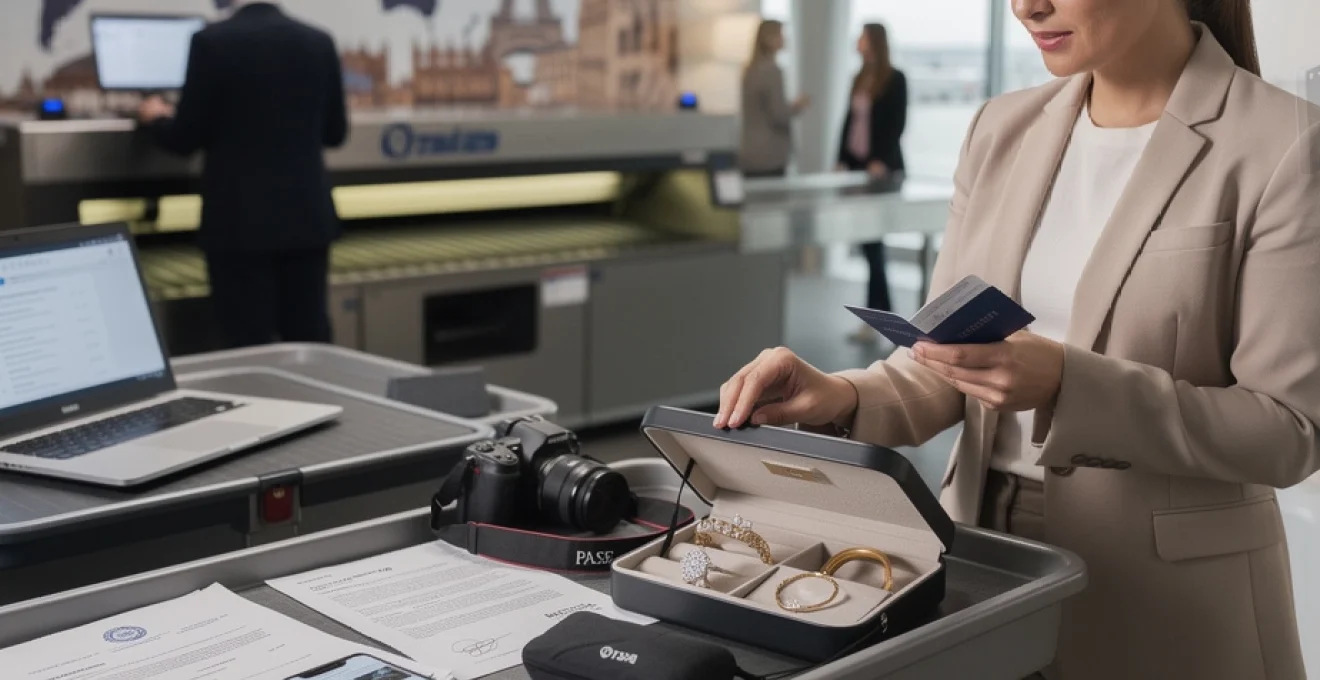
The thrill of wearing your most treasured pieces whilst exploring new destinations comes with a very real responsibility: protecting these irreplaceable items from loss, theft, or damage. Each year, insurance companies process thousands of claims for jewellery lost during travel, with many incidents proving entirely preventable through proper planning and security measures. Whether you’re attending a destination wedding in Tuscany, conducting business in Dubai’s jewellery markets, or simply refusing to be parted from your engagement ring during a beach holiday, understanding the complexities of travelling with valuable pieces is essential for maintaining both your peace of mind and your collection’s integrity.
The landscape of jewellery travel security has evolved considerably over the past decade, with sophisticated theft operations targeting travellers specifically in tourist hotspots across Europe, Asia, and beyond. Simultaneously, insurance policies have become more nuanced, offering specialised coverage options that standard travel insurance simply cannot match. Modern travellers face challenges their predecessors never encountered, from navigating enhanced airport security protocols to protecting digital documentation in an increasingly connected world. This comprehensive examination addresses the multifaceted considerations every jewellery owner must understand before embarking on their journey.
Pre-travel risk assessment and insurance coverage for High-Value jewellery
Before placing a single piece in your travel case, conducting a thorough risk assessment determines which items genuinely warrant the journey. This evaluation extends beyond sentimental attachment to encompass destination security, planned activities, and realistic wearing opportunities. A fortnight’s beach retreat rarely justifies bringing diamond chandelier earrings, whilst a week of business meetings in London might legitimately require several statement pieces to complement professional attire.
Understanding your destination’s specific risk profile proves crucial. Crime statistics vary dramatically between locations, with certain cities experiencing significantly higher rates of jewellery-targeted theft. Rome, Barcelona, and Paris consistently appear on watch lists for sophisticated pickpocketing operations and hotel room thefts, whilst destinations like Singapore and Dubai maintain comparatively lower theft rates. Research recent traveller advisories, consult government travel resources, and review tourism forums where visitors share current security conditions. This intelligence informs not only which pieces to bring but also how vigilantly you must guard them.
Professional appraisal documentation and gemological certificates
Current professional appraisals form the foundation of adequate insurance coverage, yet many jewellery owners operate with outdated valuations that bear little resemblance to today’s market values. The past three years have witnessed unprecedented price increases across certain jewellery categories, particularly luxury steel sport watches and pieces featuring rare coloured gemstones. What your engagement ring was appraised at five years ago may represent only 60-70% of its current replacement cost, leaving you significantly underinsured should loss occur.
Engage a qualified gemologist or appraiser with recognised credentials to conduct thorough evaluations every three to five years under normal circumstances. For exceptionally valuable pieces—those exceeding £20,000—consider biannual appraisals given current market volatility. The appraisal document should include detailed descriptions encompassing metal type and weight, gemstone characteristics using the four Cs (cut, colour, clarity, carat), measurements, and high-resolution photographs from multiple angles. For diamonds exceeding one carat and coloured stones of significant value, obtain gemological certificates from respected laboratories such as GIA, IGI, or HRD Antwerp.
These certificates serve dual purposes beyond insurance claims. At international borders, particularly when returning from jewellery tourism destinations, customs officials may question whether pieces were purchased abroad or brought from home. Original certificates demonstrating prior ownership can expedite clearance and prevent unnecessary duty charges on items you’ve owned for years.
Specialised jewellery insurance policies vs. standard travel coverage
Standard homeowner’s or renter’s insurance policies typically impose strict limitations on jewellery coverage, often capping claims at £1,500 to £3,000 per incident regardless of actual value. More problematically, these policies frequently exclude coverage for « mysterious disappearance »—the insurance industry’s term for items lost without identifiable cause or specific incident. If you simply cannot account for when or how your ring went missing during your fortnight abroad, standard policies may deny the claim entirely.
Specialised jewellery insurance addresses these limitations through comprehensive « all-risk » coverage protecting against virtually any loss scenario worldwide, including mysterious disappearance. These
policies are offered by dedicated providers and some luxury insurers, and they are designed with frequent travellers in mind. Features often include worldwide cover, higher single-item limits, and flexible deductibles, as well as coverage while pieces are in transit, in hotel safes, or even left with a trusted jeweller for repair. When comparing specialised jewellery insurance with standard travel insurance, pay close attention to exclusions, claim processes, and whether your policy pays out on a « repair or replace » basis or offers agreed value settlement. In most cases, relying solely on generic travel insurance for high-value jewellery is analogous to using a flimsy padlock on a vault—technically protection, but not commensurate with the asset at risk.
Declared value limits with providers like jewelers mutual and chubb
For those travelling with truly significant pieces, understanding declared value limits is essential. Providers such as Jewelers Mutual and Chubb structure their valuable articles policies around scheduled items, where each piece is individually listed with an agreed value based on recent appraisals. Policies often include per-item and aggregate limits that must be calibrated carefully if you plan to travel with multiple high-value pieces or a concentrated watch collection.
Before departure, review your schedule of insured items and confirm that all pieces you intend to carry are listed with accurate values. If you have recently acquired a new item—say, a complicated Patek Philippe or a large fancy-coloured diamond ring—ensure it has been added and endorsed to the policy prior to travel. Many underwriters require notification when pieces will be taken to higher-risk destinations or stored outside your usual safe, particularly when total value exceeds specified thresholds. Failure to disclose significant changes in exposure can complicate or even invalidate claims, so treat these conversations with your broker as an integral part of pre-travel planning rather than administrative afterthought.
Photographic evidence and serial number registration protocols
Thorough documentation bridges the gap between ownership and recovery should the worst occur. At a minimum, maintain a digital archive of high-resolution photographs for each piece, capturing hallmarks, serial numbers, and distinctive design features. Watches, in particular, should be photographed front, back, clasp, and movement (if visible), as luxury brands increasingly collaborate with law enforcement and insurers to track stolen serial numbers across international markets.
Register serial numbers with manufacturers where possible, and explore third-party databases or asset registration services that catalogue high-value items. Think of this as creating a digital passport for your jewellery: it not only facilitates police reports and insurance claims, but also increases the likelihood that items recovered in another jurisdiction can be positively identified and returned. Store scans of appraisals, certificates, and receipts in encrypted cloud storage, alongside a simple inventory list noting where each item is usually kept and any distinguishing marks or customisations.
Tsa-compliant carrying methods and airport security procedures
Airports represent one of the highest-risk environments for travellers with valuable jewellery, combining public crowds, multiple bag handoffs, and moments when your attention is divided. Navigating security checkpoints with confidence requires a clear understanding of both regulations and best practices. Your objective is straightforward: keep jewellery close, visible to you at all times, and packaged discreetly enough that it does not advertise its value to those around you.
Carry-on versus checked baggage regulations for precious items
From a security perspective, checked baggage should never house irreplaceable jewellery. Airline policies and aviation authorities strongly recommend that all valuable items—including fine jewellery, high-end watches, and loose gemstones—travel in your carry-on or personal item. Baggage handling areas, luggage carousels, and even private aviation terminals are not immune to pilferage or misrouting, and lost luggage claims rarely compensate for the full value of fine jewellery.
Instead, allocate a specific compartment within your cabin bag for a compact, nondescript jewellery case or travel safe. This case should remain under your direct control from home to hotel, never handed to porters, skycaps, or even well-meaning friends at the check-in queue. When overhead bin space is limited, keep the jewellery case in your personal item under the seat rather than risking forced gate-checking of your main carry-on. In practice, you should treat your jewellery bag as you would a passport and wallet combined: it never leaves your sight.
X-ray screening effects on gemstones and precious metals
One common concern among travellers is whether airport X-ray machines can damage gemstones or precious metals. Modern security scanners used by TSA and equivalent agencies operate at energy levels that are safe for diamonds, coloured gemstones, pearls, gold, platinum, and other jewellery materials. Unlike medical radiation, these exposures are extremely low and do not alter the structure, colour, or integrity of jewellery, even with repeated scans.
The greater risk lies not in the X-ray itself but in how items are handled during screening. Loose jewellery placed directly in plastic bins is vulnerable to being overlooked, snatched by opportunists, or jostled against hard surfaces. Whenever possible, keep pieces either on your body or secured within a zipped pouch or case that passes through the X-ray intact. If you are transporting loose stones or highly delicate items, alert security staff and request that the sealed container be inspected in your presence if additional scrutiny is required.
Declaration requirements at customs for international destinations
Crossing borders with high-value jewellery introduces legal obligations in addition to security concerns. Many countries require travellers to declare valuables above certain thresholds on arrival and sometimes on departure, particularly when importing new purchases or carrying large quantities of bullion or loose stones. Failure to declare can result in fines, seizure, or lengthy delays while customs officials verify provenance and value.
To avoid misunderstandings, research customs regulations for both your destination and your home country before travel. Some jurisdictions provide forms allowing you to pre-register personal valuables that you are temporarily exporting, demonstrating that you owned them prior to the trip and thus avoiding duty on your return. Keep copies of purchase receipts, appraisals, and gemological certificates readily accessible—think of them as your jewellery’s paperwork at passport control. If in doubt, err on the side of transparency and voluntary declaration; the brief inconvenience at the customs desk is preferable to a protracted dispute over undeclared items.
Body-worn jewellery strategy through security checkpoints
For most travellers, the safest place for valuable jewellery during airport screening is on your body. TSA and many international agencies allow you to wear fine jewellery, including engagement rings, earrings, and necklaces, through metal detectors and body scanners. These items rarely trigger alarms, and even when they do, officers can conduct a manual inspection while you maintain direct line of sight.
When carrying particularly eye-catching or high-value pieces, consider a discreet wearing strategy: pendants tucked beneath clothing, watches under sleeves, and rings turned inward on the hand while moving through crowded terminals. If an officer requests removal of an item, place it immediately into a small, zippered pouch that goes back into your bag—never loose in a tray. For those travelling with substantial pieces or large quantities, it is reasonable to request a private screening room, where you can display items for inspection away from public view and potential prying eyes.
Physical security solutions and anti-theft devices during transit
Even with robust insurance and careful planning, physical security remains your first line of defence when travelling with valuable jewellery. The goal is not to create an impenetrable fortress—that would be impractical on the move—but to add layers of protection that deter opportunistic theft and slow down more determined attempts. In practical terms, this means combining secure containers, smart concealment, and situational awareness throughout your journey.
Portable travel safes with TSA-approved locking mechanisms
Portable travel safes have evolved considerably, offering hardened exteriors, steel cable tethers, and TSA-approved combination locks in compact formats that fit easily into carry-on luggage. These devices function as a lockbox within your bag, secured to a fixed structure such as a wardrobe rail or bed frame when you reach your accommodation. While no portable safe is truly invulnerable, the added time and effort required to breach one significantly reduces the appeal for opportunistic thieves.
When choosing a travel safe for jewellery, prioritise models with slash-resistant materials, internal padding, and configurable compartments to prevent pieces from knocking against one another. Remember that « TSA-approved » refers to locks that can be opened by security officers using master keys; it does not guarantee resistance to tampering in all scenarios. Consequently, treat TSA compatibility as a convenience feature for airport inspections rather than the primary security specification. Combine the safe with discreet placement—out of sight and away from predictable locations like bedside tables—to maximise its effectiveness.
Rfid-blocking pouches and tamper-evident packaging systems
While RFID-blocking sleeves are better known for protecting payment cards and digital passports, they also have a role in securing smart jewellery and high-end watches equipped with NFC or Bluetooth capabilities. Shielding these signals reduces the risk of digital tracking or cloning attempts, particularly in environments where sophisticated theft rings operate. For most travellers, the privacy benefit is incremental but worthwhile when carrying six-figure timepieces or tech-enabled jewellery.
Tamper-evident packaging—such as security bags with unique serial numbers and irreversible seals—adds another subtle layer of control. These are especially useful when you must entrust jewellery to third parties temporarily, for example at a hotel front desk safe, cruise ship purser, or repair facility abroad. If a seal is broken or a bag number does not match your record, you have immediate indication that the contents may have been accessed. Think of these systems as the « broken wax seal » of the modern era: not an absolute barrier, but a clear signal when something is amiss.
Hotel in-room safes versus safety deposit box services
Once at your destination, the question arises: where should jewellery rest when not on your person? In-room safes offer convenience and a basic level of security, but they are not created equal. Many operate on simple keypad systems with override codes held by hotel staff, and smaller units can be physically removed from the room if not properly anchored. As such, they are best suited for mid-value items you wear frequently, rather than your most irreplaceable pieces.
For exceptionally valuable jewellery, request access to the hotel’s main vault or safety deposit box services, typically located in the back-of-house area and monitored by security. These facilities often provide dual-control access (requiring both a guest key and staff key) and more substantial physical protection. When checking items in or out, insist on a written receipt or log entry detailing what has been stored, and avoid discussing specific values or brands within earshot of other guests. If such services are not available and you are staying in a rental property or boutique hotel, a portable travel safe tethered to a solid structure may offer the best compromise between security and practicality.
Destination-specific risks in popular jewellery tourism hubs
Certain destinations exert a magnetic pull on jewellery enthusiasts, from bustling gold markets to historic gem-cutting centres. While these hubs can be treasure troves for collectors, they also attract individuals seeking to exploit unwary visitors. Understanding the local risk landscape enables you to enjoy these experiences without exposing yourself—or your existing jewellery—to avoidable dangers.
Security challenges in dubai gold souk and jaipur gem markets
Dubai’s Gold Souk and Jaipur’s gem bazaars are legendary for their dazzling displays and competitive pricing, drawing buyers from across the globe. Yet their dense crowds, open-air layouts, and cash-heavy transactions also create fertile ground for pickpockets and confidence tricksters. In these environments, wearing ostentatious jewellery while browsing is akin to walking through a marketplace with a designer handbag unzipped: it identifies you instantly as a high-value target.
Adopt a low-profile approach by keeping your own pieces minimal or concealed and using secure, crossbody bags with internal zips. When evaluating potential purchases, favour established retailers with verifiable credentials, clear return policies, and certification from recognised gemological laboratories. Be wary of street-side offers that appear dramatically under market value; if a stone seems « too good to be true, » it may be synthetic, heavily treated, or misrepresented in quality. Before leaving with newly acquired items, ensure they are securely packed, insured where possible, and not all carried in a single, easily snatched bag.
Theft hotspots in barcelona, paris, and rome tourist areas
European capitals such as Barcelona, Paris, and Rome are renowned for both cultural splendour and sophisticated petty crime networks targeting tourists. Popular attractions—the Ramblas, the Eiffel Tower, the Louvre, the Colosseum—see dense foot traffic and frequent jostling, conditions ideal for distraction theft. Jewellery, especially watches and necklaces, is a favoured target because it can be removed quickly and resold with relative ease.
Practical countermeasures include avoiding overtly flashy displays when using public transport, steering clear of impromptu crowds or staged commotions, and keeping high-value watches under sleeves in congested areas. Be cautious of individuals who invade your personal space under benign pretences—offering friendship bracelets, petitions, or sudden hugs—as these gestures sometimes mask coordinated attempts to lift watches or unclasp chains. When dining outdoors or relaxing in plazas, resist the urge to remove rings or bracelets and place them on café tables, where they can disappear in a moment of distraction.
Regional crime statistics and jewellery-targeted scams
Crime statistics, while sometimes dry on the surface, are invaluable for gauging how aggressively you should protect your jewellery in a given region. Urban police departments and tourism boards often publish data on pickpocketing incidents, bag snatches, and residential or hotel burglaries. Look specifically for references to « snatch-and-grab » thefts, scooter-assisted robberies, and watch thefts, which indicate elevated risks for visible luxury items.
Common jewellery-targeted scams include the so-called « gold ring » trick (where a passer-by pretends to find a ring and attempts to sell or swap it), staged spills or bumps that distract you while an accomplice removes a watch, and bogus « police » inspections of jewellery or money. By familiarising yourself with these ploys before you travel, you are far less likely to be caught off guard. Ultimately, the principle is simple: the more informed you are about local patterns of theft, the more effectively you can calibrate when to wear your valuable pieces proudly and when discretion is the wiser choice.
Digital security and documentation backup strategies
In an era where your phone is both filing cabinet and travel guide, digital security forms a critical component of travelling safely with valuable jewellery. Losing physical pieces is distressing enough; losing the documentation necessary to prove ownership and value can turn a challenging situation into a bureaucratic nightmare. Treat your jewellery paperwork with the same digital rigor as you would legal documents or financial records.
Begin by creating encrypted digital copies of appraisals, purchase invoices, gemological certificates, and detailed photographs for each item you might travel with. Store these in a reputable cloud service protected by strong, unique passwords and multi-factor authentication, ensuring they can be accessed from another device if your phone or laptop is lost. For added resilience, maintain a secondary backup—such as an encrypted USB drive stored separately from your main devices during travel. This layered approach mirrors a well-diversified security strategy: even if one element fails, others remain intact.
When emailing documents to yourself or your insurer, remember that standard email is not inherently secure; avoid including full policy numbers or personally identifying information in subject lines or unencrypted attachments. Consider password-protecting sensitive PDFs and sharing passwords via a different channel than the one used to send the file. Finally, keep a concise, printed summary of your jewellery inventory and insurer’s emergency contact details in a secure part of your luggage. This analogue backup proves invaluable when internet connections are unreliable or devices are unavailable at precisely the moment you need to make a time-sensitive call.
Emergency response protocols for lost or stolen jewellery abroad
Despite meticulous planning, there remains a small but real possibility that a piece may be lost, stolen, or damaged while you are away. Having a clear, rehearsed response protocol transforms a moment of panic into a series of manageable steps. Think of it as your emergency drill for jewellery: you hope never to use it, but if needed, you know exactly what to do and in what order.
The first priority is to secure your surroundings and account for all other valuables, ensuring there is no ongoing threat. Next, document the incident as thoroughly as possible: note the time, location, and circumstances; take photographs of the scene if appropriate; and identify any potential witnesses. Report thefts or suspicious losses to local authorities promptly, obtaining a written police report or incident number—insurers will almost always request this documentation. If the loss occurs within a hotel, cruise ship, or airline context, file an internal report with management as well, keeping copies of all correspondence.
As soon as practical, contact your jewellery insurer’s emergency helpline or claims department. Provide them with your policy number, a brief description of the item, and the circumstances of the loss, referencing any appraisals or photographs stored in your digital archive. Some high-end policies include access to security consultants or local assistance partners who can advise on next steps, from liaising with police to monitoring secondary markets where stolen pieces may surface. Once immediate notifications are complete, resist the understandable urge to scour every corner of your itinerary at the expense of your broader safety; instead, follow insurer and law enforcement guidance while preserving your remaining assets.
When you return home, schedule a follow-up with your insurer and, if applicable, your trusted jeweller. This is the moment to review what happened, adjust your security practices, and, if a claim is approved, consider how best to replace or reimagine the lost piece. Some find comfort in recreating an item as faithfully as possible; others choose a new design that acknowledges the break in the object’s history. Whichever route you choose, remember that while jewellery can embody powerful memories, those memories themselves reside with you. With well-considered safeguards and clear emergency protocols, you can continue to travel with your most meaningful pieces—confident that you have done everything reasonably possible to protect both their beauty and their story.