
# Comment choisir un bracelet qui complète la forme de votre poignet
A bracelet worn correctly can transform an entire outfit, adding elegance, personality, and refined style to your everyday look. Yet many people purchase bracelets based solely on aesthetic appeal, overlooking one critical factor: wrist shape compatibility. The relationship between your wrist’s anatomical structure and the bracelet you choose determines not only comfort throughout the day but also visual harmony and proportional balance. Understanding this relationship empowers you to select pieces that enhance rather than overwhelm your natural proportions, preventing the frustration of bracelets that pinch, rotate awkwardly, or simply fail to flatter your wrist’s unique contours.
The right bracelet should feel like a natural extension of your wrist, sitting securely without causing discomfort during daily activities. Whether you’re drawn to delicate chains, bold cuffs, or classic bangles, matching style to your specific wrist dimensions creates a cohesive, polished appearance that elevates your entire aesthetic. This comprehensive guide explores the anatomical considerations, sizing principles, material properties, and styling techniques that professional jewellers use to achieve perfect bracelet fit and visual balance.
Anatomical wrist characteristics that influence bracelet selection
Your wrist is far more complex than a simple cylinder around which jewellery wraps. The underlying bone structure, soft tissue distribution, and proportional relationship to your hand all play crucial roles in determining which bracelet styles will complement your natural anatomy. Before exploring specific bracelet types, you need to understand the fundamental characteristics that make your wrist unique. These anatomical factors influence everything from the internal diameter of bangles to the appropriate width of chain links.
Measuring wrist circumference and bone structure accurately
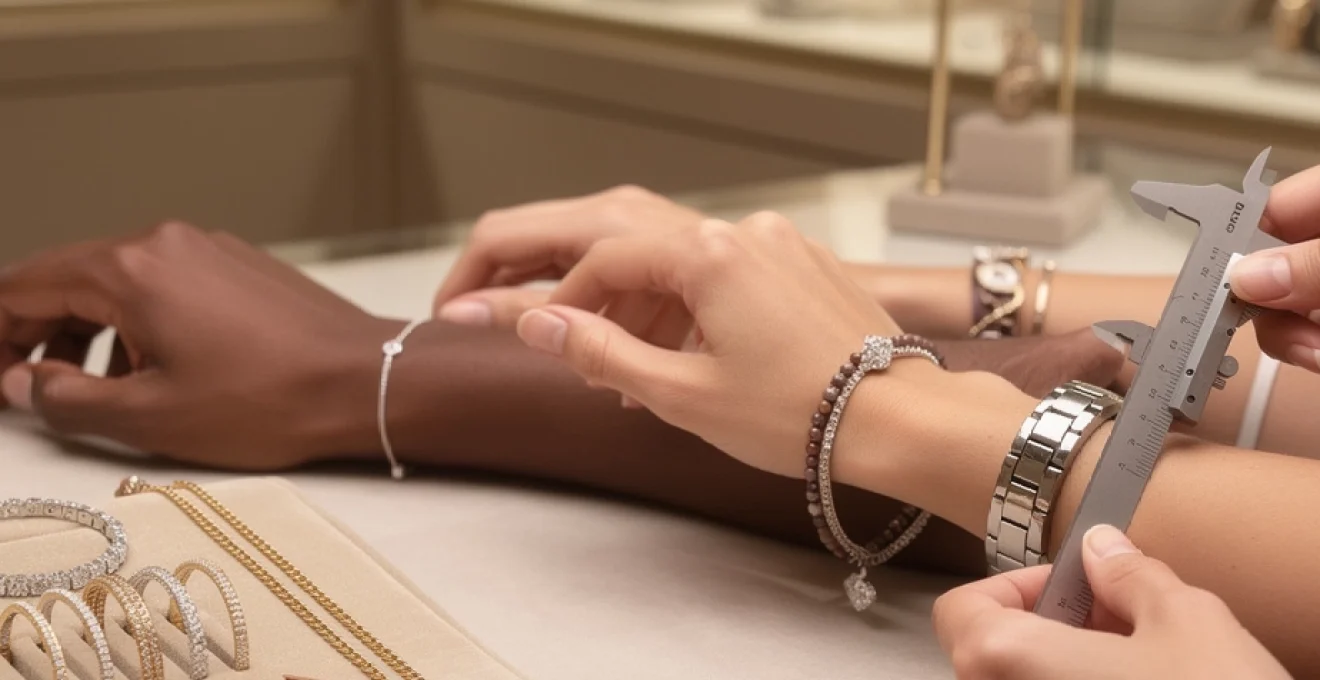
Accurate measurement forms the foundation of proper bracelet selection. Using a flexible measuring tape, wrap it around your wrist at the point where you typically wear bracelets—usually just below the wrist bone on the thumb side. Record this measurement in both centimetres and inches, as jewellery sizing varies internationally. For the most reliable reading, take this measurement at different times of day, since wrists naturally swell slightly in warm weather or after physical activity. The difference between your morning and evening measurements can reach up to 5 millimetres, which significantly impacts bracelet comfort.
Beyond circumference, assess your bone prominence by gently pressing the sides of your wrist. If you can easily feel the ulna and radius bones with minimal soft tissue coverage, you have a bony wrist structure that requires careful consideration when selecting rigid bracelet styles. Conversely, if substantial soft tissue cushions these bones, you possess greater flexibility in choosing wider, heavier pieces. This bone prominence assessment proves particularly valuable when considering bangles and cuffs, which rest directly against these anatomical landmarks and can create pressure points if poorly matched to your structure.
Identifying petite, medium, and large wrist proportions
Wrist proportions fall into three general categories, each with distinct characteristics that guide bracelet selection. Petite wrists typically measure 14 to 15.5 centimetres in circumference, featuring delicate bone structure and often appearing narrower in relation to hand size. These wrists benefit from lightweight, refined pieces that maintain visual proportion without overwhelming the slender frame. Chain bracelets with links measuring 2 to 4 millimetres in width create elegant definition, whilst overly chunky pieces can dominate and create an unbalanced appearance.
Medium wrists, measuring approximately 16 to 17.5 centimetres, represent the most versatile proportion for bracelet styling. This moderate size accommodates a broad range of styles, from delicate chains to substantial cuffs, allowing significant creative freedom in jewellery selection. The balanced proportions of medium wrists rarely create fitting challenges, though attention to specific bone prominence and hand-to-wrist ratio still matters when fine-tuning selections for optimal comfort and visual harmony.
Large wrists, measuring 18 centimetres or more, require bolder pieces to achieve proper visual balance. Substantial cuffs, wide bangles, and chunky chain links complement these proportions, preventing the bracelet from appearing lost or disproportionately small. Jewellers recommend pieces with widths
of 8 millimetres and above, as narrower bracelets can disappear visually against a broader wrist. When working with large wrists, consider not only circumference but also vertical height from palm to forearm; taller wrists can support multi-row designs, stacked bangles, and substantial charm densities without looking crowded. Choosing proportionally significant pieces ensures that the bracelet reads as an intentional design feature rather than a delicate accent that gets lost.
Understanding ulna and radius prominence in bracelet fit
The two primary forearm bones—the ulna on the little-finger side and the radius on the thumb side—form the bony landmarks you feel at your wrist. Their prominence influences how snugly a bracelet can sit without creating pressure or redness. If these bones are sharply defined and protrude noticeably, rigid bangles and thick cuffs may concentrate pressure on a small area, leading to discomfort during typing, driving, or exercise. In such cases, flexible chain bracelets or softly contoured cuffs with rounded inner edges offer a more forgiving fit.
For wrists where the ulna and radius are less pronounced and surrounded by more soft tissue, you have greater freedom with structural designs. Wider bangles, angular cuffs, and link-heavy charm bracelets can rest comfortably without digging in. However, additional soft tissue also means that bracelets may migrate toward the hand, especially if they are too loose. You may need slightly smaller internal diameters or adjustable closures to prevent constant sliding over the wrist bones and onto the palm. Observing where your current bracelets naturally settle is an easy way to gauge how bone prominence affects fit.
Assessing wrist-to-hand ratio for proportional styling
Beyond wrist circumference alone, the ratio between your wrist and hand size plays a major role in how bracelet shapes appear. To assess this, measure your wrist at the narrowest point and then measure around your knuckles with your hand slightly cupped, as if slipping into a bangle. If the knuckle measurement greatly exceeds the wrist circumference, you likely struggle with bangles that either fail to pass the hand or slide too loosely once in place. In this scenario, open cuffs, adjustable chains, and bracelets with hinged openings provide an easier, more secure option.
If your hand and wrist measurements are relatively close, most standard bracelet sizes will work, and you can confidently explore closed bangles and continuous designs. Visually, a small wrist with a large hand tends to benefit from slightly more substantial pieces to link the two in proportion, while a large wrist with a small hand often looks best with medium-width designs that do not dwarf the fingers. Thinking of the wrist-to-hand ratio as a “bridge” helps: the bracelet should visually connect hand and forearm, maintaining balance instead of drawing attention to size differences.
Bracelet width and chain link sizing for different wrist dimensions
Once you understand your anatomical measurements, the next consideration is bracelet width and link size. Width refers to how much space the bracelet occupies when viewed from above, while link or stone size determines how detailed or bold a piece appears from a distance. Selecting the right combination of width and chain type for your wrist dimensions ensures that your bracelet reads as intentional design rather than an afterthought. It also directly impacts how comfortable the bracelet feels during everyday activities like typing, carrying bags, or wearing layered clothing.
Selecting appropriate millimetre width for slender wrists
For petite or slender wrists—typically under 16 centimetres in circumference—bracelet width requires careful control to prevent overwhelming the wrist. As a general guideline, widths between 2 and 5 millimetres tend to offer the most flattering proportion, especially for everyday wear. A 2 to 3 millimetre chain creates a refined line that follows the wrist’s contours, ideal if you prefer subtle elegance or plan to pair your bracelet with a watch. Slightly wider designs around 4 to 5 millimetres introduce more presence while still maintaining delicacy on a small frame.
That said, slender wrists can still enjoy statement pieces when used selectively. The key is to limit the number of wide bracelets worn simultaneously and to balance a single bold cuff with simpler, finer chains. Think of it like typography on a page: one strong headline paired with smaller body text reads as sophisticated, whereas multiple oversized fonts compete for attention. If you love chunky styles, choose designs with tapered or curved interiors so that contact with the wrist remains comfortable despite the bolder outer profile.
Cable chain versus figaro chain proportions
Different chain structures create distinct visual rhythms on the wrist, and these rhythms interact with your wrist size and shape. Cable chains, formed from uniform oval or round links, produce a clean, continuous line that suits nearly all wrist proportions. Because each link is the same size, cable chains are straightforward to scale: a 2 to 3 millimetre width works well on petite wrists, while 4 to 6 millimetres flatters medium to larger wrists. Their symmetry makes them especially suitable for minimalists or for showcasing a single central charm or gemstone.
Figaro chains, by contrast, alternate short and long links in a repeating pattern, adding visual texture and movement. This pattern naturally draws the eye, which can be very flattering on medium to larger wrists where you want the bracelet to stand out. On petite wrists, slimmer Figaro chains in the 2 to 4 millimetre range work best, as larger patterns can appear too busy or heavy. If you are choosing a Figaro bracelet for a thicker wrist, consider widths of 5 to 8 millimetres, which provide strong visual impact without feeling bulky. In both styles, matching link scale to your wrist circumference maintains elegance and prevents the chain from appearing out of proportion.
Bangle internal diameter specifications for optimal fit
Unlike flexible chain bracelets, bangles rely on internal diameter rather than length to determine fit. To determine your ideal bangle size, measure the circumference of the widest part of your hand—usually across the knuckles while the thumb is tucked gently inward. Divide this number by 3.14 to estimate the minimum internal diameter needed for the bangle to pass over the hand comfortably. For example, an 18 centimetre hand circumference translates to roughly a 5.7 centimetre internal diameter. For most people, adding 2 to 4 millimetres to this calculated diameter achieves a balance between ease of removal and secure wear.
For petite wrists and narrow hands, typical internal diameters range from 5.3 to 5.7 centimetres, while medium wrists often fall between 5.8 and 6.3 centimetres. Larger wrists may require 6.4 centimetres or more. It is important to note that width and thickness of the bangle also influence how it feels; very wide bangles distribute pressure differently and may need an extra millimetre or two for comfort. If your knuckle measurement is significantly larger than your wrist circumference, consider hinged bangles or oval-shaped designs that mimic the natural shape of the wrist, reducing rotation and making them easier to slide on and off.
Tennis bracelet stone size relative to wrist scale
Tennis bracelets rely on a repeating line of stones to create their signature elegance, which means stone size has a major impact on proportion. For slender wrists, stones between 1.5 and 2.5 millimetres (often around 0.03 to 0.08 carats per stone) usually provide a refined sparkle without appearing overpowering. The bracelet reads as a continuous shimmer rather than a row of individual stones, which complements delicate bone structures. If your wrist is petite but you enjoy more presence, you might opt for slightly larger stones in a half-eternity style, where the diamonds do not fully encircle the wrist.
Medium and larger wrists can comfortably support stone sizes in the 2.5 to 3.5 millimetre range and beyond, depending on the desired effect. On a wider wrist, very small stones may be lost visually, whereas mid-sized stones create a balanced, luxurious look suitable for daily wear. For truly statement tennis bracelets—often with stones above 3.5 millimetres—consider how often you will wear them and whether they will sit alone or stacked with other pieces. Larger stones increase weight and rigidity, so precise sizing becomes crucial to prevent the bracelet from twisting or rotating under its own mass.
Material weight and density considerations for wrist comfort
The metal or material from which a bracelet is crafted affects not only its appearance but also its weight, flexibility, and long-term comfort. A piece that feels featherlight on one person may feel insubstantial on another, while a bracelet that looks perfect in photos may prove too heavy for day-long wear. Understanding the relative densities of common jewellery materials helps you predict how a bracelet will sit on your wrist, how much it may rotate during movement, and whether it will remain comfortable across different wrist shapes and sizes.
Sterling silver versus gold-filled weight distribution
Sterling silver and gold-filled bracelets are among the most popular choices for everyday wear, but they differ in density and how they distribute weight on the wrist. Sterling silver is slightly less dense than solid gold, which often results in lighter-feeling pieces at similar dimensions. This can be an advantage for petite wrists that are easily weighed down by chunky designs. A 4 millimetre sterling silver chain, for instance, may feel perfectly balanced on a slim wrist where a similar-width solid gold chain might feel more substantial.
Gold-filled jewellery, which consists of a layer of gold mechanically bonded to a base metal core, often has a weight profile closer to that of solid gold but at a more accessible price. On medium to large wrists, this extra weight can help a bracelet drape smoothly and maintain its position, especially in layered stacks. However, if you have prominent ulna and radius bones, very heavy pieces may concentrate pressure and cause fatigue over time. When in doubt, opt for slightly narrower widths or hollow constructions in gold-filled bracelets to achieve the visual richness of gold without excessive weight.
Titanium and stainless steel for larger bone structures
Titanium and stainless steel offer excellent strength-to-weight ratios, making them ideal for those with larger bone structures who prefer durability without bulk. Titanium is significantly lighter than steel or gold, so wide cuffs or sizable link bracelets made from titanium can feel almost weightless, even on broad wrists. This makes it a strong option if you enjoy bold designs but dislike the heaviness often associated with substantial jewellery. Additionally, titanium is highly resistant to corrosion, making it suitable for active lifestyles and humid climates.
Stainless steel, while heavier than titanium, remains a popular choice due to its resilience and contemporary aesthetic. For large wrists, stainless steel link bracelets, kadas, and cuffs can provide a reassuring sense of solidity that balances broad bone structures. Because of its density, however, it is wise to ensure a precise fit: a stainless steel bracelet that is too loose may rotate constantly and strike against the wrist bones. Conversely, a well-sized piece will sit securely and distribute weight evenly, offering comfort even in wider, more architectural designs.
Leather and textile bracelets for sensitive skin types
Leather, cotton, nylon, and other textile-based bracelets offer a softer alternative to metal, particularly suitable for sensitive skin or those prone to contact dermatitis. High-quality, vegetable-tanned leather and hypoallergenic textiles create a cushioning layer between the wrist and any metal elements, reducing friction and pressure on prominent bones. Because these materials are generally lighter than metal, they are especially comfortable on petite or very bony wrists where heavy chains might rub or leave marks. Adjustable knots and buckle closures also allow fine-tuning of fit as your wrist changes throughout the day.
For people with metal sensitivities, selecting bracelets that minimise direct skin contact with alloys such as nickel is crucial. Leather-wrap styles that position decorative metal components on the outer surface, or fabric bracelets with a minimal metal clasp, can provide the visual impact of jewellery while preventing irritation. Keep in mind that leather and textiles may stretch slightly over time and can react to water and sweat, so regular conditioning and occasional size checks will help maintain both comfort and appearance.
Clasp mechanisms and closure types for secure wrist fitting
Even the most beautifully proportioned bracelet will fail to perform if its closure is unreliable or difficult to operate. The clasp mechanism determines how securely the piece stays on your wrist, how easily you can put it on or take it off, and how it sits during movement. Choosing the right clasp type for your wrist shape, dexterity, and lifestyle ensures that your bracelet feels secure during daily wear, without digging into the skin or rotating awkwardly to the top of the wrist.
Lobster clasp versus box clasp functionality
Lobster clasps and box clasps are two of the most common mechanisms in bracelet design, each with distinct advantages. The lobster clasp features a spring-loaded arm that opens when you push a lever, then snaps closed around a jump ring or chain link. It offers good security and is well-suited to lightweight to medium-weight chain bracelets. However, if you have petite wrists or limited dexterity, operating a small lobster clasp with one hand can be challenging, particularly on very fine chains where the ring is tiny.
Box clasps, often used in tennis and high-end gemstone bracelets, consist of a tab that slides into a decorative housing, frequently secured with side safety catches. This design distributes stress more evenly along the bracelet, making it ideal for heavier or more valuable pieces that must remain securely fastened. Box clasps also tend to sit flush against the wrist, reducing snagging and pressure points. If your bracelet has a prominent clasp that frequently rotates to the top of the wrist, you may need a slightly tighter fit or a clasp style with better weight balance to keep it in place.
Adjustable sliding bolo mechanisms for variable sizing
Adjustable sliding, or bolo, mechanisms have become increasingly popular for good reason: they allow a single bracelet to fit a wide range of wrist sizes. This design uses a sliding bead or bar that moves along two chain ends, tightening or loosening the bracelet around the wrist. For people whose wrists swell throughout the day, or for those purchasing a bracelet as a gift without exact measurements, bolo mechanisms offer invaluable flexibility. They are especially effective for delicate chain bracelets and lightweight gemstone designs where precise drape is essential.
From a comfort perspective, bolo closures work best when the sliding component is smooth and rounded, preventing snagging on fine hairs or clothing. The dangling chain ends add a decorative element but should not be so long that they interfere with typing or catch on bags. If you have a very petite wrist, look for bolo bracelets that allow the slider to move far enough to achieve a snug fit; some designs stop before the bracelet can be adequately tightened, leaving excess slack.
Magnetic closures for arthritic or limited dexterity
For individuals with arthritis, reduced grip strength, or limited mobility in the hands and fingers, traditional clasps can transform bracelet-wearing into a frustrating task. Magnetic closures address this challenge by using paired magnets that snap together effortlessly when brought close. This makes them an excellent option if you prefer to put jewellery on without assistance. Many modern magnetic clasps incorporate safety features such as side grooves or interlocking shapes that reduce the risk of accidental separation during vigorous movement.
When choosing a bracelet with a magnetic closure, consider both magnet strength and bracelet weight. Heavier, more rigid pieces require stronger magnets to remain secure, particularly on larger wrists where leverage increases. Additionally, those with implanted medical devices such as pacemakers should consult their healthcare provider before wearing strong magnetic jewellery near the wrist. For everyday use, however, a well-designed magnetic clasp can dramatically improve wearability and independence while still complementing your wrist shape and style.
Visual balance through bracelet style and wrist proportion harmony
Beyond technical fit and comfort, the art of selecting a bracelet lies in achieving visual balance between jewellery and anatomy. An effective design enhances your wrist’s natural lines, complements your hand size, and aligns with your clothing and watch choices. By matching bracelet style to your wrist profile—whether narrow, medium, or broad—you create a cohesive look in which each element appears intentional. This is where considerations such as bracelet density, stacking strategies, and focal pieces come together to support your overall aesthetic.
Delicate chain bracelets for narrow wrist profiles
Narrow or petite wrists tend to look most refined when framed by simple, delicate chains that echo their subtle lines. Fine cable, trace, or box chains in the 1.5 to 3 millimetre range offer a quiet elegance that does not compete with the hand or dominate the forearm. A single slim chain with a minimal charm or gemstone can act as a highlight, similar to a fine underline in typography—it draws the eye without shouting. If you enjoy layering, two or three ultra-fine chains at slightly different lengths create depth while still respecting the small scale of the wrist.
To prevent delicate bracelets from appearing childlike or insubstantial, consider details such as mixed metals, small bar elements, or evenly spaced beads. These add visual interest without much added bulk. You may also find that a slightly snugger fit, allowing just one finger between bracelet and skin, keeps the chain properly centred on the narrow wrist and reduces flipping or sliding toward the palm.
Cuff and statement pieces for broad wrist structures
Broad or structurally strong wrists provide an ideal canvas for cuff bracelets and statement designs. Wide cuffs, substantial bangles, and multi-row link bracelets help balance the visual weight of a larger wrist, much as bold frames complement a strong facial structure. Designs between 10 and 25 millimetres wide often look particularly powerful, sitting like sculptural elements rather than small accessories. When the cuff follows the natural oval of your wrist and forearm, it can appear almost tailored, emphasising strength and presence.
If your wrist is wide but your bones are prominent, choose cuffs with rounded inner edges, open backs that allow micro-adjustments, or slightly tapered shapes that are narrower underneath. Textured finishes—such as hammered metal, brushed surfaces, or engraved patterns—also work beautifully on broad wrists, as there is enough surface area for the detail to be appreciated. The aim is to let the bracelet claim its space with confidence, turning your wrist into a focal point rather than attempting to minimise its size.
Charm bracelet density and wrist thickness correlation
Charm bracelets introduce another variable: density, or how many charms are suspended along the chain. On thinner wrists, a bracelet overloaded with large charms can quickly look cluttered and may twist, causing charms to pile up uncomfortably on one side. A useful rule is to scale charm size to wrist thickness: petite wrists often look best with smaller, flatter charms spaced more widely, while medium and large wrists can accommodate chunkier charms in closer succession. Think of each charm as a word in a sentence; you want enough spacing that each one can be “read” clearly.
Wrist thickness also affects how charms hang. On fuller wrists, the bracelet circumference is larger, which means the same number of charms will naturally spread out more evenly. This makes it easier to wear higher-density charm bracelets without visual overload. If you have a thick wrist and enjoy a full, storybook-style charm collection, consider slightly heavier chains that can handle the added weight and maintain a smooth drape. For any wrist size, ensure the bracelet is long enough that charms do not dig into the skin when you flex your hand or rest your wrist on a surface.
Stackable bracelet combinations for medium wrist sizes
Medium wrists occupy a sweet spot for stackable bracelet styling, as they can typically support multiple pieces without looking either overcrowded or under-accessorised. When building a stack, aim for a mix of widths and textures: for example, one anchor piece such as a 5 to 7 millimetre chain or slim cuff, paired with two or three finer bracelets in the 2 to 3 millimetre range. This layering approach creates rhythm and contrast, similar to combining melody and harmony in music. Varying finishes—polished, matte, braided, or beaded—adds further depth without requiring excessive bulk.
To maintain comfort and visual order, keep each bracelet at a slightly different length so they do not compete for the exact same position on the wrist. Allow 0.5 to 1 centimetre variation between pieces, placing the most prominent bracelet closest to the hand where it naturally becomes the focal point. If you also wear a watch, consider it part of the stack: balance its visual weight with slimmer bracelets on the opposite side, or frame it with a single chain and a bangle that echo its metal tone and proportions.
Professional fitting techniques and jeweller customisation options
Even with careful at-home measurements and style selection, professional fitting can refine the final details of bracelet comfort and proportion. Jewellers possess tools and techniques that allow precise size adjustments, structural modifications, and bespoke fabrication for unique wrist shapes. Understanding what services are available empowers you to transform an almost-right bracelet into a piece that feels custom-made for your anatomy and aesthetic preferences.
Jeweller link removal and addition services
For chain and link bracelets, the most common professional adjustment involves adding or removing links to achieve an ideal length. A jeweller can measure your wrist, consider your preferred drape (snug, comfortable, or loose), and then calculate the exact number of links to alter. Because each link represents a fixed length—often between 3 and 10 millimetres—this process enables fine control over sizing. Removing just one or two links can prevent a bracelet from rotating to the palm or slipping over the hand, issues that are especially noticeable on petite wrists.
Conversely, if a bracelet feels tight or restricts movement, additional links can be incorporated, often using matching or complementary components to maintain design integrity. For high-value pieces such as gold or diamond bracelets, professional link work is essential to preserve strength and aesthetic continuity. When you bring a bracelet for sizing, wear it for a few minutes in the store and move your hand as you would in daily life; this helps the jeweller observe how the piece behaves and recommend the most appropriate adjustment.
Bespoke sizing for non-standard wrist measurements
Not all wrists fall neatly into standard sizing ranges. If your wrist is particularly small, large, or shaped in a way that makes off-the-shelf bracelets uncomfortable, bespoke sizing can provide a tailored solution. Many jewellers offer custom-length chains, made-to-measure bangles with precise internal diameters, and cuffs formed to match the specific curvature of your wrist. This process may involve taking multiple measurements, including wrist circumference, hand circumference, and even the distance between wrist bones, to create a detailed fit profile.
Custom work proves especially valuable for rigid pieces such as kadas, hinged bangles, and architectural cuffs, where small deviations in size greatly affect comfort. If you frequently experience bracelets that either rotate excessively or dig into your wrist when you flex, a bespoke design can correct these issues by adjusting the oval shape, gap size, or overall dimensions. While customisation involves a higher initial investment, the resulting bracelet often becomes a long-term staple precisely because it feels and looks uniquely right.
Extender chains and adjustable closure installations
For bracelets you already own, extender chains and upgraded clasps offer a flexible path to improved fit without full redesign. An extender chain—typically a short length of matching metal with several open links—can be attached to the existing clasp to add 1 to 5 centimetres of adjustable length. This is particularly helpful if your wrist size fluctuates, if you plan to wear the bracelet over sleeves, or if you wish to share it with someone whose wrist is slightly larger. Extenders are discreet and can be removed later if no longer needed.
In other cases, a jeweller can replace a standard clasp with a more adjustable design, such as a larger lobster clasp paired with multiple end rings, or a sliding mechanism that allows micro-adjustments in length. Magnetic or bolo-style closures can also be retrofitted to some bracelets, improving both accessibility and fit. By combining these customisation options with a thoughtful understanding of your wrist shape and daily habits, you can turn existing pieces into comfortable, proportionally balanced favourites that you reach for again and again.