
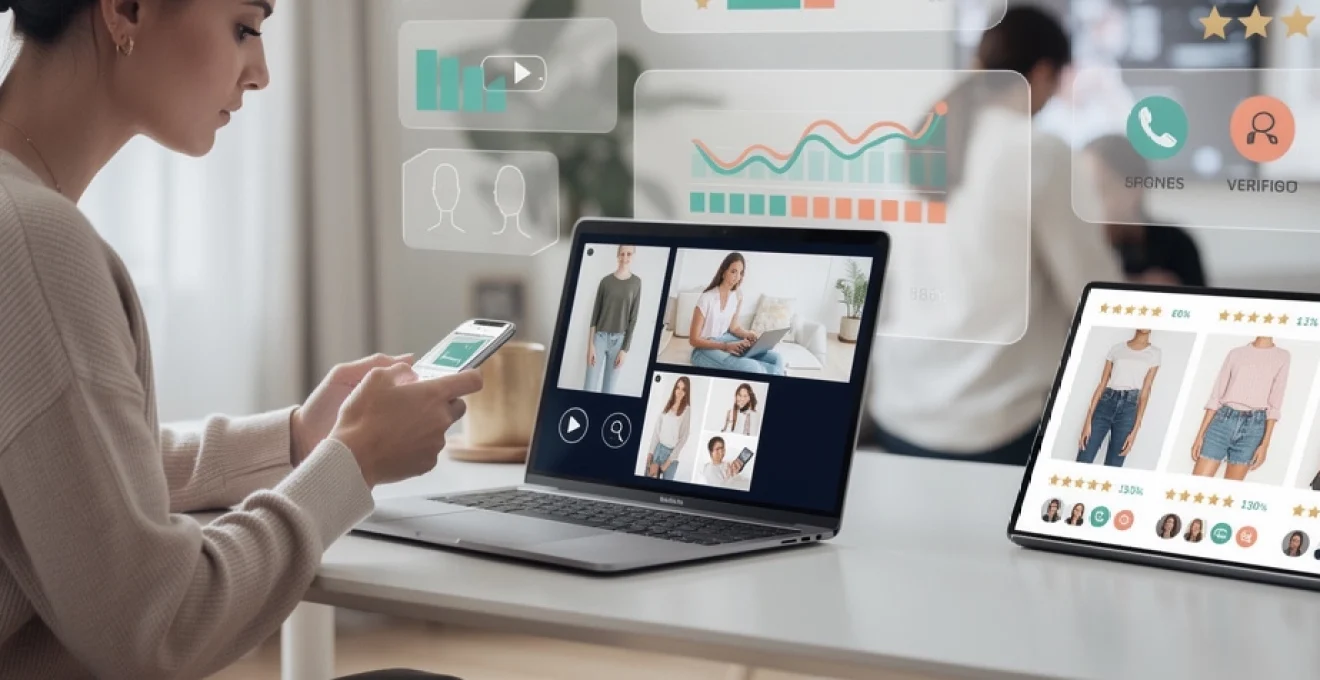
The fashion e-commerce landscape has transformed dramatically over the past decade, with online reviews emerging as one of the most influential factors in consumer purchasing behaviour. Research from BrightLocal reveals that approximately 93% of consumers read online reviews before making a purchase, and this figure is particularly pronounced in the fashion sector where fit, quality, and appearance cannot be physically assessed before buying. The digital shopping experience has fundamentally shifted from a transactional process to a socially-informed decision-making journey, where peer opinions carry as much weight as traditional marketing messages. In an industry worth billions, understanding the mechanics of review influence isn’t merely academic—it’s essential for brands seeking to convert browsers into buyers.
The Competition and Markets Authority estimates that £23 billion of UK consumer spending annually is influenced by online customer reviews, with fashion representing a substantial portion of this figure. What makes this phenomenon particularly fascinating is the psychological complexity underlying it: consumers aren’t simply reading reviews for product information, they’re seeking validation, reassurance, and social proof that their fashion choices align with community standards. This behavioural pattern has created an entirely new dimension of consumer engagement that savvy fashion retailers are learning to harness strategically.
Consumer psychology behind social proof in fashion E-Commerce
The concept of social proof—the psychological phenomenon where people conform to the actions of others under the assumption that those actions reflect correct behaviour—has found its ultimate expression in fashion e-commerce reviews. When you browse through ASOS or Boohoo, you’re not just looking at product descriptions; you’re subconsciously seeking confirmation that others have validated the purchase decision you’re contemplating. This isn’t weakness or indecision—it’s fundamental human psychology that evolved over millennia to help us navigate uncertain situations by leveraging collective wisdom.
Fashion purchases carry inherent uncertainty that amplifies the need for social proof. Unlike functional products where specifications can be objectively assessed, clothing involves subjective elements like style appropriateness, fit variability, and fabric quality that photographs alone cannot convey. Reviews bridge this information gap by providing experiential data from real users. Research from the Medill Spiegel Research Center demonstrates that purchase likelihood for a product with five reviews is 270% greater than for products with no reviews—a staggering statistic that underscores the commercial importance of cultivating customer feedback.
Bandwagon effect and herd behaviour in online fashion marketplaces
The bandwagon effect operates powerfully in fashion e-commerce, where products with substantial positive reviews create momentum that attracts additional purchases. When you see a dress with 847 five-star reviews on Pretty Little Thing, your brain interprets this as powerful evidence that the item delivers value. This herd behaviour isn’t irrational—it’s an efficient cognitive shortcut that saves you the mental energy of comprehensively evaluating every purchase option independently. Fashion retailers understand this dynamic and strategically display review counts prominently to leverage this psychological tendency.
Interestingly, the bandwagon effect operates differently across fashion price points. Higher-consideration purchases in luxury fashion segments show less susceptibility to pure review volume, with consumers demonstrating greater scrutiny of review content quality. Conversely, fast fashion purchases exhibit stronger herd behaviour patterns, where high review volumes combined with affordable pricing create compelling conversion triggers. This distinction has significant implications for how brands should structure their review collection and display strategies based on their market positioning.
Cognitive dissonance reduction through User-Generated content validation
Post-purchase cognitive dissonance—the uncomfortable tension between wanting to make good decisions and uncertainty about whether you actually did—drives much of the review-seeking behaviour in fashion e-commerce. Before committing to a purchase, consumers actively seek reviews to pre-emptively reduce the dissonance they anticipate experiencing after buying. Positive reviews function as psychological insurance, providing reassurance that validates your impending purchase decision. This explains why 84% of consumers trust online reviews as much as personal recommendations—reviews serve as surrogate experiences that reduce perceived purchase risk.
The validation mechanism operates bidirectionally. Not only do consumers seek reviews before purchasing, but they also consult reviews after buying to confirm their decision was sound. Fashion retailers that understand this psychological dynamic create post-purchase engagement strategies that reinforce buyer satisfaction through curated review displays and community feedback mechanisms. This approach transforms the transaction from a discrete event into an ongoing relationship anchored by
a sense of belonging and shared style preferences. When shoppers see others with similar body types, aesthetics or lifestyles wearing the same item, it reinforces that their choice fits not just their wardrobe, but their identity within a wider fashion community.
Trust signals and credibility indicators in digital fashion retail
Not all online reviews are created equal, and fashion consumers are becoming more sophisticated at reading credibility signals. Features like verified buyer badges, purchase dates, and detailed fit notes (“runs small”, “true to size”, “short in the torso”) dramatically increase trust. Research from the Medill Spiegel Research Center shows that reviews from verified buyers improve the odds of purchase by around 15%, highlighting how powerful these credibility indicators can be in fashion e-commerce.
Fashion retailers also use design cues to communicate trustworthiness at a glance. Star ratings, review volume, and labels such as “most helpful review” act like road signs guiding shoppers through uncertainty. When these elements are combined with transparent moderation policies and visible responses from customer service, they signal that feedback is genuine and that the brand is accountable. In a market where fake reviews and incentivised testimonials are a real concern, these micro-signals of authenticity can make the difference between adding to basket and abandoning the page.
Another important trust indicator is consistency across platforms. If a pair of trainers has glowing reviews on a brand’s site but noticeably weaker ratings on marketplaces like Zalando or Amazon, consumers pick up on this discrepancy. Many shoppers now cross-check reviews across sites, especially for higher-priced coats, handbags, or trainers. Fashion brands that maintain consistent quality and invite honest feedback across multiple review ecosystems build deeper, more durable credibility than those relying on curated praise alone.
FOMO marketing tactics amplified by customer testimonials
Fashion is inherently time-sensitive: trends move fast, stock sells out, and seasonal drops create urgency. Online reviews and testimonials supercharge this sense of urgency, fuelling a subtle but powerful fear of missing out (FOMO). When you see statements like “bought this in every colour” or “please restock, I need the black one too” in the review section, they don’t just praise the product; they signal scarcity and desirability. This social proof suggests that people like you are already enjoying the item, nudging hesitant shoppers to act quickly.
Retailers tap into this psychology by combining reviews with real-time signals such as “17 people have this in their basket” or “last few units remaining in your size.” These elements mirror the feeling of watching a popular item disappear from a physical rack, but intensified by the visibility of online testimonials. Used responsibly, FOMO tactics help fashion brands convert genuine demand into sales without resorting to aggressive hard-sell messages. The key is authenticity: exaggerated scarcity or obviously scripted “this changed my life” reviews quickly erode trust.
We also see FOMO amplified on social channels where user-generated reviews blend seamlessly with influencer content. When everyday shoppers post try-on hauls and tag brands with “run, don’t walk” messages, they create a cascade of urgency that can sell out a style in hours. For retailers, encouraging honest, timely reviews right after product drops is like priming a social engine that drives momentum for new collections, capsule drops, or collabs.
Star ratings and review volume impact on conversion rates
In fashion e-commerce, star ratings and review volume function like a quick-read summary of collective opinion. They are the first filter many shoppers use before they even scroll to product photos or descriptions. Studies from the Spiegel Research Center show that the purchase likelihood for a product with five reviews is 270% higher than for one with none, with the strongest gains occurring between zero and the first handful of reviews. For fashion brands, this means that getting to an initial critical mass of ratings is often more impactful than chasing very large numbers.
Interestingly, conversion rates don’t increase in a straight line with higher ratings. Across product categories, including apparel and footwear, purchase likelihood often peaks between 4.0 and 4.7 stars, then drops slightly as ratings approach a flawless 5.0. For many shoppers, a perfect rating looks implausible, especially for something as subjective as style and fit. A sprinkling of three- or even two-star reviews makes the overall rating distribution feel human and believable, which in turn enhances trust and ultimately supports conversion.
Optimal review threshold for purchase confidence on ASOS and boohoo
On platforms like ASOS and Boohoo, where choice overload is the norm, shoppers rely heavily on reviews to cut through hundreds of similar items. Our behaviour online often follows a simple pattern: we shortlist by visuals and price, then look at the rating and number of reviews to decide whether to click “view details.” In this context, the optimal review threshold—the point at which most shoppers feel confident enough to buy—tends to be relatively low, often between 5 and 20 reviews per item, particularly in fast fashion categories.
Why so few? Because in a fast fashion environment, decisions are quick and risk tolerance is higher due to lower prices and easy returns. Once a dress has around 10 reviews and a rating above 4.2, many ASOS or Boohoo customers feel they’ve seen enough to justify a trial. Beyond that, additional reviews have diminishing marginal impact on conversion, even though they remain useful for long-tail questions like fabric feel, colour accuracy, or durability after multiple washes.
For brands, this suggests a practical strategy: prioritise review collection to get every key SKU past that initial confidence threshold as quickly as possible, rather than focusing only on bestsellers. Post-purchase email prompts, in-app notifications, and occasional incentives such as loyalty points can rapidly lift items from zero to a credible base. Once a product reaches this threshold, retailers can shift their efforts towards newer or under-reviewed pieces to raise the overall reliability of the catalogue.
Negative review tolerance levels in luxury fashion segments
Luxury fashion operates under different rules. When you’re considering a £1,500 handbag or a designer coat, even a small number of negative reviews can feel disproportionately concerning. Shoppers in this segment often display lower negative review tolerance: a single detailed two-star review about stitching issues or leather quality can outweigh multiple shorter five-star comments. The perceived risk is higher, not just financially but reputationally—luxury purchases are closely tied to self-image and status.
At the same time, a wall of perfect five-star ratings can appear suspicious in luxury as well. Many customers expect to see well-argued three- and four-star reviews that discuss both strengths and weaknesses: “Beautiful cut, but sizing is narrow at the shoulders” or “Gorgeous leather, but hardware scratches easily.” These nuanced reviews indicate that feedback hasn’t been filtered and that the brand is confident enough to showcase imperfection. Luxury consumers are often prepared to accept minor flaws if they are clearly explained and align with their own priorities—craftsmanship and design may matter more than practicality for some purchases.
For premium and luxury labels, the goal isn’t to eliminate negativity but to manage it transparently. Responding thoughtfully to critical feedback, clarifying care instructions, or offering tailored customer service solutions shows that the brand stands behind its products. Over time, this open dialogue can raise overall trust levels, which may matter more than a marginal improvement in the average star rating.
Rating distribution analysis and purchase intent correlation
Beyond the headline average, savvy shoppers and data-driven brands pay attention to the distribution of ratings. A 4.4-star average built from mostly four-star reviews with some threes and fives feels very different from a 4.4 that’s heavily polarised between fives and ones. In fashion, polarisation often points to variability in fit or quality control—some customers received a perfect garment, while others experienced defects or inconsistent sizing. This pattern can either intrigue or worry shoppers depending on how risk-averse they are.
From a conversion perspective, smoother distributions with a strong cluster in the four-star range tend to perform best. These suggest reliable, predictable performance and manageable trade-offs: perhaps the fabric creases slightly, or the colour is a shade brighter than expected. Mixed distributions, on the other hand, can actually stimulate engagement as shoppers click through to “worst” and “best” reviews to diagnose whether the risks apply to them. This behaviour is particularly common for jeans, occasionwear, and shoes—categories where personal preferences and body variations play a large role.
Brands can use rating distribution analysis as an early-warning system and product development tool. A spike in one- and two-star reviews mentioning the same issue—zips breaking, seams fraying, dyes bleeding—signals problems that need urgent resolution. Conversely, a consistent pattern of four-star reviews that mention “would buy again in another colour” highlights prime candidates for range expansion. Connecting this data with purchase intent metrics helps retailers fine-tune both inventory and merchandising strategies.
Review recency effects on fast fashion buying behaviour
In fast fashion, recency of reviews is almost as important as rating and volume. A dress with a 4.5-star average based on reviews from three years ago feels less relevant than one with slightly lower ratings but fresh feedback from last month. Why? Because collections, suppliers and quality levels can change quickly, and shoppers know it. Recent reviews reassure customers that the current production run still meets expectations in terms of fabric, fit, and finish.
Recency is particularly critical for trend-led pieces tied to specific seasons or viral aesthetics. When customers see recent comments like “bought this for last weekend’s wedding” or “perfect for festival season this year,” it signals not only product quality but also style relevance. Old reviews, by contrast, risk suggesting that the item is a leftover from a previous trend cycle. In a category where FOMO and trend timing are key, outdated social proof can inadvertently depress conversion.
Operationally, this means fashion retailers should aim to maintain a steady flow of new reviews, especially on evergreen styles and carryover favourites. Simple tactics—such as sending a review reminder a week after delivery and a second prompt after the first wash—can help keep feedback aligned with current customer experiences. For shoppers, seeing a stream of recent, detailed reviews is like checking the weather forecast right before leaving the house: it offers up-to-date reassurance before stepping out in a new outfit.
User-generated visual content and authenticity perception
Text alone can’t fully capture how clothes drape, move, or look in real-world lighting. That’s why user-generated visual content—photos and videos from everyday shoppers—has become one of the most powerful authenticity signals in fashion e-commerce. Compared to polished studio shots, candid phone images feel imperfect but real, helping potential buyers imagine how a garment might work for their own body, skin tone, and style. This kind of visual social proof bridges the gap between online browsing and in-store try-ons.
For many younger consumers, especially Gen Z, seeing “real people” wearing an item is no longer a bonus but an expectation. Photo reviews have essentially become the online equivalent of seeing someone in the street wearing a look you love, then mentally trying it on yourself. When combined with honest comments about size, comfort and fabric feel, these visuals significantly reduce perceived risk and can dramatically improve conversion rates on dresses, denim, outerwear, and occasionwear.
Instagram-style photo reviews on zalando and pretty little thing
Retailers such as Zalando and Pretty Little Thing have leaned into Instagram-style photo reviews, turning their review sections into mini lookbooks curated by customers. Shoppers upload mirror selfies, outfit-of-the-day shots, and styled flat lays that mirror the aesthetics they already consume on social media. This blending of review content and social content makes the shopping experience feel familiar and aspirational, yet more attainable than influencer campaigns alone.
These platforms often highlight top photo reviews at the top of the page or in dedicated “style gallery” sections. This not only rewards engaged customers but also gives prospective buyers a quick visual summary of how the item looks across different body shapes, heights, and styling approaches. It’s like seeing multiple models for the same piece without leaving the product page. For retailers, encouraging this type of visual UGC can be as simple as adding a prompt in post-purchase emails: “Share your look and help others choose their size.”
There’s also a subtle but important trust benefit. When customers see a mix of lighting conditions, poses, and camera quality, they intuitively understand that the images are genuine, not professionally staged. This rawness counterbalances the highly edited nature of brand campaigns and can reassure sceptical buyers who worry about colour accuracy, transparency of fabrics, or how clingy a material might be. In this way, Instagram-style photo reviews act as a reality check that brings product expectations back down to earth—in a good way.
Fit and sizing verification through customer photography
One of the biggest friction points in online fashion is sizing. A medium on one site can feel like a small on another, and returns data often shows that “didn’t fit as expected” is a top reason for sending items back. Customer photos, combined with sizing notes, provide powerful fit verification. When reviewers share their height, weight, usual size, and the size they ordered—alongside a full-body photo—shoppers get a far more accurate sense of how an item might look and feel on them.
This visual fit data functions almost like a digital fitting room. You might think: “She’s 5’6 and a UK 12 like me, and the midi dress hits just below her knee—so I’ll probably get a similar result.” Over time, customers learn to identify reviewers whose bodies and style preferences resemble their own, treating them as informal “fit advisors.” This level of granular, relatable feedback can significantly reduce return rates and increase satisfaction, especially in complex categories such as jeans, tailored pieces, and swimwear.
Brands can enhance this effect by structuring the way they collect fit-related visuals and data. Optional fields for body measurements, size chosen, and desired fit (tight, regular, oversized) give context to photos and make them more actionable. Some fashion retailers are even integrating machine learning tools that analyse patterns in photos and fit feedback to refine size guides or offer personalised size recommendations. The end result is a more confident shopper and fewer unpleasant surprises when the parcel arrives.
Video review integration on fashion retailer platforms
Video reviews add another dimension by showing how garments move as you walk, sit, or raise your arms—details that static photos can’t convey. A dress that looks structured in a photo might reveal itself as unexpectedly sheer or clingy in motion. For footwear, video can showcase how a boot creases at the ankle or how stable a heel looks while walking. This dynamic perspective gives shoppers a richer, more realistic understanding of product performance in everyday use.
Retailers are increasingly experimenting with native video upload tools inside their review systems, sometimes incentivising short try-on clips with loyalty points or entry into prize draws. On mobile, these snippets feel very similar to stories or reels, making the review experience feel modern and intuitive. For shoppers who are on the fence, watching a 10-second clip of someone twirling in a dress can tip the balance far more effectively than reading another paragraph of text.
However, video integration also poses moderation and accessibility challenges. Brands must ensure that content complies with guidelines, loads quickly, and includes captions or descriptions where necessary. Still, when implemented thoughtfully, video reviews can significantly reduce the gap between digital browsing and physical fitting rooms, especially for high-stakes purchases like wedding guest outfits, prom dresses, or tailored suits.
Review sentiment analysis and language processing in fashion
As the volume of fashion reviews explodes, it becomes impossible for merchandisers and customer service teams to read everything manually. This is where sentiment analysis and natural language processing (NLP) step in. By using algorithms to detect patterns in language—positive, negative, or neutral tones—brands can quickly assess how customers feel about specific products, fabrics, or collections at scale. It’s like having thousands of focus group conversations running in the background, 24/7.
For shoppers, the benefits of this technology show up in features like summarised pros and cons, highlighted keywords (“comfortable”, “itchy”, “great for petites”), and smart sorting of “most helpful” reviews. These tools distil complex review data into digestible insights that shorten decision time. For brands, NLP-driven dashboards surface issues—such as recurring complaints about see-through fabrics or inconsistent sizing—before they snowball into widespread dissatisfaction or high return rates.
Natural language processing for fabric quality assessment
Fabric quality is notoriously hard to judge from product photos and basic descriptions like “polyester blend” or “soft jersey.” NLP models can scan thousands of reviews to detect recurring terms related to texture, durability, and comfort. Words and phrases such as “scratchy,” “pills after one wash,” “holds shape well,” or “surprisingly thick” form a rich data layer that goes far beyond material composition. Over time, patterns in these words allow brands to benchmark perceived fabric quality across suppliers and collections.
Imagine being able to spot that customers consistently describe one supplier’s knitwear as “cosy” and “premium,” while another’s is often called “thin” or “cheap-feeling.” With NLP, this insight emerges automatically, without manually reading every line. Retailers can then feed these findings back into buying and design decisions: investing more in high-performing fabrics, renegotiating supplier standards, or updating product descriptions to set accurate expectations. For customers, this can lead to clearer, more honest information such as “lightweight, best layered” or “substantial, warm knit suitable for winter.”
Some advanced systems even tie fabric-related sentiment to specific SKUs and return reasons, creating a closed feedback loop. For example, if many customers mention “sheer” in negative contexts for a particular dress, a brand could add lining, adjust photography, or explicitly market it as a layering piece. In this way, language processing doesn’t just describe reality; it helps improve it.
Emotional tone detection in verified purchase reviews
Not all positive or negative reviews are equal in intensity. Emotional tone detection goes beyond star ratings and simple sentiment labels to identify how strongly customers feel about an item. Phrases like “absolutely obsessed,” “my new favourite jeans,” or “utterly disappointed” carry far more weight than mild comments such as “it’s fine” or “okay for the price.” By analysing these nuances, fashion retailers can prioritise responses and interventions where they matter most.
Verified purchase reviews are especially valuable here, as they reflect real, completed transactions. When tone analysis highlights clusters of highly emotional negative reviews about, say, a limited-edition coat that sheds fibres or a heel that causes blisters, brands can respond quickly with design tweaks or proactive customer service outreach. On the flip side, intensely positive emotional language identifies true hero products—items that generate delight, loyalty, and organic word-of-mouth on social media.
From a shopper’s perspective, emotional tone often influences which reviews feel most persuasive. We naturally gravitate towards passionate stories, whether they’re glowing endorsements or cautionary tales. Surfacing these emotionally rich reviews higher on the page can improve decision quality: you see not just the average opinion, but the experiences that prompted people to speak up most strongly.
Comparative sentiment scoring across next, H&M, and zara reviews
Many consumers instinctively compare brands like Next, H&M, and Zara when making online fashion purchases. Sentiment scoring tools can quantify these comparisons by analysing reviews across multiple sites and creating a sort of “emotional performance dashboard.” For example, one brand might score consistently high on comfort and fit for workwear, while another leads on trendiness but lags on durability for knitwear and basics.
These cross-brand insights are valuable for both shoppers and retailers. Consumers benefit when review platforms or price comparison tools surface patterns like “customers often praise the quality of Next’s tailoring” or “Zara receives strong sentiment scores for on-trend dresses but mixed views on sizing consistency.” For retailers, benchmarking against peers highlights competitive advantages and blind spots. If H&M sees that its eco-conscious lines generate more positive sentiment than the main range, it may double down on sustainable fabrics and transparent storytelling.
Of course, sentiment scoring doesn’t replace qualitative insight; it directs attention. Once a pattern emerges—say, Zara scoring lower on “comfort” for a specific category—teams can dive into the actual review text and product attributes to understand what’s going wrong. In the long run, this comparative lens helps fashion brands evolve from gut-feel decisions to data-informed strategies grounded in real customer voices.
Influencer reviews versus peer reviews in purchase decisions
Influencer marketing and online reviews often sit side by side, but they don’t play identical roles in fashion purchasing decisions. Influencer reviews tend to spark awareness and aspiration: they introduce you to a new collection, show styling possibilities, and make a look feel culturally relevant. Peer reviews, by contrast, tend to resolve doubts: they answer practical questions about fit, comfort, and quality. Both are forms of social proof, but they operate at different stages of the funnel.
Trust levels also differ. While some influencers build deep, long-term credibility with their audiences, shoppers are increasingly alert to sponsored content and gifted items. A glowing haul video may be inspiring, but many viewers head straight to the product page to see what “people like me” have to say before committing. In surveys, a large share of consumers report trusting fellow customers’ reviews at least as much as influencer endorsements, especially when those reviews come with verified purchase tags and unedited photos.
Smart fashion brands don’t choose between influencer reviews and peer reviews—they connect them. For example, a retailer might collaborate with influencers to launch a capsule collection, then prominently feature early customer reviews and UGC on the same product pages. This way, the aspirational halo of influencer content is grounded by the authenticity and detail of peer feedback. Over time, as more shoppers contribute their own reviews and photos, the influence shifts from a few paid voices to a broad community chorus.
Review platform integration strategies for fashion brands
Managing reviews solely on your own website is rarely enough in today’s multi-channel fashion landscape. Shoppers encounter your brand across search engines, marketplaces, social platforms, and independent review sites—and they expect consistent, trustworthy information everywhere. Effective review platform integration ensures that ratings, comments, and UGC flow across this ecosystem, amplifying social proof while maintaining control and compliance.
For fashion retailers, the objective is twofold: maximise visibility of authentic feedback where customers are already browsing, and centralise insights internally to inform product, merchandising, and customer service decisions. This often involves connecting on-site review systems with third-party platforms such as Trustpilot, Feefo, Google Shopping, Yotpo, and Bazaarvoice. When done well, these integrations turn scattered opinions into a strategic asset that supports both conversion and brand equity.
Trustpilot and feefo implementation for UK fashion retailers
In the UK, Trustpilot and Feefo are among the most recognisable third-party review platforms, and many fashion consumers see them as independent arbiters of a brand’s overall reliability. Unlike product-specific reviews, these services often focus on the shopping experience—delivery speed, packaging, customer service, and returns handling. For categories like occasionwear or school uniforms, where timing and stress levels are high, this reassurance can be as important as garment quality.
Implementing Trustpilot or Feefo typically involves sending automatic invitations to customers after purchase and integrating widgets on your site to display overall ratings and recent comments. This creates a feedback loop that signals transparency: you’re willing to have your service publicly rated by a third party. For fashion brands dealing with seasonal peaks—like Christmas, Black Friday, or back-to-school—these platforms can also highlight operational pressure points through spikes in negative service sentiment.
From a shopper’s perspective, seeing a strong Trustpilot or Feefo score reinforces confidence at checkout, especially for first-time purchases or lesser-known labels. For retailers, the key is to actively respond to reviews on these platforms, treating them as an extension of customer service rather than a passive badge. Prompt, empathetic replies to complaints can turn public criticism into public problem-solving, which future customers will also notice.
Google shopping review snippets and rich results optimisation
Before many customers even reach your website, they encounter your products in Google Shopping results. Here, star ratings and review counts act as powerful click-through drivers. Rich results—search listings enhanced with structured data like price, availability, and aggregate rating—often outperform plain listings because they provide a quick credibility snapshot. In crowded fashion categories, a visible 4.5-star rating can be the deciding factor that wins you the click over a similar product with no reviews displayed.
To harness this, brands need to implement structured data markup (such as Product and AggregateRating schema) correctly on their product pages and ensure that reviews are being passed through to Google. Many review solutions, including Yotpo and Bazaarvoice, offer built-in support for this; the technical work is mostly about clean implementation and regular validation. For multi-brand retailers, ensuring that GTINs and other identifiers are consistent also helps Google match reviews to the right products across sellers.
Strategically, it makes sense to focus rich result optimisation on high-consideration items—coats, trainers, premium denim, and event dresses—where shoppers are likely to compare multiple listings. When these products display strong ratings and detailed snippets (“4.6 stars · 132 reviews · Free returns”), they send a clear message: not only do people like this item, but buying it here is low risk.
Yotpo and bazaarvoice deployment for multichannel fashion commerce
For larger fashion retailers operating across web, app, marketplace, and physical store channels, enterprise-grade solutions like Yotpo and Bazaarvoice provide the infrastructure needed to manage reviews at scale. These platforms centralise ratings, text reviews, Q&A, and visual UGC, then push that content out to various touchpoints. The result is a consistent layer of social proof whether a customer is browsing your site, using your mobile app, or viewing your products on a partner marketplace.
Yotpo and Bazaarvoice also bring advanced capabilities such as AI-driven moderation, personalised review prompts, and analytics dashboards that segment feedback by product, category, region, or customer segment. For fashion brands, this means you can quickly identify, for example, that dresses are performing well in terms of style sentiment but lagging on fit in specific markets. You can then adjust size charts, imagery, or even tailoring specs for those regions.
Another advantage is marketing integration. These platforms make it easier to repurpose high-quality reviews and UGC in email campaigns, social ads, and on-site carousels, extending the impact of each piece of customer feedback. When a glowing review and photo from a verified buyer appear in both your PDP and your Instagram ad, it reinforces authenticity and shortens the journey from discovery to purchase.
Review syndication across fashion marketplace ecosystems
Finally, review syndication allows fashion brands to share product reviews across multiple sales channels, such as their own e-commerce site, department store partners, and major marketplaces. Instead of starting from scratch each time a new retailer lists your product, syndicated reviews ensure that early feedback follows the item wherever it appears. This is particularly valuable for new labels or capsule collections trying to build credibility quickly across several platforms.
From the shopper’s viewpoint, syndication reduces confusion. Seeing similar ratings and comments for the same pair of trainers on a brand’s website, a marketplace like Zalando, and a department store site helps confirm that the product—and its reputation—are consistent. It also minimises the suspicion that a brand might be selectively showcasing only positive feedback on its own domain.
Operationally, syndication must be handled carefully to comply with each platform’s policies and to avoid duplicating or misattributing reviews. But when executed well, it turns dispersed feedback into a unified reputation asset. For fashion brands competing in crowded marketplaces, this consistent wall of social proof can be as important as price or imagery in attracting the next wave of customers.