
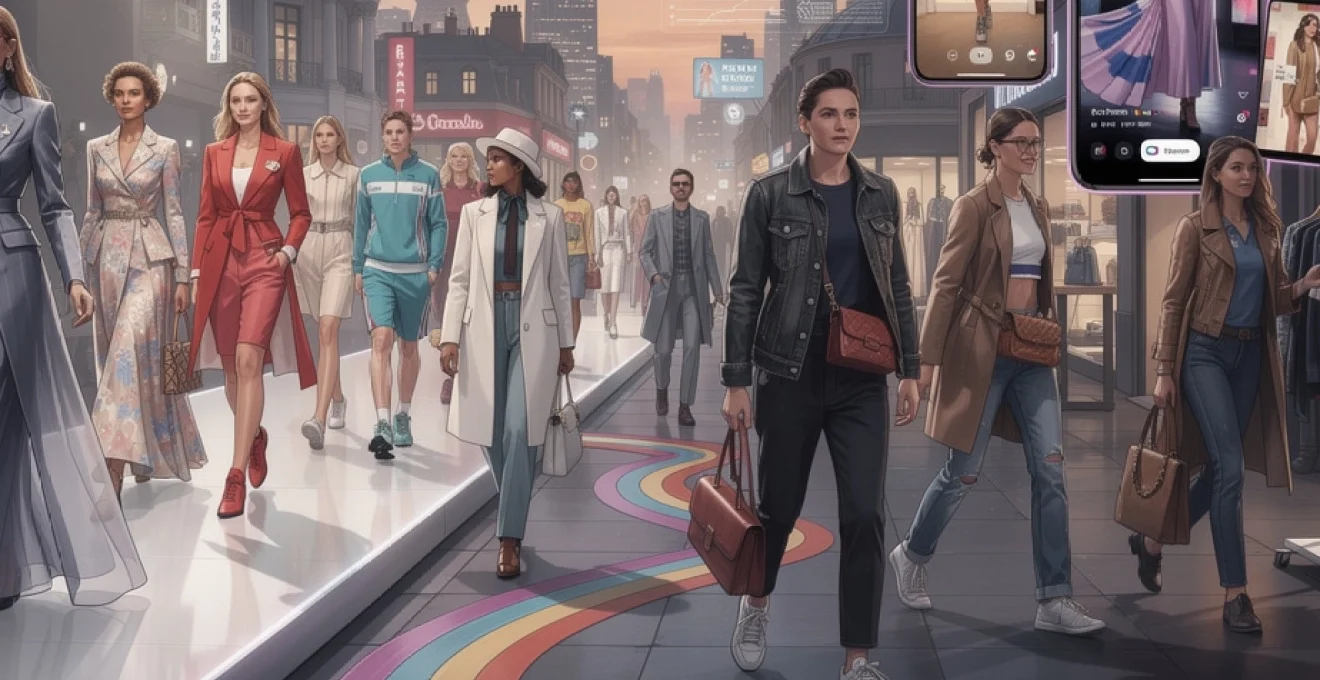
The journey from haute couture catwalks to high street hangers represents one of fashion’s most fascinating transformations. What begins as an avant-garde vision in Paris or Milan eventually finds its way into wardrobes across the globe, adapted and reimagined for everyday wear. This complex ecosystem of trend translation shapes not only what we wear but how we express our identity through clothing. The modern fashion landscape operates at unprecedented speed, with digital platforms accelerating the once-seasonal rhythm of trend adoption. Understanding this intricate process reveals the powerful mechanisms that influence our daily style choices, from the psychological drivers behind trend acceptance to the technological innovations that predict what we’ll be wearing next season.
Fashion week trend forecasting: how runway collections shape consumer behaviour
Fashion weeks serve as the industry’s primary trend laboratories, where designers present collections that will influence global style directions for months to come. These carefully orchestrated events function as both artistic showcases and commercial blueprints, with each runway presentation meticulously analysed by buyers, journalists, and trend forecasters. The impact extends far beyond the fashion elite, as these shows establish colour palettes, silhouettes, and aesthetic directions that eventually permeate mass market retail.
The forecasting process begins months before collections reach consumers, with trend prediction agencies like WGSN and Fashion Snoops analysing cultural movements, technological advances, and social shifts to anticipate what will resonate with future shoppers. This predictive intelligence informs designers’ creative processes, creating a feedback loop between cultural zeitgeist and commercial viability. Fashion professionals understand that successful trend forecasting requires balancing artistic vision with market practicality, ensuring that runway concepts can be translated into wearable, desirable pieces for diverse consumer segments.
Milan fashion week Spring/Summer collections and mass market translation
Milan’s position as a luxury powerhouse makes its fashion week particularly influential in shaping global trends. The city’s emphasis on craftsmanship and commercial sophistication creates collections that bridge artistic expression with market accessibility. Italian luxury houses like Prada and Versace often present concepts that fast fashion retailers can adapt within weeks, transforming high-end silhouettes into affordable interpretations.
The translation process involves careful analysis of key trend elements that can be reproduced at scale. Design teams at mass market brands study Milan runways for colour directions, fabric treatments, and silhouette innovations that can be executed using cost-effective materials and production methods. This democratisation of luxury aesthetics allows consumers to access designer-inspired styles at fraction of original prices, though often with compromises in quality and construction.
Paris haute couture influence on high street retail chains
Paris haute couture represents fashion’s most rarefied expression, yet its influence on everyday style remains profound. The meticulous craftsmanship and innovative techniques showcased in couture collections often inspire manufacturing innovations that eventually benefit mass market production. Retail chains monitor couture presentations for emerging techniques, colour combinations, and design details that can be adapted for their collections.
The challenge lies in translating labour-intensive couture techniques into machine-producible processes. High street retailers employ design teams specifically tasked with identifying which couture elements can be simplified without losing their essential appeal. This process requires deep understanding of both fashion construction and consumer psychology, ensuring that affordable interpretations capture the essence of their high-end inspirations whilst remaining commercially viable.
New york fashion week street style photography impact on social media trends
Street style photography during New York Fashion Week has evolved from industry documentation to trend-setting force in its own right. Photographers capture how fashion insiders interpret runway trends in real-world contexts, creating visual inspiration that spreads rapidly across social media platforms. These images often prove more influential than runway presentations themselves, showing consumers how to integrate new trends into existing wardrobes.
The immediacy of social media amplifies street style’s impact exponentially. Instagram posts from fashion week streets generate millions of impressions within hours, with style enthusiasts screenshotting and sharing looks that resonate with their personal aesthetic. This creates micro-trend cycles that can peak and fade within weeks, fundamentally altering the traditional seasonal fashion calendar and demanding unprecedented agility from retailers seeking to capitalise on emerging trends.
London fashion week sustainable fashion movement
has positioned London as a leader in sustainable fashion innovation, with designers using the runway as a platform to question overconsumption and promote circular design. Collections increasingly showcase recycled textiles, regenerative materials, and modular garments designed for longevity rather than rapid replacement. These visible commitments influence consumer behaviour, particularly among younger demographics who are more likely to align purchases with environmental values. Research from the Global Fashion Agenda suggests that over 60% of Gen Z shoppers consider sustainability when making fashion decisions, and London Fashion Week’s emphasis on eco-conscious design helps normalise these expectations. As retailers respond with “conscious” lines and transparency initiatives, we see a gradual but measurable shift in adoption rates of sustainable fashion, even if price and availability still present barriers for many consumers.
Digital fashion media and trend dissemination mechanisms
The transition from runway to reality no longer relies solely on print magazines and in-store merchandising. Digital fashion media has created a multi-layered dissemination system where trends are filtered, reframed, and amplified across platforms in near real time. From editorial recaps and celebrity styling features to user-generated outfit posts, each digital touchpoint subtly shapes how we perceive and adopt new aesthetics. Understanding these mechanisms reveals why some runway trends explode into mainstream style while others remain niche, despite similar levels of industry support.
Vogue runway platform analytics and consumer engagement metrics
Vogue Runway has become a central archive and discovery tool for fashion enthusiasts, buyers, and designers, offering comprehensive coverage of global fashion weeks. Beyond its editorial authority, the platform leverages analytics to understand which collections, looks, and details generate the most engagement. Metrics such as time-on-page, save rates, and look-by-look click-throughs provide valuable feedback on which trends resonate most strongly with users. This data, in turn, informs future editorial emphasis and can even influence how brands frame their campaigns and lookbooks.
For consumers, the ability to filter by season, city, or designer democratises access to high fashion, allowing anyone to conduct their own “trend research” from home. When we notice certain silhouettes or colours recurring across multiple collections, we are more likely to perceive them as legitimate trends worth exploring in our own wardrobes. In this sense, Vogue Runway functions like a real-time trend textbook, with analytics acting as highlighter pens that draw attention to the most commercially viable ideas.
Instagram fashion influencer algorithm impact on trend velocity
Instagram remains a powerful engine for fashion trend diffusion, with algorithmic feeds determining which outfits and aesthetics gain visibility. Influencers who consistently generate high engagement effectively become unofficial trend forecasters, as their interpretations of runway looks are surfaced to millions of followers. When the algorithm rewards particular styling choices—say, pairing oversized blazers with cycle shorts or styling ballet flats with athleisure—the velocity of trend adoption increases dramatically. What might once have taken a season to trickle down can now feel ubiquitous within weeks.
This algorithm-driven acceleration creates both opportunities and challenges for everyday style. On one hand, we gain instant inspiration on how to wear complex runway trends in realistic settings, from office-appropriate looks to weekend outfits. On the other, the constant influx of new micro-trends can foster a sense of wardrobe fatigue and pressure to keep up. As conscious consumers, we benefit from approaching Instagram fashion as a mood board rather than a shopping list, using it to refine our personal style instead of chasing every algorithm-approved look.
Tiktok fashion content creator monetisation and brand partnerships
TikTok has introduced a new, hyper-dynamic layer to the runway-to-reality pipeline, where short-form video content drives viral trends at unprecedented speed. Fashion creators on TikTok often specialise in decoding runway aesthetics—such as “quiet luxury” or “mob wife” style—into bite-sized styling tutorials that feel approachable and personal. Through TikTok Shop, affiliate links, and brand partnerships, these creators monetise their influence, turning trend explanation into a viable business model. Brands in turn leverage this ecosystem to test which runway-inspired pieces resonate before scaling production.
The platform’s “For You” algorithm rewards engaging, repeatable formats, which is why we see waves of styling challenges (“style this sheer dress three ways”) or aesthetic breakdowns (“how to dress like Paris Fashion Week street style on a budget”). For everyday consumers, this means we can experiment with high-fashion trends using low-risk styling hacks before committing to major purchases. However, it also means that micro-trends can burn out almost as quickly as they emerge, encouraging a more mindful approach to which TikTok-driven aesthetics we actually integrate into long-term wardrobe strategies.
Pinterest visual search technology and style discovery patterns
Pinterest operates more like a visual search engine than a traditional social network, making it a crucial tool for long-term trend discovery rather than short-lived hype. Users often search for phrases such as “how to wear runway trends in everyday life” or “Paris fashion week outfit ideas,” and the platform responds with curated boards mixing editorial imagery, brand content, and user-generated outfits. Visual similarity algorithms suggest related looks, guiding users from abstract concepts—like “hyper-textured knitwear”—to specific, shoppable pieces.
This search-led behaviour means Pinterest plays a unique role in turning inspiration into action. When someone saves multiple images of, for example, minimalist Scandinavian tailoring or Japanese-inspired layered streetwear, the platform learns their style preferences and refines future recommendations. For brands, understanding these style discovery patterns is invaluable: pins that perform well often signal emerging demand that can inform both product development and merchandising. For individuals, Pinterest essentially acts as a personalised trend forecast, helping to filter out noise and focus on runway influences that align with authentic personal style.
Fast fashion supply chain response to runway aesthetics
Fast fashion brands have built their business models around rapid response to runway aesthetics, compressing traditional design-to-retail timelines from months to mere weeks. As soon as key looks debut in Paris, Milan, London, or New York, in-house design teams begin sketching simplified versions tailored to their target price points and production capabilities. Digital product lifecycle management tools allow patterns, fabric specs, and costings to be updated in real time, coordinating suppliers, factories, and logistics partners across multiple countries. The result is a near-immediate presence of runway-inspired garments on high street racks and e-commerce platforms.
This agility, however, comes with significant ethical and environmental implications. Short lead times often pressure manufacturers to prioritise speed over worker welfare, and the volume of new product contributes to rising textile waste. At the same time, consumer demand for fast, affordable runway-inspired pieces remains strong, creating a complex tension between accessibility and sustainability. As shoppers, we can navigate this landscape more consciously by prioritising timeless silhouettes over fleeting fads, choosing higher-quality fast fashion where possible, and extending garment life through repair, resale, and considered care.
Psychological drivers behind trend adoption in everyday wardrobes
While supply chains and social media shape what trends are available, psychology determines which ones we actually adopt. One key driver is the human desire for social belonging: wearing recognisable trends signals that we are in tune with our cultural moment and our chosen peer group. At the same time, we seek individuality, using fashion to differentiate ourselves within those groups. This push and pull between conformity and self-expression explains why many people embrace trends in subtle ways—opting for a runway-inspired colour or accessory rather than a head-to-toe look.
Another powerful factor is the novelty effect. Our brains are wired to respond positively to new stimuli, which is why trying a fresh silhouette or styling technique can feel energising. However, novelty wears off quickly, particularly in a fast-paced digital environment where we are constantly exposed to new aesthetics. To balance excitement with longevity, it can help to treat trends like spices in a recipe: potent in small doses, but overwhelming when overused. By anchoring our wardrobes in classic, well-fitting pieces and layering in trend-led elements selectively, we support both psychological satisfaction and sustainable style habits.
Regional fashion capitals and localised style interpretation
Although global fashion weeks and digital platforms promote a sense of shared style language, regional fashion capitals still play a crucial role in localising trends. Cultural norms, climate, and lifestyle all affect how runway concepts are interpreted and worn in different cities. A sheer dress that appears on a Paris runway may manifest as a layered, modest look in Dubai or as a beach cover-up in Sydney. Understanding these contextual differences helps us see that there is no single “correct” way to wear a trend—only variations that make sense for specific environments and identities.
Brands increasingly recognise this need for localisation, adapting colour palettes, fabric weights, and marketing narratives for different markets. Consumers, in turn, pick and choose from global influences, blending Scandinavian minimalism with American sportswear or Japanese avant-garde layering with Italian tailoring. This hybridisation means everyday style is no longer dictated solely by one fashion capital; instead, it emerges from a dynamic exchange between regional aesthetics and global runway ideas.
Scandinavian minimalism translation through COS and arket brand strategies
Scandinavian minimalism, with its focus on clean lines, neutral palettes, and functional design, has become a powerful counterpoint to more maximalist runway trends. Brands like COS and Arket translate this philosophy into accessible collections that emphasise long-term wearability over seasonal novelty. Their design teams often reference runway concepts—such as exaggerated proportions or monochrome dressing—but reinterpret them in simplified, modular forms that slot easily into capsule wardrobes. For consumers seeking to incorporate trends without overwhelming their personal style, this approach offers a practical blueprint.
Strategically, COS and Arket use consistent visual merchandising and storytelling to reinforce the idea that minimalism can still be fashion-forward. Campaigns show how to style a single coat or tailored trouser in multiple ways, demonstrating that trend-led details like sculptural sleeves or asymmetric hems can coexist with timeless silhouettes. By anchoring their identity in Scandinavian design values, these brands help popularise a more mindful, less cluttered approach to trend adoption—one that favours subtle evolution over constant reinvention.
Japanese avant-garde fashion influence on western streetwear culture
Japanese avant-garde designers such as Rei Kawakubo, Yohji Yamamoto, and Issey Miyake have long challenged Western conventions of fit, symmetry, and beauty. Their experimental silhouettes and emphasis on deconstruction have filtered into global streetwear, particularly through oversized shapes, layered looks, and unconventional fabric treatments. What once appeared radical on Tokyo runways now feels familiar in everyday outfits featuring wide-leg trousers, voluminous coats, and intentionally “unfinished” details. This influence underscores how conceptual runway ideas can ultimately reshape the very foundations of casual dressing.
Western streetwear brands often borrow elements of Japanese design philosophy—such as the idea of clothing as protective shell or sculptural form—and translate them into more accessible pieces. For example, a dramatic runway cape might become an elongated parka, while intricate origami pleats inform the construction of technical joggers or backpacks. As we integrate these influences into our wardrobes, we participate in a quiet cultural exchange, blending comfort and artistry in ways that would have been rare in mainstream style just a decade ago.
Italian luxury house diffusion lines and accessible luxury markets
Italian luxury houses have refined the art of reaching broader audiences through diffusion lines and secondary labels. Brands such as Armani, Prada, and Dolce & Gabbana use these lines to distil their runway aesthetics into more wearable, price-conscious offerings. While the main collections might showcase bold prints, intricate embellishments, or extreme tailoring, diffusion lines present simplified versions with adjusted fabric choices and streamlined construction. This strategy expands the market for “accessible luxury,” allowing consumers to participate in brand narratives without investing in couture-level pieces.
From a trend perspective, diffusion lines act as intermediaries between high fashion and the high street. Buyers from department stores and online retailers often look to these collections as indicators of which runway ideas are most commercially viable. When we purchase a logo belt, structured handbag, or tailored blazer from a diffusion line, we are effectively wearing a translated version of a more experimental concept that debuted on the catwalk. This layered ecosystem ensures that Italian luxury continues to shape everyday style, even for those who never enter a flagship boutique.
American sportswear brand innovation and athleisure trend evolution
American sportswear has been instrumental in blurring the boundaries between performance clothing and everyday fashion. Brands rooted in athletic heritage—such as Nike, Adidas, and newer direct-to-consumer labels—have embraced design collaborations with high-fashion houses, bringing runway aesthetics into trainers, track jackets, and technical leggings. The rise of athleisure, accelerated by changing work patterns and a greater focus on wellbeing, has turned items once confined to the gym into accepted components of office and social wardrobes.
This evolution reflects a broader shift in consumer priorities towards comfort, versatility, and functionality. When we pair tailored blazers with performance leggings or style statement sneakers with midi dresses, we are participating in a trend that began with runway experiments in sports-luxury hybrids. American sportswear brands, through fabric innovation and smart branding, have ensured that these hybrid looks feel intentional rather than improvised. As a result, athleisure has moved from passing fad to enduring wardrobe category, reshaping dress codes across sectors.
Technology-driven fashion forecasting and consumer predictive analytics
Behind the visible world of runways and retail displays lies an increasingly sophisticated layer of technology-driven forecasting. Brands now use artificial intelligence and machine learning to analyse vast datasets—ranging from social media engagement and e-commerce search queries to sell-through rates and weather patterns—to predict which trends will convert into sales. Tools can identify rising interest in specific keywords like “sheer maxi dress” or “hyper-textured knitwear” months before those items peak in demand. This allows product teams to adjust assortments, order quantities, and marketing messages with far greater precision.
For consumers, these predictive systems often manifest as personalised recommendations, targeted ads, and curated “edit” pages that seem uncannily aligned with our tastes. While this can make shopping more efficient, it also raises questions about how much our style choices are being nudged by algorithms. The relationship is somewhat like a dance: data guides us towards certain runway-inspired pieces, but our actual purchases feed back into the system, refining future predictions. By staying aware of this feedback loop, we can use technology as a tool rather than a directive, selectively embracing forecasted trends that genuinely resonate with our lifestyle and sense of self.