
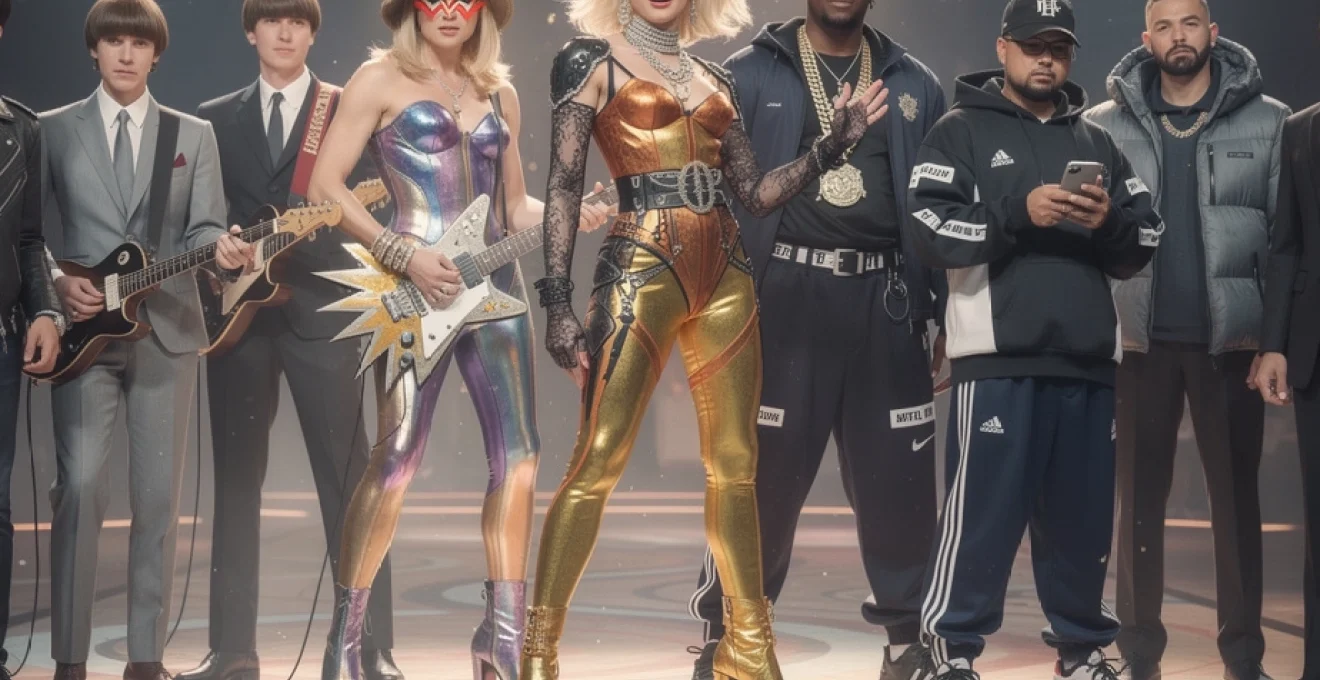
The relationship between fashion and music represents one of the most dynamic creative partnerships in contemporary culture. This symbiotic connection has shaped decades of artistic expression, consumer behaviour, and cultural identity formation. From Elvis Presley’s revolutionary leather jacket to Billie Eilish’s oversized silhouettes challenging conventional beauty standards, musicians have consistently served as both muses and catalysts for fashion innovation. The influence flows in both directions, with fashion designers drawing inspiration from musical movements whilst simultaneously creating visual languages that enhance and define artistic personas.
This intricate dialogue extends far beyond mere aesthetic choices, encompassing complex collaborative frameworks, brand partnerships, and cultural movements that continue to reshape both industries. The phenomenon demonstrates how creative expression transcends traditional boundaries, creating new markets, cultural narratives, and forms of artistic communication that resonate across global audiences.
Historical evolution of Fashion-Music synergy from 1950s rock to contemporary Hip-Hop
The intersection of fashion and music gained unprecedented momentum during the post-war cultural revolution of the 1950s, fundamentally altering how society perceived youth culture and self-expression. This transformation established patterns of influence that continue to shape contemporary creative industries, with each musical era introducing distinctive aesthetic vocabularies that permeate mainstream fashion consciousness.
Elvis presley’s pompadour and leather jacket revolution in 1950s youth culture
Elvis Presley’s emergence in the mid-1950s marked a seismic shift in both musical and sartorial expression, introducing rebellious aesthetics that challenged conventional menswear traditions. His signature pompadour hairstyle required extensive grooming rituals and specific products, creating an entirely new market for male grooming accessories and styling techniques. The leather jacket, previously associated with motorcycle culture and working-class masculinity, became a symbol of youthful rebellion and sexual magnetism through Presley’s stage presence.
The influence extended beyond individual garments to encompass an entire lifestyle philosophy that emphasised personal style as a form of cultural resistance. Young men across America and Europe began adopting similar styling approaches, creating demand for leather goods, hair pomade, and fitted trousers that would define masculine fashion for decades. This phenomenon demonstrated fashion’s capacity to serve as a vehicle for generational identity formation and cultural transformation.
The beatles’ mod aesthetic and collarless suit phenomenon
The Beatles’ sartorial evolution from leather-clad Hamburg performers to sharply dressed international icons exemplifies music’s power to mainstream avant-garde fashion concepts. Their collaboration with London tailors, particularly the adoption of Pierre Cardin’s collarless suits in 1963, introduced European modernist design principles to global youth culture. The clean lines, minimal ornamentation, and innovative silhouettes aligned perfectly with the band’s musical evolution towards sophisticated pop compositions.
This aesthetic transformation coincided with London’s emergence as a fashion capital, with Carnaby Street becoming synonymous with youth-oriented design innovation. The phenomenon created a template for musician-fashion collaboration that prioritised visual coherence with musical identity, establishing precedents for comprehensive artistic branding that contemporary artists continue to utilise.
David bowie’s ziggy stardust costume design and glam rock visual language
David Bowie’s creation of Ziggy Stardust in 1972 represents perhaps the most comprehensive integration of fashion design with musical persona development in popular culture history. Working closely with designer Freddie Burretti and Kansai Yamamoto, Bowie developed costume concepts that challenged gender norms, colour conventions, and performance expectations simultaneously. The metallic fabrics, asymmetrical cuts, and theatrical makeup created a visual language that was inseparable from the music’s futuristic themes.
The influence extended far beyond entertainment, inspiring fashion designers like Jean Paul Gaultier and Thierry Mugler to experiment with gender-fluid silhouettes and theatrical presentation methods.
This approach established fashion as a legitimate artistic medium capable of supporting complex narrative development and character construction within musical contexts.
The legacy continues to influence contemporary artists like Lady Gaga, who similarly use costume design as an integral component of artistic expression.
Madonna’s jean paul gaultier collaborations and pop icon styling
Madonna’s partnership with Jean Paul
Gaultier during her 1990 Blond Ambition tour redefined what pop stagewear could communicate about power, sexuality and female autonomy. The now-iconic cone bra corset, sharply tailored suits and lingerie-as-outerwear styling blurred boundaries between private and public dress, challenging conservative views of what a female pop star “should” look like. By combining Catholic iconography, streetwear references and high-fashion corsetry, Madonna and Gaultier created a visual manifesto that aligned perfectly with her provocative lyrics and boundary-pushing performances.
Their ongoing collaborations throughout the 1990s and 2000s helped normalise the idea of the pop star as a fully styled fashion product, supported by a cohesive visual narrative rather than isolated outfits. High fashion houses increasingly recognised the marketing potential of such partnerships, using music videos and world tours as global runways for experimental designs. Madonna’s approach demonstrated that styling could drive both record sales and fashion trends, laying groundwork for later pop icons like Beyoncé, Rihanna and Dua Lipa to enter the fashion world not just as muses but as co-creators.
Hip-hop’s luxury brand integration from Run-DMC’s adidas to travis scott’s nike partnership
Hip-hop’s relationship with fashion evolved from grassroots streetwear expression to boardroom-level luxury collaborations, fundamentally reshaping both industries. Run-DMC’s embrace of Adidas tracksuits and shell-toe sneakers in the 1980s, immortalised in their track My Adidas, marked one of the first moments a hip-hop act turned a personal style choice into a global branding phenomenon. Their endorsement deal with Adidas, reportedly worth around $1.6 million at the time, signalled that rap artists could move products at scale and deserved a seat at the commercial table.
By the late 1990s and early 2000s, figures like Jay-Z, Sean “Diddy” Combs and Pharrell Williams were no longer content to merely endorse brands; they launched their own labels, from Rocawear to Sean John and Billionaire Boys Club. This paved the way for the current era, in which Travis Scott’s Nike collaborations sell out in minutes and resell for multiples of retail price on secondary markets. These partnerships demonstrate how hip-hop’s luxury brand integration has turned sneakers, hoodies and graphic tees into high-value cultural artefacts, while allowing fashion houses to tap into loyal fan communities and street-level credibility.
Designer-musician collaborative frameworks in contemporary fashion houses
As the fashion and music industries have matured, their collaborations have shifted from ad-hoc endorsements to sophisticated, long-term creative frameworks. Major fashion houses now treat musicians as strategic partners rather than mere campaign faces, involving them in everything from capsule collections to runway casting and social-media storytelling. This shift reflects the reality that a musician’s aesthetic choices can influence global fashion trends overnight, particularly in an era where a single Instagram post or music video can reach hundreds of millions of viewers.
Understanding how these collaborative frameworks operate offers valuable insight into the mechanics of modern brand-building. We can see clear models emerging: some labels position musicians as co-designers, others as creative directors or “muses” whose persona guides an entire collection. In practice, these roles often overlap, but they share a common aim—merging the emotional power of music with the aspirational symbolism of fashion to create narratives that resonate across cultures and platforms.
Virgil abloh’s Off-White music industry partnerships and streetwear aesthetics
Virgil Abloh, founder of Off-White and former artistic director of Louis Vuitton menswear, embodied the seamless integration of DJ culture, streetwear and high fashion. Before becoming a household name, Abloh worked as a creative consultant for Kanye West, helping turn album campaigns and tours into multimedia style experiences. At Off-White, he extended this music-industry mindset, collaborating with artists such as Serena Williams (for her on-court looks) and designing stagewear for musicians including Drake and Beyoncé, where performance constraints and visual impact had to coexist.
Off-White’s streetwear aesthetics—quotation marks, industrial belts, graphic logos—functioned almost like sampling in hip-hop, remixing familiar symbols into new forms. This approach resonated strongly with younger audiences who grew up with mixtape culture and digital mashups. Abloh’s work illustrates how fashion and music now share similar creative logics: both rely on referencing, recontextualising and reissuing cultural motifs in new combinations, much like a DJ blends tracks to create an evolving sonic narrative.
Riccardo tisci’s Givenchy-Kanye west creative direction model
Riccardo Tisci’s tenure at Givenchy in the late 2000s and early 2010s provides a clear blueprint for deep, reciprocal designer-musician relationships. Tisci formed a close bond with Kanye West, designing album artwork, tour wardrobes and red-carpet looks while West amplified Givenchy’s gothic, sportswear-inflected luxury aesthetic to a global hip-hop audience. This partnership culminated in the lavishly staged Watch the Throne era, where baroque patterns, leather kilts and bold graphic prints became synonymous with a new, opulent version of street luxury.
Crucially, the Givenchy–Kanye model went beyond transactional product placement. Tisci invited West and other musicians to front campaigns, sit front row at shows and act as informal sounding boards for collections. In turn, West brought high fashion into rap lyrics, cover art and merch, making label names part of the musical vocabulary. This kind of integrated creative direction demonstrates how, when mutual trust exists, fashion and music can co-author visual and sonic identities that feel coherent across albums, tours and retail spaces.
Alessandro michele’s gucci artist residency programme and celebrity styling
At Gucci, Alessandro Michele championed a maximalist, vintage-inflected aesthetic that relied heavily on close relationships with musicians and visual artists. Under his direction, Gucci cultivated what was effectively an informal “artist residency,” dressing and collaborating with performers such as Harry Styles, Lana Del Rey and A$AP Rocky. These artists embodied Michele’s eclectic, gender-fluid vision onstage, in music videos and at high-profile events like the Met Gala, turning Gucci’s runway codes into widely discussed cultural moments.
Rather than treating celebrity dressing as a one-off PR exercise, Michele worked with stylists and musicians to craft long-term style narratives—Harry Styles’ silk blouses and flared trousers, for instance, evolved in tandem with his musical shift toward 1970s-inspired soft rock. This approach shows how celebrity styling can operate more like character development than simple product placement. For fashion and music professionals alike, the lesson is clear: sustained storytelling often yields more impact than sporadic headline-grabbing outfits.
Hedi slimane’s saint laurent rock photography and musician muse strategy
Hedi Slimane’s work at Dior Homme and later at Saint Laurent and Celine is a case study in building a fashion brand on a foundation of rock mythology. Slimane has long photographed emerging bands and underground scenes, using his lens to document the skinny jeans, leather jackets and dishevelled shirts that would become his signature silhouettes. At Saint Laurent in particular, he cast musicians as campaign faces, invited them to perform at shows and styled collections around the archetype of the androgynous rock star.
By blurring the line between his personal photography and official brand imagery, Slimane turned Saint Laurent into a living mood board of rock history and indie subcultures. For audiences, the appeal was more emotional than purely aesthetic: buying a Saint Laurent jacket felt like buying into a carefully curated soundtrack and lifestyle. This musician muse strategy underlines a key point about contemporary fashion-music synergy—people are not just purchasing garments, but narratives, attitudes and the promise of belonging to a particular creative tribe.
Music video visual aesthetics and fashion trend amplification mechanisms
Since the launch of MTV in 1981, music videos have become one of the most powerful vehicles for fashion trend amplification. A three-minute clip can introduce more looks to more people, more quickly, than many traditional runway shows. From Madonna’s layered lace and crucifixes in the 1980s to TLC’s baggy streetwear in the 1990s and Beyoncé’s custom designer wardrobes today, video styling often dictates what fans will search for, buy and recreate on social media.
In the streaming era, this influence has only intensified. Platforms like YouTube, TikTok and Instagram Reels allow users to pause, screenshot and imitate outfits instantly, turning every frame into potential shoppable content. Fashion brands now seed pieces in videos, understanding that a single viral moment—think of the red boots in Doja Cat’s videos or the plaid sets in BLACKPINK clips—can drive global demand overnight. In this way, music videos function not just as promotional tools for songs, but as visual catalogues for emerging fashion aesthetics.
From a strategic standpoint, musicians and stylists treat videos like mini fashion editorials, planning looks that align with both sonic mood and commercial objectives. They may incorporate archival couture to secure prestige, emerging designers to signal insider knowledge, and streetwear to maintain relatability. For designers, aligning with the right video can be transformative: a small label featured on a major artist can see search traffic spike dramatically, similar to how a playlist placement boosts a new track’s streaming numbers.
Runway show soundtrack curation and atmospheric branding techniques
If music videos carry fashion into the music world, runway soundtracks bring music into the heart of fashion’s most sacred ritual: the show. The music selected for a catwalk does more than keep time for the models; it sets the emotional tone, contextualises the clothes and signals the brand’s cultural alignment. A techno-heavy soundtrack might suggest futurism and urban energy, while a classical score may underline craftsmanship, romance or heritage.
Many leading houses now work directly with DJs, producers or even full orchestras to create bespoke soundscapes. Alexander McQueen famously paired haunting, symphonic tracks with his theatrical shows, while brands like Chanel and Dior regularly commission original compositions. This attention to sound design mirrors film scoring: just as a movie’s soundtrack shapes how we feel about a scene, runway music guides how buyers, editors and consumers interpret a collection’s narrative and commercial potential.
From a branding perspective, consistent musical choices help reinforce identity. A label that repeatedly leans into 1990s hip-hop instrumentals, for example, signals a commitment to street culture and nostalgia-driven fashion. Conversely, minimalist electronic soundtracks may align with a brand’s clean, architectural silhouettes. As we attend or watch shows online, we subconsciously absorb these cues; the soundtrack becomes an audio logo that supports visual branding, much like a jingle does in traditional advertising.
Festival fashion culture and brand activation through music tourism
Music festivals like Coachella, Glastonbury and Rolling Loud have evolved into open-air laboratories for fashion experimentation and brand activation. What began as functional dressing for outdoor concerts—denim shorts, boots, rain ponchos—has transformed into a distinct festival fashion ecosystem, complete with its own micro-trends, from flower crowns and crochet tops to utility vests and futuristic rave wear. For many attendees, outfit planning is as central to the experience as the music itself.
Brands have quickly recognised festivals as prime environments for immersive marketing. Pop-up shops, experiential installations and limited-edition capsule collections allow labels to meet consumers where they are already primed for self-expression and discovery. When you see hundreds of people in coordinated looks under a shared hashtag, you’re witnessing music tourism double as a live-action fashion campaign. This convergence blurs the line between audience and advertisement, as fans effectively become walking billboards for the styles they choose to wear and share.
For designers and marketers, the key challenge is authenticity. Festival-goers are highly attuned to performative branding; overtly commercial activations can feel out of sync with the communal, escapist spirit of the event. Successful strategies instead offer utility or creative enhancement—providing shade structures, customisation booths or repair services, for example—while subtly weaving brand aesthetics into the environment. In this sense, festival fashion culture operates like a temporary city where clothing, community and sound co-create a distinct identity that persists long after the stages are dismantled.
Digital era influence networks: social media Fashion-Music Cross-Pollination
The digital era has radically accelerated the feedback loop between fashion and music, turning fans into co-creators and social platforms into real-time trend laboratories. A single performance clip on TikTok or Instagram can propel both a track and an outfit into viral territory, as users replicate choreography, styling and even makeup down to the smallest details. Have you ever noticed how quickly a specific jacket, dress or hairstyle starts appearing across your feed after a major award show or tour kickoff? That’s cross-pollination in action.
Influencers now sit alongside musicians and designers as key nodes in this network. A rising artist might wear an independent label in a low-budget video; an influencer then tags and explains the look; fans search for “the exact outfit from…” and fast-fashion brands respond with rapid-fire interpretations. This dynamic can be problematic in terms of sustainability and intellectual property, but it also offers unprecedented visibility to emerging designers and subcultural styles that once stayed local. In effect, social media has democratised—though not always equitably—the once-exclusive dialogue between high fashion and big-budget music marketing.
For creatives navigating this landscape, strategic collaboration is essential. Musicians benefit from cultivating relationships with stylists and small labels whose pieces can differentiate their visual identity in a saturated market. Designers, in turn, gain by understanding playlist culture, meme formats and platform-specific aesthetics, tailoring lookbooks and campaigns to feel native to each channel. Much like a well-mixed track balances melody, rhythm and bass, a successful fashion-music partnership in the digital age balances authenticity, storytelling and commercial clarity—ensuring that the conversation between style and sound continues to evolve rather than simply repeat itself.